

Why in news?
Jordan has been in the headlines after Iranian missile and drone attacks targeted U.S. military bases in the country as part of a wider Middle Eastern conflict. While the strikes caused no significant damage, they underline Jordan’s strategic role in regional security.
Background
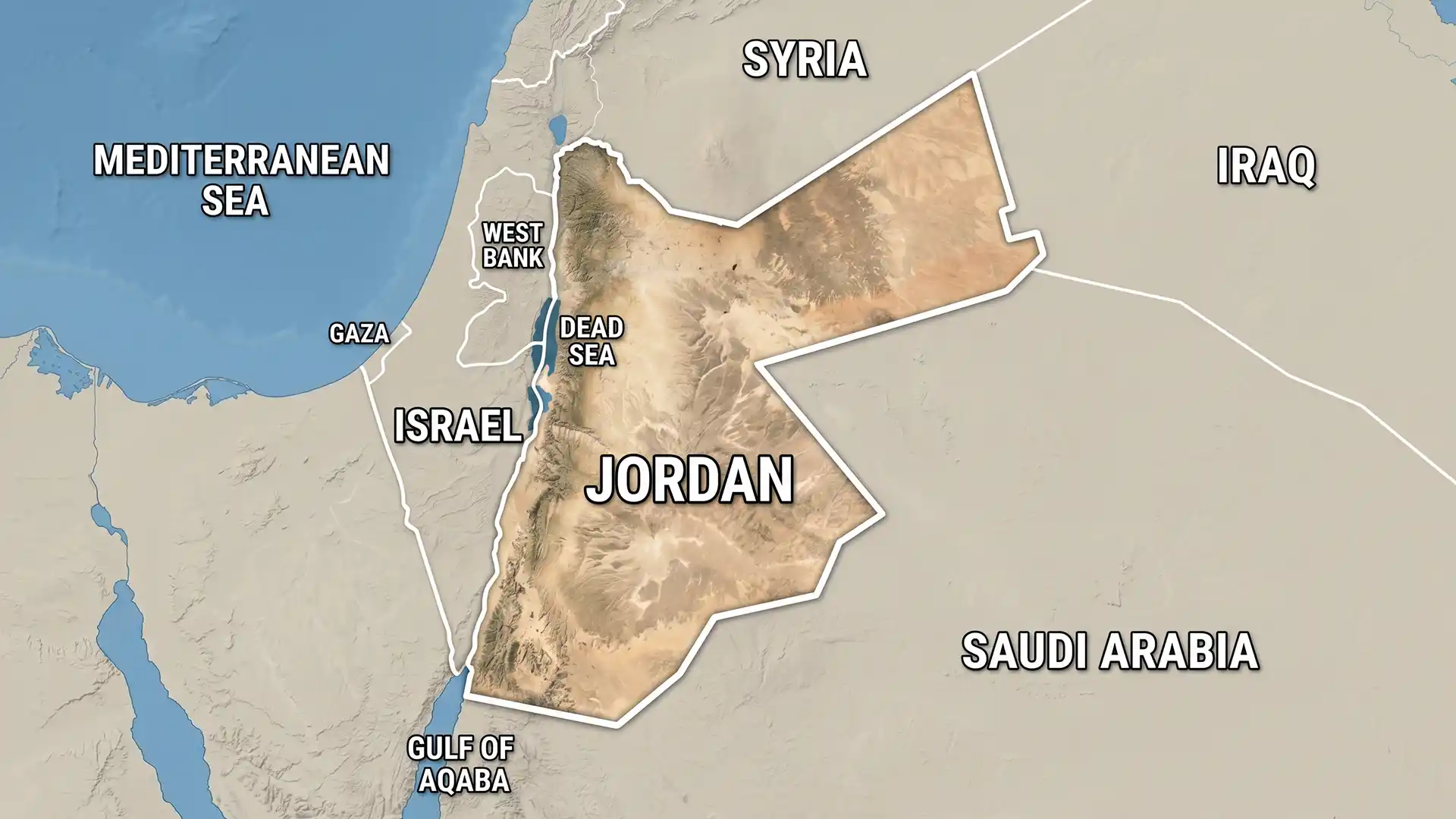
Officially known as the Hashemite Kingdom of Jordan, the country is located in the Middle East. It is bounded by Syria to the north, Iraq to the northeast, Saudi Arabia to the east and south, Israel and the Palestinian territories to the west and the Red Sea’s Gulf of Aqaba to the southwest. About three‑quarters of its 89,000 square kilometres is desert. Jordan’s capital and largest city is Amman. The climate is mostly arid, with warm, dry summers and mild, rainy winters.
Geographical features
- Dead Sea: Jordan’s western border includes part of the Dead Sea, the lowest point on Earth at about 408 metres below sea level.
- Highest peak: The highest point is Jebel Umm ad Dami in the southern desert, rising 1,854 metres above sea level.
- Jordan River: The Jordan River flows along the north‑western border and empties into the Dead Sea. The river is important for agriculture and forms part of the country’s natural boundary.
- Natural resources: Jordan has deposits of phosphates, potash and shale oil. Water scarcity and desertification remain serious environmental challenges.
Political context
Jordan gained independence from Britain in 1946. It is a constitutional monarchy currently ruled by King Abdullah II. The country is known for its relative stability and for acting as a mediator in Middle Eastern conflicts. Despite limited natural resources, Jordan hosts large numbers of refugees and maintains strong relations with neighbouring states and the West.
Conclusion
Jordan’s strategic location at the crossroads of Asia, Africa and Europe has shaped its history and current affairs. Its rugged landscape includes the Dead Sea, the Jordan River and high desert peaks. As regional tensions flare, the country continues to balance diplomacy and security while addressing domestic economic and environmental challenges.