

Why in news?
Andhra Pradesh stopped the Chennai-bound supply from Kandaleru reservoir on 10 September, citing low storage, according to a 15 September report. The New Indian Express reported that Tamil Nadu officials were seeking its resumption. Kandaleru is part of the Telugu Ganga system, which carries water towards Poondi reservoir for Chennai’s drinking-water network. The interruption did not mean that every release from the dam had stopped; water was still being released for other requirements. Nor did it mean Chennai had immediately exhausted all its supplies. The episode highlights the city’s dependence on a chain of reservoirs, canals and interstate decisions, alongside the water stored closer to home.
The river and the transfer system are different things
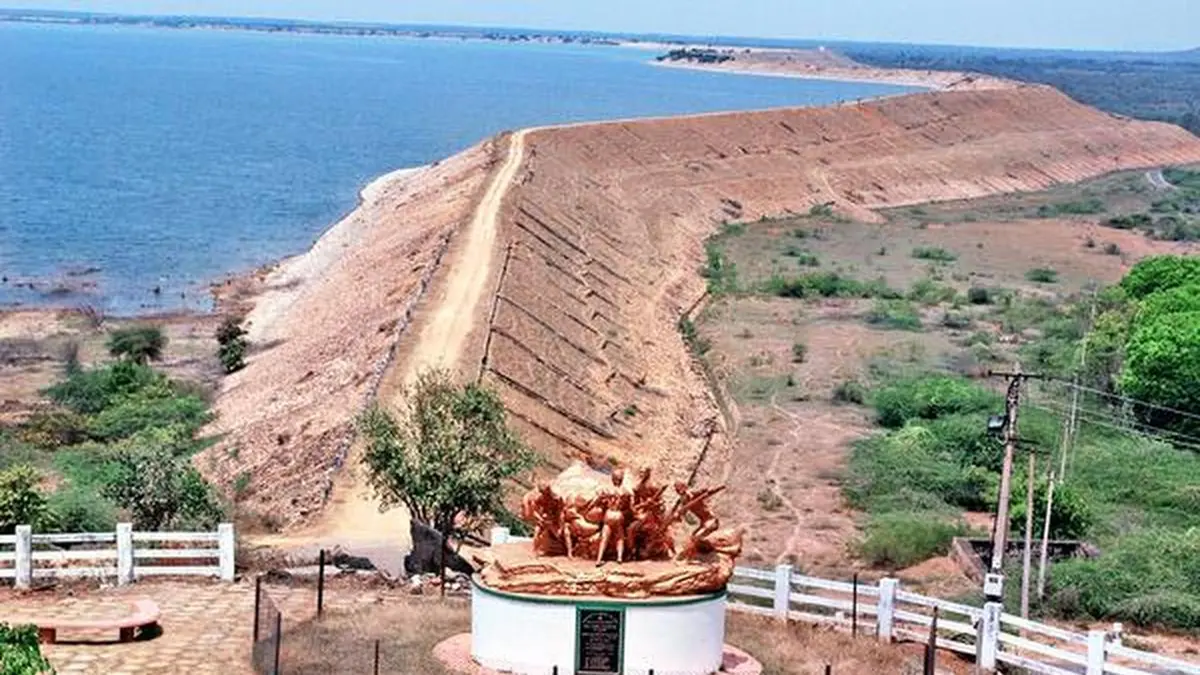
Kandaleru Dam stands on the Kandaleru River, a tributary of the Penna, near Rapur in southern Andhra Pradesh. Yet the water reaching Chennai through this system is commonly called Krishna water. There is no contradiction. The dam’s local river location and the wider transfer network describe different geographical relationships.
The Telugu Ganga system brings Krishna-basin water towards southern Andhra Pradesh and Chennai through linked reservoirs and canals. Somasila and Kandaleru form important parts of this chain. Official district records describe the Somasila–Kandaleru canal as carrying both Penna floodwater and Krishna water. Kandaleru therefore functions as a regulating reservoir within a wider network, rather than merely storing its local river’s flow.
From Kandaleru, the canal system continues towards the Tamil Nadu border and Poondi. Poondi itself lies on the Kosasthalaiyar River. It is one part of Chennai’s surface-water network, connected with other storage and distribution arrangements. Understanding these separate rivers explains why a decision upstream in Andhra Pradesh can affect a city located in another state and basin.
What the interruption actually involved
The September report distinguished the reservoir’s overall release from the portion reaching Chennai. It described earlier releases of about 2,000 cubic feet per second, with roughly 500 reaching the Chennai supply route. Other water served irrigation needs in Andhra Pradesh. The figures explain why a reduction in total release and a halt in the Chennai-bound component are different events.
This also shows why a headline about a dam “stopping water” needs context. A reservoir can have several outlets, users and operating commitments. A reduction for one destination does not necessarily mean that its gates are entirely closed. The report presented low storage as the reason for the interruption, with resumption linked to improved water availability.
Reading storage and flow correctly
A cusec means one cubic foot of water passing a point each second. It measures flow. Reservoir storage, by contrast, measures a volume held at a particular time. Andhra Pradesh’s official project description gives Kandaleru a gross storage capacity of about 68 thousand million cubic feet. That design capacity is not the amount available on any particular September day.
The difference is similar to distinguishing the amount held in a tank from the speed at which its tap runs. Storage rises with inflows and falls through releases and other losses. A large reservoir may still face restricted operations when actual storage is low. Conversely, a high release rate does not guarantee that the same flow can continue indefinitely.
An annual allocation is another distinct measure. The Telugu Ganga arrangement provides for water supply over time; it is not a promise of an identical daily flow. Delivery depends on the functioning of the connected system. Assessing a shortage therefore requires three quantities: existing storage, incoming water and the rate at which water is being used.
Why Chennai needs several sources
A water-sustainability assessment by The Energy and Resources Institute explains Chennai’s combination of reservoirs, imported river water, groundwater and desalination. The last process removes salts from seawater. These sources have different constraints and cannot be treated as interchangeable taps. Reservoirs depend on catchments and inflows, while desalination requires treatment infrastructure and energy.
That assessment also emphasises conservation, rainwater management and the reuse of treated wastewater. These measures address demand as well as supply. Reusing suitable treated water for non-drinking purposes can reduce pressure on freshwater. Protecting local catchments and storage can help retain rainfall that would otherwise leave the urban system quickly.
The immediate administrative issue is restoring a dependable supply, but the wider planning issue is resilience. A city is more exposed when one disrupted source forces abrupt changes elsewhere. Coordinated release information, transparent storage reporting and demand management can help authorities respond earlier. They cannot create water, but they can improve decisions about the water available.
Conclusion
Kandaleru’s significance extends beyond the river on which it stands. It links irrigation needs in Andhra Pradesh with Chennai’s drinking-water system through the Telugu Ganga network. The September interruption should therefore be understood as a specific supply disruption, not the shutdown of an entire dam or city. Reliable water security depends on both interstate coordination and the careful management of Chennai’s other sources.