

Why in news?
Growers in Sagam say expanded cultivation has weakened demand and prices. They also fear that unsuitable locations may reduce the rice’s quality.
What farmers are experiencing
Sagam lies in the Kokernag area of Anantnag district in south Kashmir. It is a traditional centre for this highly aromatic rice.
Farmers said quality grain earlier sold for ₹20,000–₹25,000 per quintal. They now struggle to obtain ₹10,000–₹15,000 per quintal.
A farmer-company member estimated that about 800 quintals from the previous harvest remained stored. He linked roughly 730 local families with cultivation.
These production and price figures describe farmers’ current account. They should guide an official market assessment rather than become permanent benchmarks.
The Anantnag agriculture administration has promised marketing support and a local rice mill. Processing capacity could reduce delays and improve consistency.
What makes Mushqbudji distinctive?
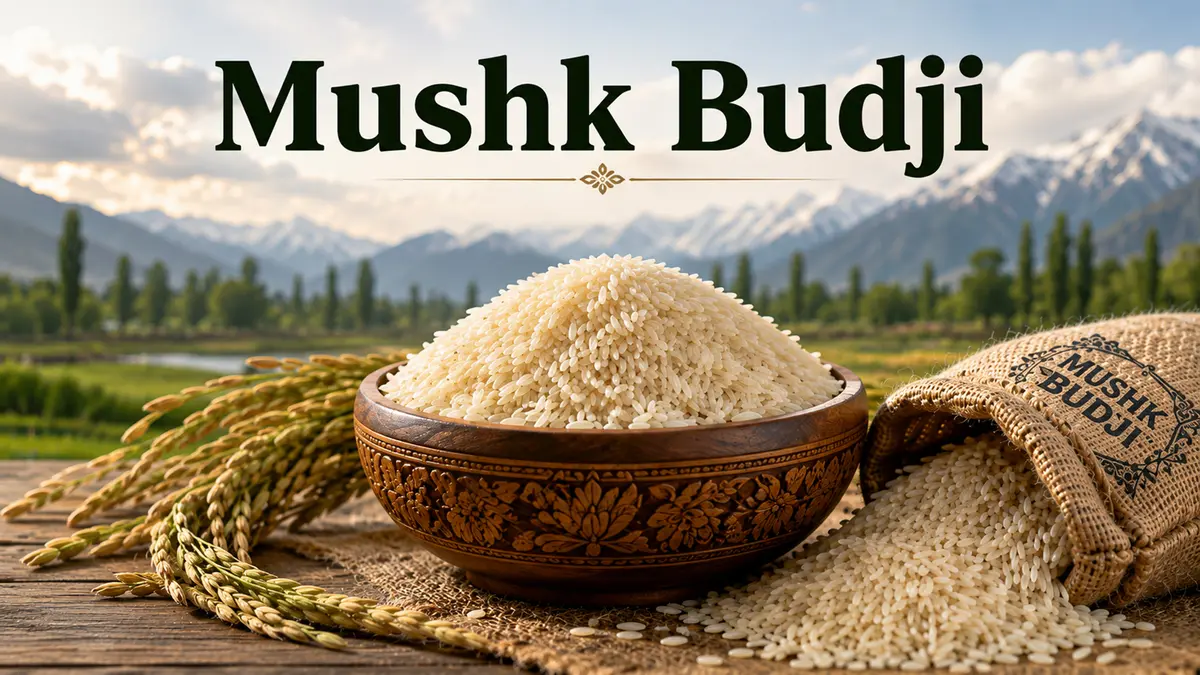
The registered geographical-indication name is “Mushqbudji Rice”. It is a short-grained aromatic rice associated with the Kashmir Valley.
The grain is valued for its fragrance, taste and cooking quality. It has a close cultural link with Wazwan and important family occasions.
Traditional cultivation suffered heavily from rice-blast disease during the twentieth century. Scientific selection and farmer participation later supported its revival.
The Sagam belt combines altitude, cool conditions, soil and irrigation practices. Such local factors can influence aroma and grain characteristics.
The official GI record
Application 758 produced certificate 490 on 31 July 2023. The registration remains valid until 13 June 2031.
What a geographical indication does
A geographical indication, or GI, links a product’s qualities or reputation with a defined origin. It protects the registered name against improper commercial use.
The right belongs collectively to eligible producers, not one private owner. Authorised users must meet the registered product specification.
A GI does not guarantee sales, high prices or export demand. Those outcomes require quality control, branding, processing and reliable market access.
Expansion beyond suitable areas can create two risks. Extra supply may depress prices, while uneven quality can weaken consumer trust.
How policy should respond
The first need is a verified stock and demand assessment. Authorities should separate unsold grain, seed needs and expected new production.
Cultivation advice should follow agro-climatic evidence. Farmers outside core areas need testing before large public programmes promote expansion.
Seed purity, blast resistance and aroma should be monitored. Traceable lots can connect each package with an authorised grower and production area.
A local mill can improve grading and packaging. It must operate under transparent farmer-company governance and professional quality standards.
Restaurants, retailers and exporters need predictable volumes and specifications. Promotion should therefore grow alongside demand, not years ahead of it.
A protected name still needs market discipline
The GI can defend identity. Careful production planning must protect farmer income and the qualities that created that identity.
Conclusion
Mushqbudji’s revival is an agricultural success, but success can create its own imbalance. Expansion without demand planning now threatens growers.
The answer is not to freeze cultivation forever. It is to match suitable land, verified quality and market growth at a sustainable pace.