

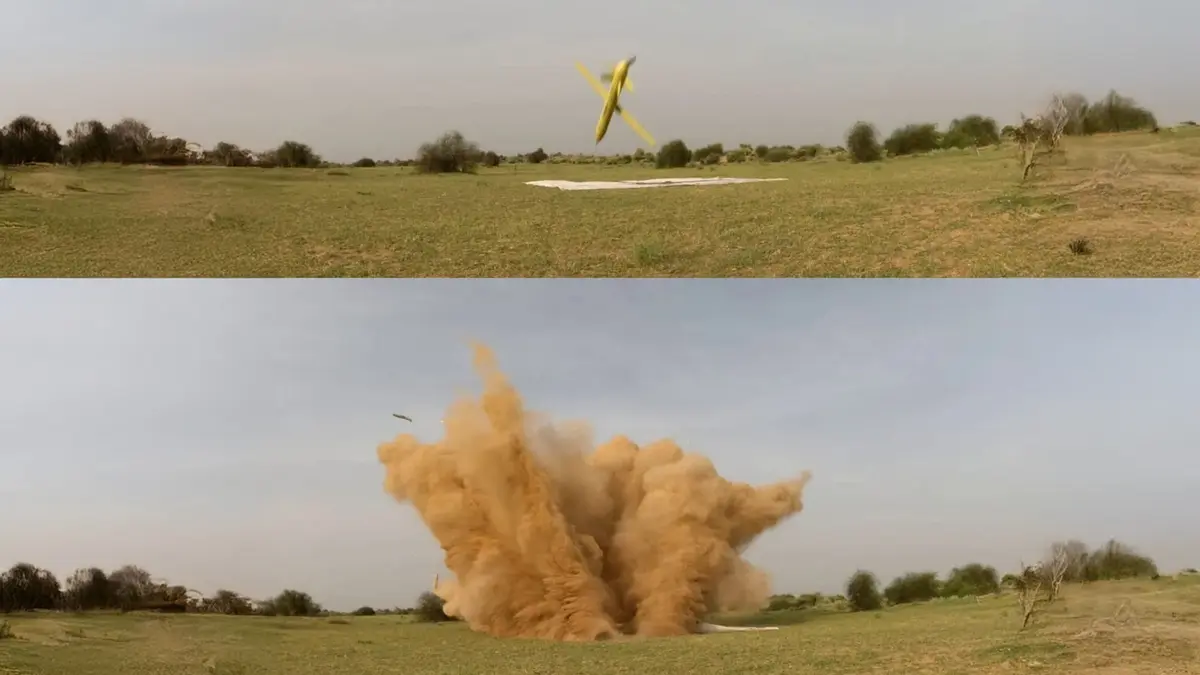
Why in news?
The Indian Air Force announced a successful drop trial of Khagantak-243 on 2 September 2026. It described the indigenously developed long-range glide bomb as having met the trial’s objectives. The programme combines private design capabilities with public-sector defence electronics. The development draws attention to India’s effort to build domestic precision-strike weapons.
What a glide bomb does
A glide bomb travels forward after release by using aerodynamic lift. It does not rely on sustained engine thrust like a cruise missile. Wings and control surfaces help shape its descending flight. Guidance equipment helps direct that flight towards the intended destination.
Gliding allows a weapon to cover distance instead of falling steeply beneath its release point. The aircraft can therefore release it away from the target. This is the basic meaning of a stand-off weapon. It can reduce the need for the aircraft to fly directly over a defended location.
The available distance depends on the weapon’s design and release conditions. Aerodynamic drag reduces energy, while altitude gives a glider room to descend. A published maximum range is consequently not a fixed distance under every condition. General gliding principles help explain why performance figures require their stated context.
The industrial partnership behind the programme
Khagantak-243 was developed jointly by JSR Dynamics Private Limited and Bharat Electronics Limited. JSR Dynamics is based in Nagpur, Maharashtra. Bharat Electronics Limited is a public-sector company under the Ministry of Defence. The partnership brings together airframe and control work with electronic and guidance capabilities.
The companies signed a memorandum of understanding at Aero India on 20 February 2019. Their agreement covered development, manufacture and sale of glide weapons and lightweight cruise missiles. This establishes a longer industrial background to the present trial. The September announcement is therefore one stage in a programme developed over several years.
At Aero India 2025, company officials disclosed a contract for Khagantak-243 to defence publication Janes. The quantity and contract value were not specified in that account. The weapon was described as belonging to the 300-kilogram class. This refers to its overall weight category, not a separately established explosive weight.
Understanding the reported capabilities
The earlier company briefing described an intended range exceeding 140 kilometres under specified release conditions. It also identified the Sukhoi Su-30MKI fighter as the initial integration platform. These details describe the programme’s design and integration background. They should not be confused with a public measurement of the latest trial’s achieved range.
A guided weapon combines several systems that must work together. Its structure must withstand carriage and separation from the aircraft. Control equipment must respond correctly during flight. Navigation and guidance must then support the required flight path, making integration as important as individual components.
A successful drop trial provides evidence about the objectives tested during that event. Wider operational confidence requires consistent performance across the relevant conditions. Production quality and maintenance arrangements also matter after development testing. These are distinct stages, even when they form part of one acquisition programme.
Why indigenous development matters
Domestic design can give India greater control over upgrades and technical support. It can also create opportunities for specialised suppliers and engineering skills. However, the benefit depends on reliable production and sustained quality. An indigenous label alone does not answer questions about delivery, cost or operational readiness.
The partnership illustrates how a smaller company can work with an established public-sector manufacturer. Such arrangements can combine specialised ideas with wider production and support capacity. Clear responsibilities are important when problems cross mechanical and electronic systems. Successful coordination can strengthen the wider defence manufacturing base.
Precision and distance should also be assessed without absolute claims. Stand-off capability does not remove every operational risk. Guidance does not guarantee a particular outcome in every environment. A balanced assessment should recognise the achievement while keeping design claims, test results and service readiness distinct.
Conclusion
Khagantak-243’s trial marks progress in India’s domestic glide-weapon programme. Its significance includes both the weapon and the industrial partnership behind it. Further value will come from dependable integration, production and support. Performance should be judged through clearly defined evidence rather than promotional comparisons. The programme’s lasting contribution will depend on reliable capability delivered at scale.