

Why in news?
Lok Sabha Speaker Om Birla paid tribute to Amrita Devi Bishnoi and those killed while protecting Rajasthan's khejri trees. Akashvani reported the commemoration on 21 September 2026. The reference is to the 1730 sacrifice at Khejarli, near Jodhpur, where villagers resisted tree felling. Khejri is more than a memorial symbol: it is a dryland tree that supports farming, livestock and food in western India. Its continued importance helps explain why protecting living trees became a community commitment. The tribute recalls that history and an enduring conservation question. How can a working agricultural landscape retain its trees and their ecological benefits?
The tree behind the historical memory
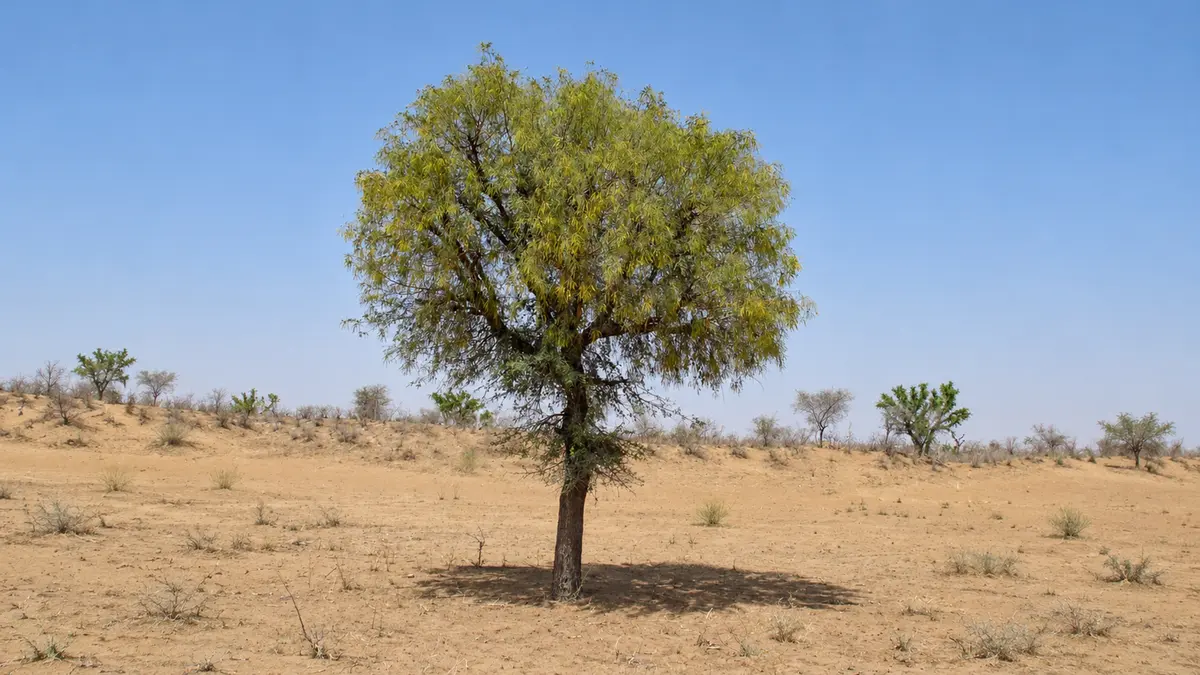
Khejri is scientifically known as Prosopis cineraria and belongs to the legume family. It is strongly associated with Rajasthan's arid landscape, particularly the Thar region, but its range is not confined to that state. Its ability to survive dry conditions makes it useful where rainfall is limited and uncertain. The small leaflets and thorny branches are readily recognisable features. Unlike a seasonal crop, an established tree remains part of the farm through successive good and bad rainfall years.
At Khejarli in 1730, Amrita Devi and other Bishnoi villagers resisted the cutting of green trees by the ruler's men. The sacrifice is remembered in the community's history and in official conservation commemorations. It should not be collapsed into the much later Himalayan Chipko movement, although both are associated with protecting trees. The historical setting here is eighteenth-century Marwar. The modern tribute recalls the community's willingness to defend a resource on which people and animals depended.
Why survival in a desert requires more than toughness
A dryland tree must obtain water while limiting losses and surviving long periods without dependable rain. Research by the Central Arid Zone Research Institute describes khejri's strong root development and access to deeper moisture. Young plants invest in roots before developing a large crown. That helps explain why a mature tree cannot be replaced immediately by planting a seedling. The replacement still has to survive establishment, grazing pressure and successive dry seasons.
Deep roots also help explain khejri's place beside rain-fed crops. Crops depend heavily on moisture in shallower soil, while the tree can draw on deeper layers. This can reduce direct competition, although it does not abolish competition for water, light or nutrients. The result depends on tree spacing, soil, rainfall and management. A useful agroforestry species is not a guarantee that every crop will yield more under every individual tree.
How trees, crops and livestock support one another
Agroforestry means managing trees together with crops or livestock on the same land. In khejri-based systems, people retain a tree for several services rather than treating its presence as wasted crop area. Leaves provide fodder, while tender pods are used as the vegetable known as sangri. Branches and wood have other household uses. These different outputs matter because a family need not depend on one harvest or one sale alone.
The tree also changes conditions beneath its crown. Shade moderates exposure, and litter contributes organic material as it decomposes. Research has associated khejri-based systems with improved soil organic matter and fertility. Its legume relationship includes nitrogen-fixing associations, but soil improvement is not explained by a single process. Moisture, plant residues and soil organisms interact. The practical benefit is a more supportive growing environment, not a tree manufacturing an unlimited substitute for all fertilisers.
A 2021 agroforestry review, including field observations, examined these provisioning and supporting services. It found benefits for farm income, nutrition and resilience in the systems studied. That evidence supports looking beyond timber value when assessing khejri. Cutting a tree produces wood once; retaining it can sustain repeated fodder and pod harvests. The comparison is especially important in dry regions where replacement growth is slow and alternative sources may be scarce.
Conserving a working landscape
Protection need not mean that farmers cease all use of a tree. Traditional management includes harvesting leaves and pruning branches. The challenge is to retain the tree's capacity to recover while allowing useful production. Excessive removal, damage around the root zone or repeated browsing of young plants can weaken that continuity. Conservation therefore involves mature trees, regeneration and the knowledge needed to manage them. Counting newly planted saplings alone cannot describe whether this system is secure.
Khejri should also be distinguished from Prosopis juliflora, the introduced species often called vilayati babul. Similar genus names do not make the two ecologically interchangeable. Indian dryland research describes the rapid colonisation and management problems associated with the latter. Protecting a locally valued agroforestry tree is therefore different from encouraging any thorny species that survives drought. Species identity matters when planning restoration or judging an apparent increase in tree cover.
Conclusion
The Khejarli remembrance connects a historical act of resistance with a living ecological system. Khejri's importance comes from the combination of dryland adaptation, recurring products and its place within community-managed farms. Preserving that value requires more than a ceremonial tribute or a plantation count. It requires healthy older trees, surviving young plants and continued management that keeps livelihoods and ecological functions together.