

Why in news?
United States forces struck two Iranian rocket launchers on Larak Island on 30 August. The island lies inside the strategically important Strait of Hormuz. Washington said the launchers threatened international shipping with rocket-delivered sea mines. Iran reported casualties and answered with missiles against American sites in Jordan.
What happened
The United States Central Command said Iranian forces were preparing rockets carrying sea mines. It described the threat as imminent and the strike as limited. Iran’s official and semi-official reports said people were killed and injured. Independent reporting could not verify every battlefield claim immediately.
Iran’s Islamic Revolutionary Guard Corps then announced a retaliatory missile operation. Jordan said its air defences intercepted eight missiles entering national airspace. American officials reported no impact on United States bases in Jordan. These statements came from the parties involved and require careful attribution.
The exchange ended roughly one month without known direct American strikes inside Iran. It also returned military pressure to a route already affected by conflict. Even a limited incident can alter insurance rates and ship movements. Markets therefore watch developments around Larak closely.
Where Larak Island is located
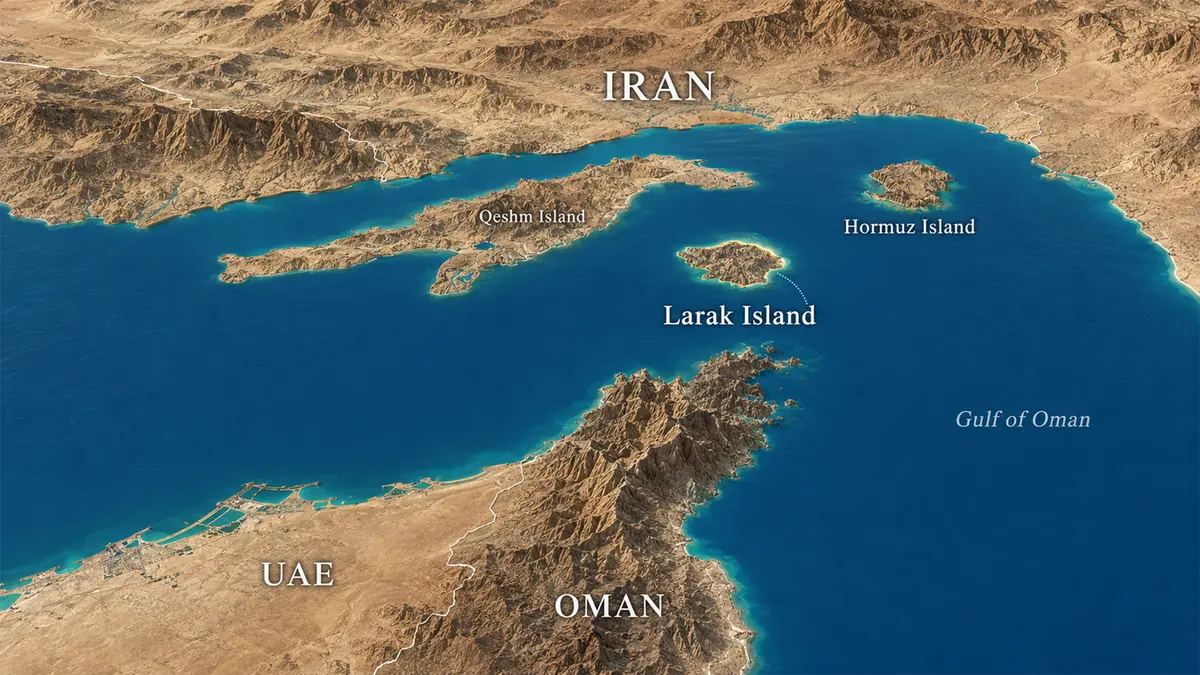
Larak is an Iranian island in Hormozgan Province. It sits near the southern entrance of the Strait of Hormuz. The larger Qeshm Island lies to its north-west. Iran’s mainland port of Bandar Abbas is farther north.
The strait connects the Persian Gulf with the Gulf of Oman and Arabian Sea. Iran forms its northern coast. Oman’s Musandam Peninsula lies on the southern side. The United Arab Emirates is nearby along the southern Gulf coast.
Ships use defined traffic lanes through this narrow waterway. Larak’s position places it close to those approaches. The island is therefore significant beyond its small land area. Military activity there can affect civilian navigation across the region.
Why the strait matters globally
The United States Energy Information Administration calls Hormuz a leading global oil chokepoint. Around twenty million barrels of oil passed through daily during 2024. That equalled about one-fifth of global petroleum liquids consumption. Few pipelines can replace all this maritime capacity.
Major Gulf exporters depend on the route for Asian and global markets. Liquefied natural gas cargoes also cross the strait. A disruption can delay deliveries and reduce available tanker capacity. Freight charges and war-risk insurance may rise before physical supplies fall.
India depends heavily on imported crude oil and natural gas. Disturbance in Hormuz can therefore affect costs, shipping schedules and inflation. The effect is not automatic or uniform. It depends on duration, inventories, alternative supplies and freight conditions.
Why sea mines create a broad danger
A sea mine can remain hazardous after the immediate fighting ends. It may damage military or commercial vessels without continuous human control. Clearing a shipping lane demands specialised ships, divers and surveillance. One suspected mine can slow traffic across a much wider area.
Rocket-delivered mines would combine stand-off launch capability with a persistent naval hazard. The American account said these were being prepared for international routes. Iran did not accept the American justification for the strike. The exact operational situation remains contested.
Civilian mariners face the greatest immediate uncertainty. Captains must weigh official warnings against routes and cargo obligations. Coastal states also carry search, rescue and pollution responsibilities. A damaged oil tanker could create consequences beyond the military target.
Regional and legal implications
Jordan’s interceptions show how a local strike can involve neighbouring airspace. The Gulf states also remain exposed to drones and missiles crossing busy waters. Their infrastructure supports global energy and trade. They therefore have strong reasons to prevent wider escalation.
Freedom of navigation remains central to international commerce. States also claim security interests around their territory and forces. Competing military narratives do not settle the legality of particular attacks. A responsible account should separate verified events from legal conclusions.
De-escalation requires communication as well as defensive readiness. Maritime warnings must be timely and specific. Mine-clearance information should reach commercial operators. Diplomatic channels can reduce misreading during fast military exchanges.
Claims from a live conflict need attribution
The strike and missile exchange are established events. The purpose, target status and damage assessments mainly come from the governments involved.
Conclusion
Larak Island matters because geography places it beside a vital shipping route. The latest exchange joined local military action with global commercial risk. Mine threats can outlast the strike that prompted them. Neighbouring states need reliable warnings and strong crisis communication. Restraint around Hormuz protects both regional security and the world economy.