

Why in news?
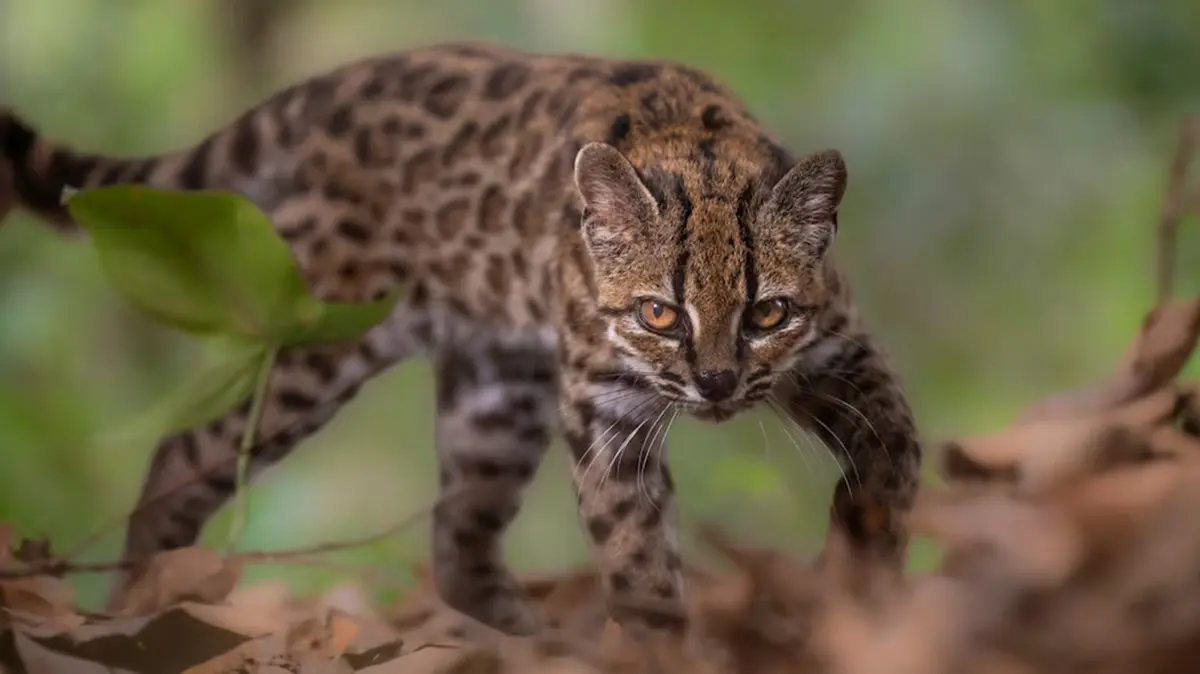
A study published in Current Biology on 17 September has formally described Leopardus tilcayo, a small wild cat from Bolivia's Yungas forests. Researchers combined modern genetic analysis with museum specimens to clarify a long-standing classification problem. Similar-looking South American tiger cats do not all belong to one species. Their analysis supports five species and identifies the Bolivian cat as a previously unnamed one. Local communities already knew it as tilcayo, a name retained in the scientific description. Grouping a narrowly distributed animal with widespread cats can hide its particular conservation needs. Recognising the difference allows those needs to be investigated separately.
A small cat, not a tiger or leopard
“Tiger cat” is a common name for small spotted wild cats of South America. It does not mean a miniature member of the tiger species. The newly described animal belongs to the genus Leopardus within the cat family, Felidae. Its light-brown coat carries irregular rosette-like markings. Similar colouring among related cats helps explain why appearance alone did not settle its identity.
Researcher Paola Nogales-Ascarrunz first examined an unusual cat at a Bolivian wildlife refuge in 2016. It had been taken in by a local family before reaching the refuge. Its markings and other features did not fit existing descriptions comfortably. That observation became a research question, rather than immediate proof of a new species: was it individual variation, or a distinct evolutionary lineage?
Where the Yungas fit on the map
The Bolivian Yungas lie along the eastern side of the Andes, between high mountain country and lower Amazonian landscapes. Moisture, steep slopes and differences in elevation create varied forest habitats. Cloud forests are frequently enveloped in mist, rather than simply being any forest receiving heavy rain. These conditions help support localised species, but also make fieldwork and comprehensive wildlife surveys difficult.
The wider Yungas region extends beyond Bolivia. That does not establish that tilcayo occupies its entire length. Genetically confirmed records remain confined to the Bolivian Yungas, and the researchers say its full range is unknown. A separate newly described subspecies from Peru belongs to Leopardus tigrinus. The Peruvian and Bolivian findings should therefore not be merged into one newly discovered animal.
How genetics resolved the identification
The team analysed complete genomes from 38 cats in the genus, including 26 representatives of the tiger-cat complex. Eight genomes came from museum specimens. A genome contains an organism's genetic information; comparing many parts of it allows researchers to reconstruct relationships. This approach is more informative than relying on one visible characteristic, especially where closely related animals look alike.
Museum material was particularly useful for comparing cats from regions with few modern samples. Recovering genetic information from preserved collections is called museomics. It links historical specimens with living populations. Such collections are therefore not merely displays of past discoveries. They provide comparisons needed to test whether a newly examined animal fits an existing scientific name.
The analysis identified a distinct Bolivian lineage, with an estimated separation around 1.4 million years ago. That date is an evolutionary estimate, not the animal's discovery date. The researchers also compared physical traits and geographical evidence. Together, these supported the formal description. The result is an argument built from several kinds of evidence, rather than a rule that any particular genetic difference automatically creates a species.
Understanding the “first in a century” claim
The authors describe tilcayo as the first discovery of a novel cat species in more than a century. The important distinction is between a previously unnamed species and a revision involving an already named form. Earlier studies have raised recognised subspecies to species status or restored older names. The claim should not be read as saying that cat classification has remained unchanged for a hundred years.
Scientific recognition is also different from first human knowledge. Retaining the local name acknowledges that communities knew the animal before this formal description. The research contribution is to document its distinguishing characteristics, evolutionary relationships and taxonomic identity. That makes the finding available for comparison, further investigation and conservation decisions without erasing the knowledge that preceded the study.
What remains to be learned
Researchers still have limited observations of living tilcayos. Small-rodent remains in scat suggest part of their diet, while camera records indicate possible greater activity at night. These are early findings, not a complete behavioural profile. The International Union for Conservation of Nature must assess the newly distinguished lineages separately. An existing category for a broader tiger-cat grouping cannot automatically be assigned to tilcayo.
Forest loss, fragmentation, agriculture, fires and mining threaten the Yungas landscape. Separating a species from a widespread grouping can reveal that its actual habitat is much smaller than previously assumed. It also changes the questions researchers must ask: where does it occur, how connected are its populations, and which pressures affect them? Those answers are needed before precise population or extinction-risk claims can be justified.
Conclusion
Tilcayo shows how close observation, local knowledge, museum collections and genetics can work together. The immediate achievement is a clearer account of biodiversity, not a completed conservation assessment. Its recognition now makes targeted surveys and habitat protection more meaningful. Understanding which animal is being protected is the foundation for deciding where—and how—conservation effort should be directed.