

Why in news?
A 17-member Indian group entered Taklakot through Lipulekh with merchandise, according to reporting published on 8 September 2026. It comprised nine traders and eight helpers. This was the season’s second group, after an earlier unsuccessful trading visit. The movement revives a border livelihood route while leaving the India–Nepal territorial disagreement unresolved.
Where the pass lies
Lipulekh is a high Himalayan pass on the route from Uttarakhand’s Pithoragarh district towards Tibet, administered by China. The Indian approach runs through the Kumaon region and the upper Kali valley. The pass is above 5,000 metres. Published elevations differ, so an unnecessarily precise height would suggest more agreement than the sources provide.
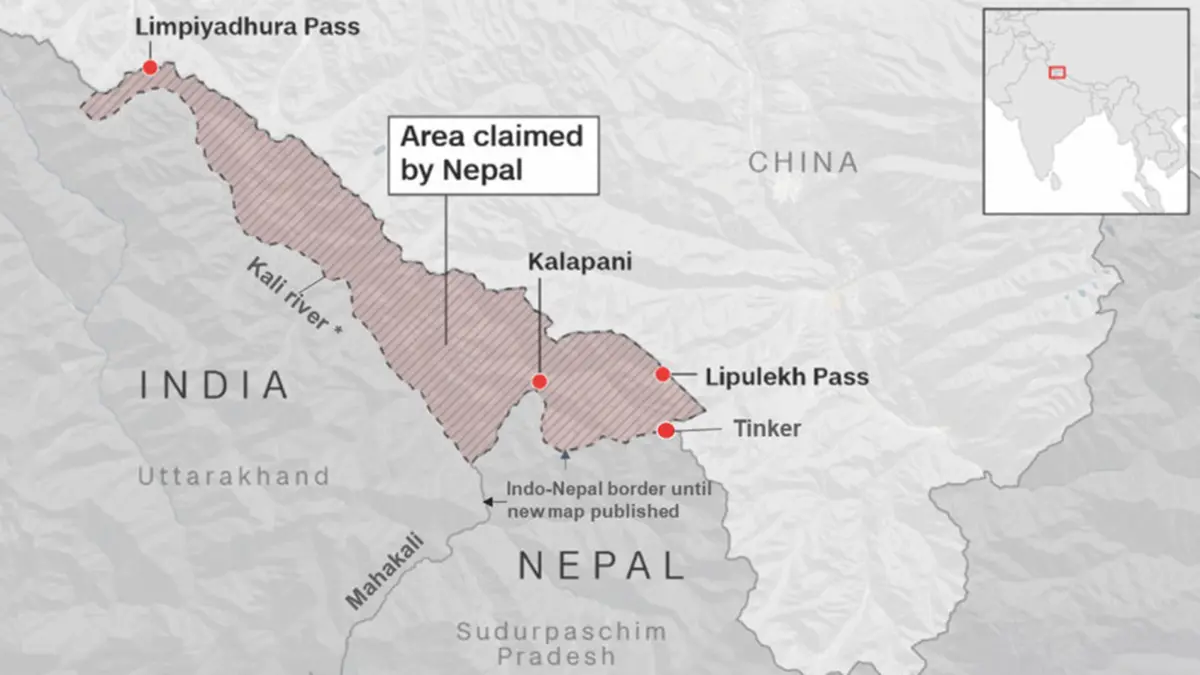
India administers the approach, while Nepal claims Lipulekh together with Kalapani and Limpiyadhura. A geographical account must distinguish administration from competing territorial claims. Describing the area simply as an undisputed three-country junction would conceal that disagreement. Trade movement does not, by itself, resolve the location of the contested boundary.
Pithoragarh’s district records separately identify Lipulekh in the Kali valley and Limpiyadhura in the Kuti valley. They are not alternative names for the same pass. Nearby valleys and headwaters are central to the wider dispute. Keeping their identities separate is therefore necessary for both geographical and diplomatic accuracy.
What the September movement involved
The New Indian Express quoted Dharchula’s administration about the group’s entry on 7 September. The traders carried their own merchandise and goods belonging to an earlier batch. The newspaper reported that the first group had departed on 31 July. Its members had been unable to conduct the intended trade because permission was delayed.
The later crossing therefore marks more than an announcement that preparations were under way. Merchandise actually moved after clearance. At the same time, it was not the first group to attempt the route that season. Distinguishing permission, physical crossing and completed trading activity prevents several different milestones from being combined.
Taklakot, also known as Purang, is the market on the Tibetan side. The route links it with traders and transport services around Dharchula. Border commerce can support livelihoods beyond the people carrying the goods. Porters, local transporters and households supplying services may also depend on a functioning trading season.
A route with repeated interruptions
Trade across these Himalayan routes predates modern customs arrangements. The Lipulekh route was interrupted after the 1962 India–China war and reopened for regulated trade in 1992. More recently, pandemic-era restrictions brought another interruption. Those separate episodes should not be collapsed into a claim that the route had remained closed continuously since 1962.
Recent accounts use both six-year and seven-year descriptions of the latest interruption. The difference reflects whether they count from the last trading season or the pandemic shutdown. The chronology is more useful than a dramatic duration label. In particular, the pandemic should not be described as having already closed the route in an ordinary 2019 trading season.
The route’s reopening is distinct from the restoration of unrestricted trade across the entire India–China frontier. A designated border-trade arrangement operates through specified procedures and permissions. It is also different from the much larger national merchandise trade between the countries. A local crossing’s importance need not be exaggerated to recognise its livelihood value.
Why Nepal objects
Nepal’s foreign ministry reiterated its position on 3 May 2026. It cited the 1816 Treaty of Sugauli and claimed the territory east of the Mahakali River. Nepal includes Lipulekh, Limpiyadhura and Kalapani within that claim. Its statement objected to activities arranged through the area without accepting Nepal’s position.
The dispute involves interpretation of the river boundary and its headwaters, not merely the spelling of a place name. The Kali is also known as the Mahakali in this boundary context. Historical maps, treaty interpretation and differing territorial positions remain relevant. A route map used for travellers cannot adjudicate those questions.
India rejected Nepal’s claim in its response on the same date. The Ministry of External Affairs maintained India’s established position and cited the route’s longstanding pilgrimage use. It also expressed openness to dialogue on outstanding boundary issues. Both governments’ statements should be reported as their positions, rather than one being silently presented as settled international agreement.
Trade, pilgrimage and physical access are different
Lipulekh also serves the Kailash Manasarovar pilgrimage route. That shared geography does not make pilgrimage permission equivalent to commercial clearance. The traveller, purpose and applicable arrangements differ. News that pilgrims can use a route therefore does not automatically establish that merchants can conduct trade through it.
High-altitude access creates practical constraints alongside diplomatic ones. Snow, difficult terrain and limited seasonal windows can affect movement. Local livelihoods consequently depend on predictable permissions and workable transport arrangements. Better physical connectivity can help, but cannot on its own remove customs restrictions or settle a territorial disagreement.
The September movement should therefore be assessed through evidence of continuing operations. Regular clearances, actual transactions and dependable access would show whether the reopening becomes durable. A single successful group is an important start. It cannot establish the season’s final trade volume or guarantee that interruptions will not recur.
Conclusion
Lipulekh’s renewed trade connects a specific Himalayan pass with border livelihoods and wider diplomatic tensions. The September report documents a concrete movement of traders and goods. It does not settle the territorial dispute or create unrestricted frontier trade. A careful account keeps the route, chronology, competing claims and practical significance together.