

Why in news?
Newly reported forest records show a concentration of detected poaching cases in Karnataka’s Male Mahadeshwara Hills division. It recorded 166 of the Chamarajanagar circle’s 370 poaching cases in the period examined. The division also accounted for 32 of 66 cases involving guns. The findings highlight the need for effective enforcement and sustained engagement with nearby communities.
Reading the figures in their proper scope
The records cover 2010–11 through 19 August in the 2026–27 financial year. They concern three divisions within the Chamarajanagar forest circle. Male Mahadeshwara Hills accounted for about 45 percent of detected poaching cases. Its share of gun-related cases was about 48 percent.
The other divisions were Biligiriranganatha Swamy Temple Tiger Reserve and Cauvery Wildlife Sanctuary. Their recorded poaching cases numbered 107 and 97 respectively. The detailed figures were reported from Forest Department data. They do not describe half of all wildlife crime across Karnataka or India.
Detected cases are not identical to all offences committed. Better patrols and reporting can increase recorded cases even without a matching increase in underlying crime. Conversely, low detection can hide serious pressure. Trends should therefore be examined alongside enforcement effort and investigation outcomes.
Where the sanctuary lies
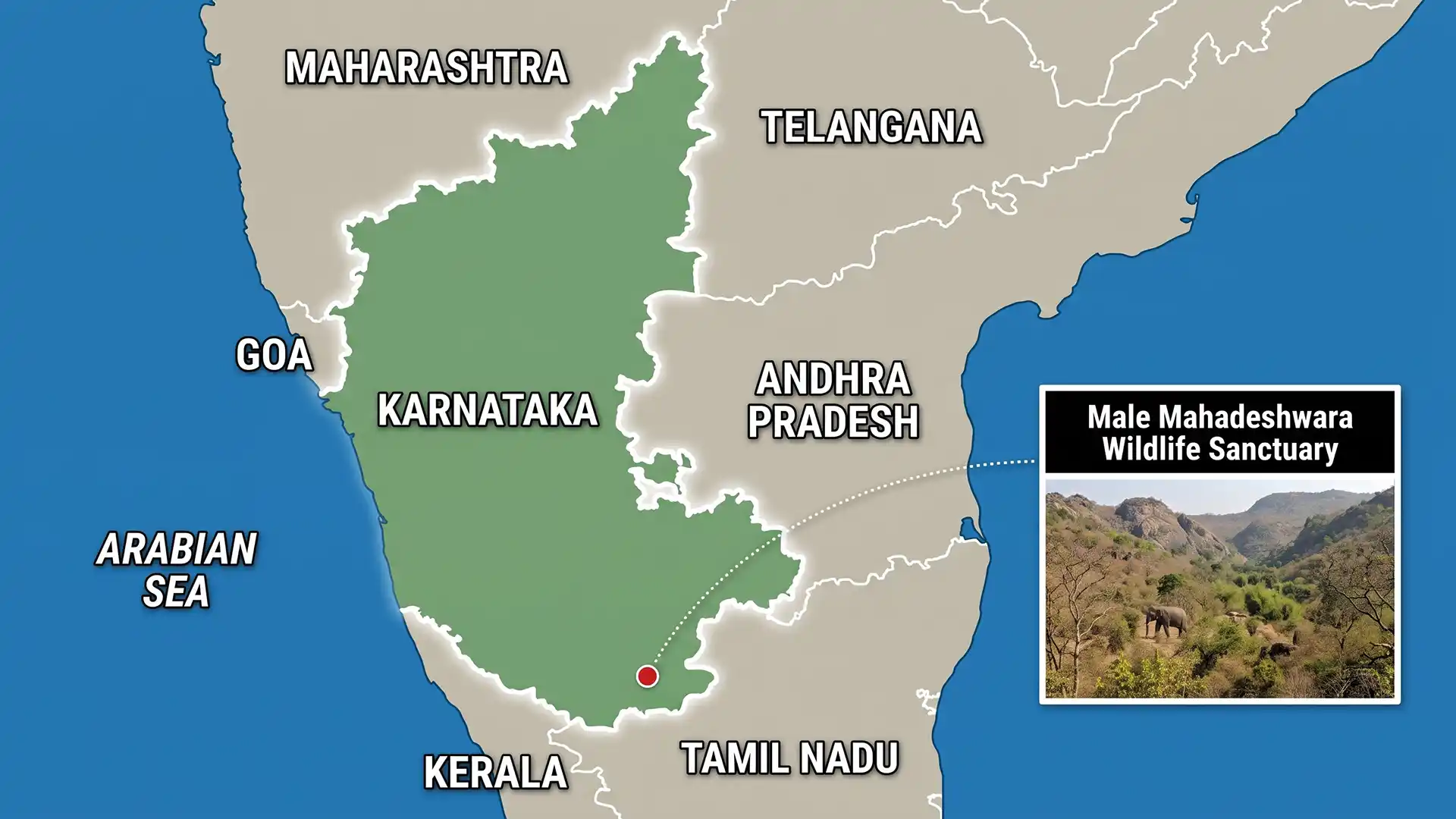
Male Mahadeshwara Wildlife Sanctuary lies in Chamarajanagar district, in southern Karnataka. It forms part of a forest landscape adjoining Tamil Nadu. The hills are associated with the Eastern Ghats. Their ecological importance also comes from connections with neighbouring protected forests.
Cauvery Wildlife Sanctuary lies towards the north and east. The Biligiriranganatha Swamy Temple landscape lies to the west. Sathyamangalam’s protected forests lie to the south in Tamil Nadu. Together, these areas provide a wider landscape for animals moving beyond individual administrative boundaries.
The sanctuary was established in 2013 and covers about 906 square kilometres. Dry and moist deciduous forests are important vegetation types. Elephants, leopards and deer occur in the surrounding protected landscape. Its hills also contain a major pilgrimage centre dedicated to Male Mahadeshwara.
The distinction between a sanctuary and a tiger reserve matters here. A proposal for tiger-reserve status is not the same as completed notification. The September report still describes that status as proposed. The area should therefore continue to be identified accurately as a wildlife sanctuary.
Why connected habitats need coordinated protection
Wild animals do not follow state or forest-division boundaries. They move to find food, water and breeding opportunities. Damage within one part of a connected landscape can affect neighbouring populations. Conservation planning must therefore consider movement routes as well as individual protected areas.
Poaching can also affect a food web beyond the animal directly killed. Losses among prey species can influence predators that depend on them. Repeated disturbance may change how animals use habitat. These effects make prevention important even where individual cases appear isolated.
Cross-border coordination should support information sharing and lawful investigation. Karnataka and Tamil Nadu agencies may need to follow linked movements of people and wildlife products. Clear procedures can prevent gaps between jurisdictions. Investigations should identify individual responsibility rather than stigmatise entire communities.
Enforcement and public services must work together
Patrolling remains essential, but it cannot solve every underlying problem. Officials quoted in the report called for a wider approach. Difficult access to health, education and livelihoods can weaken trust in public institutions. Addressing those gaps supports conservation without excusing unlawful hunting.
Local residents can help identify unusual activity and emerging threats. Cooperation is more likely when officials respond fairly and consistently. Grievance channels should be accessible, including in remote settlements. Respectful engagement can improve information while reducing avoidable confrontation.
Enforcement quality also depends on what happens after detection. Evidence must be documented carefully and investigations completed lawfully. Case records should distinguish allegations, prosecutions and convictions. This makes public reporting more accurate and helps authorities identify weaknesses in the enforcement process.
Development measures need to be designed with local participation. Useful priorities may include reliable transport, schooling and access to healthcare. Livelihood support should reflect actual skills and market opportunities. Programmes should be evaluated for lasting benefits rather than the number of activities announced.
Forest protection also needs safe working conditions for frontline staff. Equipment, training and communication support can improve patrol effectiveness. Staff should receive guidance on lawful procedures and community engagement. Strong institutions combine operational capacity with public accountability.
Conclusion
The Male Mahadeshwara figures identify a serious concentration of detected offences within a specific forest circle. They support closer attention, not sweeping claims about entire communities. Effective protection requires reliable evidence, coordinated enforcement and connected habitats. Better public services can strengthen cooperation around the sanctuary. Conservation will be more durable when local people become trusted partners in protecting the landscape.