

Why in news?
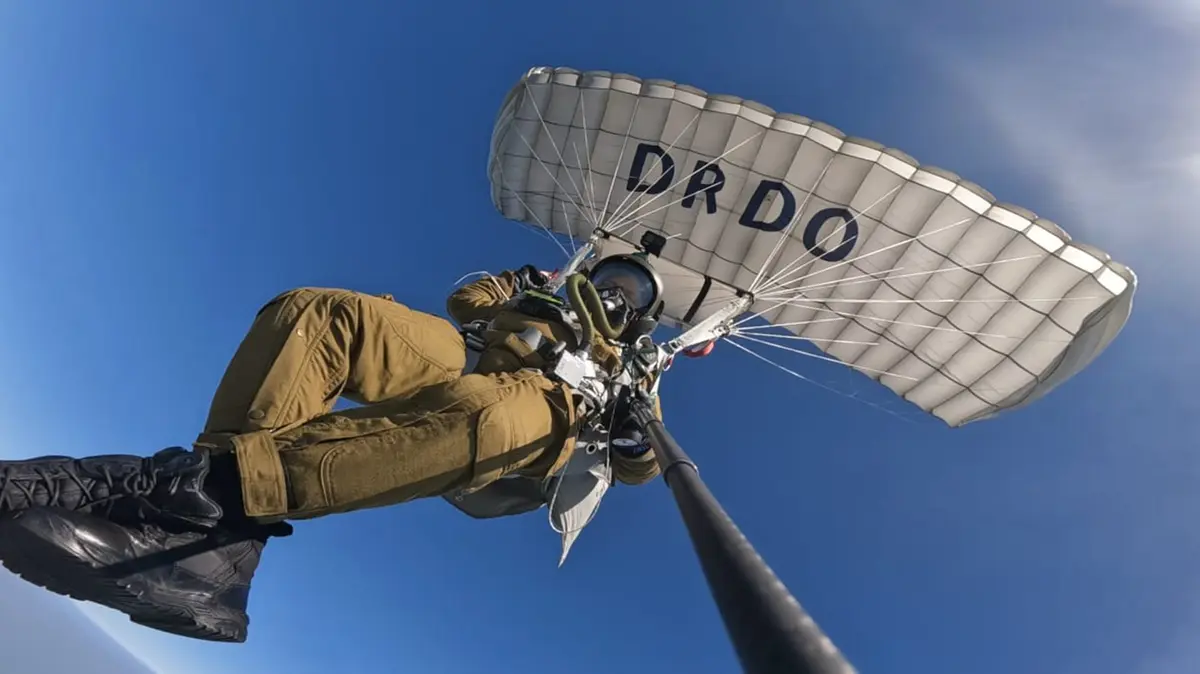
The Defence Research and Development Organisation tested its Military Combat Parachute System at Nyoma on 26 August. The reported jump occurred at a 22,000-foot drop zone. Nyoma lies in the high-altitude Changthang region of eastern Ladakh. The trial examined operation in demanding terrain and thin air.
What the system is designed to do
The Military Combat Parachute System, or MCPS, carries paratroopers and combat loads into an operational area. A jumper exits an aircraft and deploys the canopy at a planned height. The steerable system supports navigation towards a chosen landing zone. It can also keep an aircraft away from the target.
The Defence Research and Development Organisation, or DRDO, designed the complete system for special operations. Its major elements include main and reserve canopies. It also carries navigation, oxygen, communication and safety equipment. A harness and combat-load attachments integrate these parts around the jumper.
Different high-altitude modes
High Altitude High Opening deploys the canopy soon after exit. This allows a long glide from a distant release point. High Altitude Low Opening keeps the jumper in free fall longer. It reduces time under an open canopy near the landing area.
DRDO also lists a High Altitude Medium Opening mode. Mission planners choose a method according to threat, weather and terrain. Every mode requires accurate altitude awareness and trained body control. Oxygen support becomes important at extreme heights.
Design and earlier qualification
The Aerial Delivery Research and Development Establishment in Agra designed the parachute components and navigation equipment. The Defence Bioengineering and Electromedical Laboratory in Bengaluru developed oxygen support and individual gear. This division joins aeronautical and human-physiology expertise.
DRDO’s technology-transfer document lists satellite navigation, a magnetic compass and an altimeter. It also lists an automatic activation device and an oxygen pocket. Certification tests were prepared with international parachute standards. The Centre for Military Airworthiness and Certification approved the qualification schedule.
An official October 2025 release recorded a combat freefall from 32,000 feet. It described MCPS as the Indian Armed Forces’ only operational system deployable above 25,000 feet. That earlier test established extreme exit capability. The Nyoma trial examined a different high-altitude operating environment.
Why Nyoma is demanding
Nyoma is the headquarters of Changthang district in Ladakh. The wider Changthang is a cold, high plateau with sparse vegetation and broad open valleys. Low air density affects canopy inflation, descent and steering. Cold also influences materials, batteries and human performance.
The region lies in eastern Ladakh near India’s frontier with China. Reliable air insertion can matter where ground movement is slow and landing areas are limited. This geography gives the test clear operational relevance. Detailed military scenarios should not be inferred from a public trial.
What the new report establishes
The first report placed the trial at a 22,000-foot Nyoma drop zone. Reuters Connect also carried visual material identifying the event and location. No detailed official test report was available with the first news. Exact performance results should therefore remain limited to the reported test.
A test is not the same as mass deployment. Designers must examine canopy behaviour, landing accuracy and equipment reliability. User training and maintenance remain equally important. Local testing can reveal problems that controlled environments do not reproduce.
Indigenous capability and supply chains
Domestic design can reduce dependence on imported specialised equipment. It also allows modification for Indian operating conditions. DRDO has invited industry participation through technology transfer. Production quality must remain consistent across every safety-critical component.
Parachute fabric, stitching and packing require strict inspection. Oxygen systems and activation devices need scheduled servicing. A small defect can have severe consequences. Indigenous content is valuable only when certification and lifecycle support remain rigorous.
Scope of the latest claim
Reputable first reports confirm the Nyoma event and reported 22,000-foot drop zone. This article does not add unsupported records or precise test results. Earlier 32,000-foot capability comes from a separate official release.
Conclusion
The Nyoma test placed MCPS in one of India’s most demanding operating environments. Its systems combine controlled descent, navigation and high-altitude life support. Earlier official trials already demonstrated a higher exit capability. The latest value lies in terrain-specific validation. Safe production, training and maintenance will determine operational reliability.