

Why in news?
Preparations for the Meenakshi Sundareswarar Temple’s consecration brought a livelihood dispute into focus in Madurai, Tamil Nadu. The New Indian Express reported on 14 September 2026 that vendors had been removed from the surrounding Chithirai streets. The ceremony was scheduled for 17 September. Vendors said the clearance had interrupted their earnings, while municipal officials linked it to preparations and pedestrian access. The temple is both an active place of worship and a centre of the old city’s commercial life. Managing large gatherings therefore affects people who depend on its surrounding streets. Questions about vendors’ return or alternative arrangements remained unresolved. The report did not establish a final legal ruling on the clearance.
Why the temple and the city cannot be separated
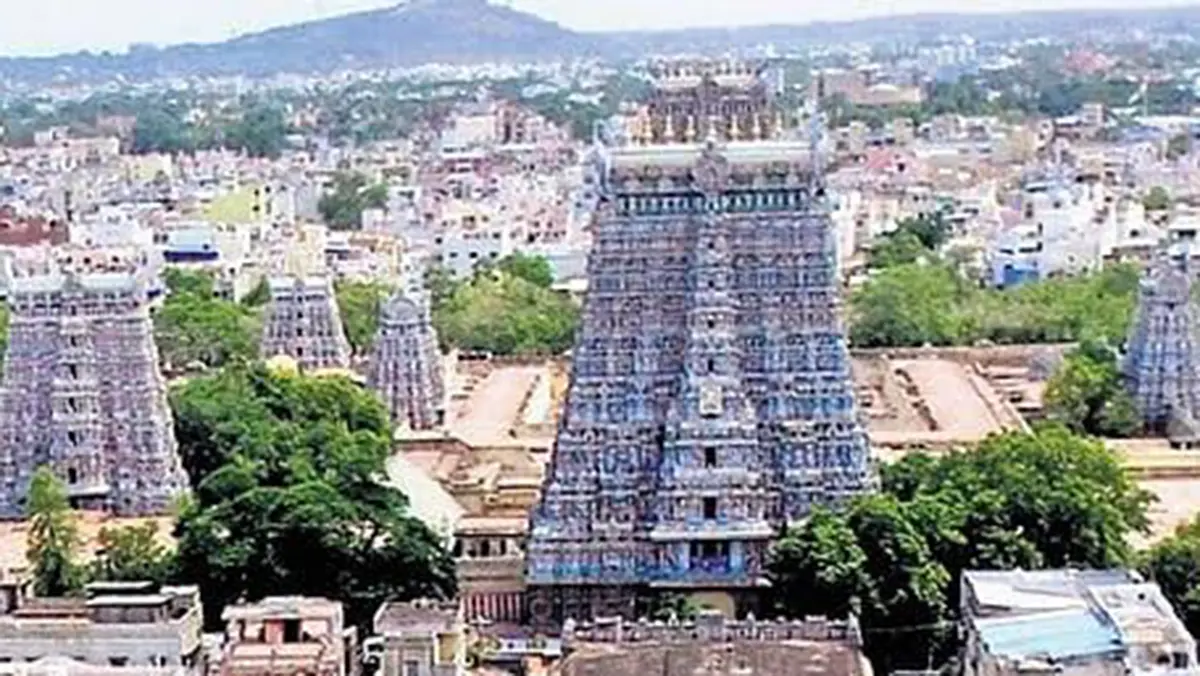
The complex stands in Madurai, a historic city associated with the Vaigai River in southern Tamil Nadu. Its two principal shrines honour Meenakshi and Sundareswarar, forms of the goddess and Shiva. The district administration describes the temple as the centre around which the city developed. Its significance consequently extends beyond an individual building.
Worship, processions and seasonal festivals bring people into the surrounding streets. Shops and small vendors serve that movement of visitors. A change in access near the temple can therefore affect both religious activity and everyday income. This relationship explains why preparations for a major ceremony can become an urban-governance issue.
Temple traditions recount the marriage of Meenakshi and Sundareswarar. These narratives give meaning to ritual and imagery within the complex. They are religious traditions, however, not a dated construction record. The history of the physical buildings must be understood through their different patrons, additions and periods of rebuilding.
A complex built across generations
Madurai’s temple history is associated with the Pandyas and later Nayak rulers. Much of the complex’s monumental expansion belongs to the Nayak period. The district’s account particularly notes Thirumalai Nayak’s contribution in the seventeenth century. It would therefore be misleading to assign every surviving structure to one founding ruler or one ancient date.
The temple administration’s descriptions identify particular halls with different patrons. Its account of the Vasantha Mandapam associates that hall with Thirumalai Nayak and the spring festival. The celestial wedding hall is associated with Vijayaranga Chokkanatha Nayak. Such details show how later construction accommodated particular ceremonial needs within an older sacred setting.
The complex also illustrates important elements of southern temple architecture. A gopuram is a monumental gateway tower, marking entry through an enclosing wall. A mandapam is a pillared hall used for assembly or ritual activity. These are not simply alternative names for the innermost shrine, where the principal deity is housed.
The Hall of Thousand Pillars is especially well known for its sculpted supports. Its name identifies a celebrated architectural space; the larger lesson is how halls, gateways, shrines and open areas work together. They organise movement and worship through a sequence of spaces rather than presenting the temple as one undivided room.
Consecration and the needs of a functioning site
The ceremony commonly called kumbabishekam is a consecration ritual associated with the temple’s sacred structures. In this context, it should not be confused with opening a newly founded temple. A long-established shrine can undergo restoration and ritual reconsecration while retaining its older history and continuing religious identity.
Large ceremonies require arrangements for movement, cleanliness and access. Clear routes can matter for visitors and emergency services. But a temporary operational need does not answer every question about how space should be managed afterwards. The duration of restrictions, communication with affected people and arrangements for resuming livelihoods remain separate issues.
What the vending dispute requires authorities to address
The newspaper placed the clearance on 31 August and quoted a vendors’ association saying more than 300 people were affected. That number was the association’s account, not a separately published municipal census. The central issue was the uncertainty following removal: vendors lacked clarity about when, or under what conditions, they could resume work.
India’s Street Vendors (Protection of Livelihood and Regulation of Street Vending) Act, 2014 provides the broader legal framework. It combines livelihood protection with the regulation of public space. It provides for surveys, vending certificates and Town Vending Committees. These institutions are intended to make street vending part of planned urban management.
Section 18 addresses relocation and eviction. It includes a thirty-day notice requirement before removal from a place specified in a vending certificate. Applying that provision to particular vendors requires the relevant certificates, notices and local records. The news report alone cannot establish every person’s legal position or determine whether the entire operation complied with the law.
Conclusion
The Madurai dispute shows that conserving and managing a living temple also involves its surrounding economy. Safe access during a major ceremony and predictable treatment of vendors are connected responsibilities. Clear, lawful arrangements for the streets after the event would address the uncertainty that brought this historic temple into the news.