

Why in news?
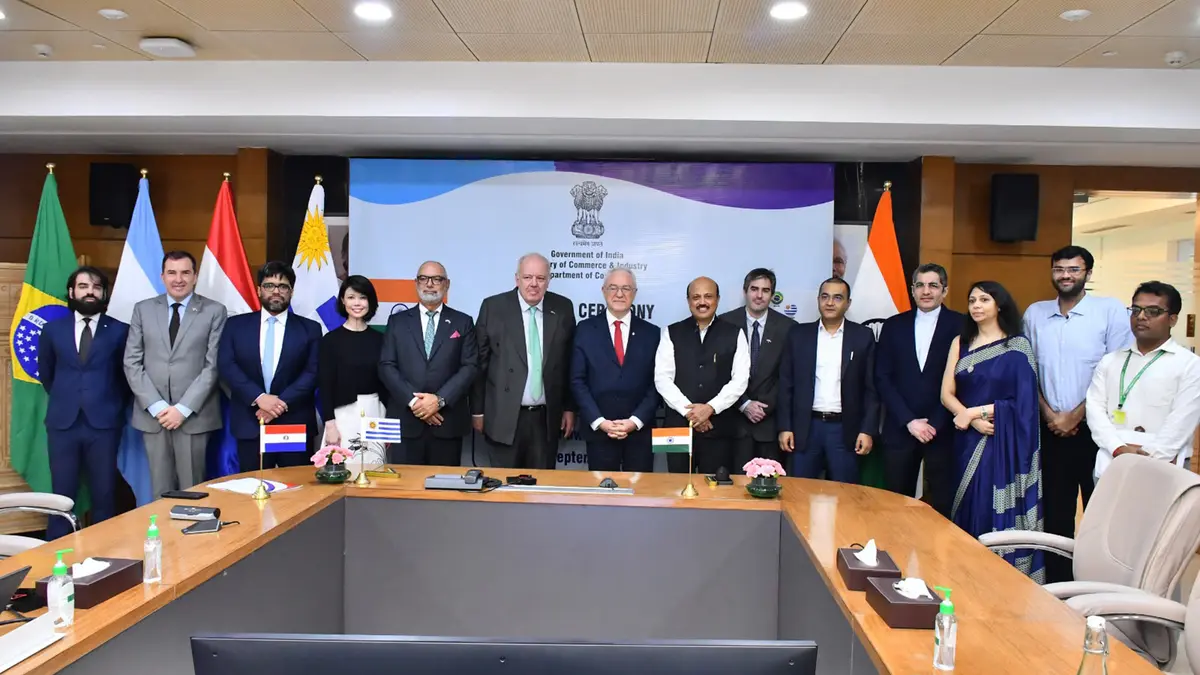
India and the South American bloc MERCOSUR have signed a protocol to facilitate acceptance of electronic Certificates of Origin. The Commerce Ministry announced the change to their Preferential Trade Agreement on 14 September 2026. These certificates help establish whether imported goods qualify for the agreement’s existing tariff preferences. The change would give an eligible electronic certificate the same legal standing as its paper counterpart, reducing dependence on physical documents. It is not a new agreement removing duties on all trade. Nor did signing alone bring the protocol into force: the announced process still requires completion of internal procedures and the relevant notification. The development concerns easier administration of an existing trade arrangement.
What MERCOSUR is—and who belongs to it
MERCOSUR takes its name from the Spanish Mercado Común del Sur, meaning Southern Common Market. Argentina, Brazil, Paraguay and Uruguay founded it through the Treaty of Asunción in 1991. It is a South American integration arrangement with intergovernmental decision-making. Its institutional objectives are broader than a single bilateral trade agreement with India.
The bloc’s official membership record now includes Bolivia alongside the four founding participants. Bolivia became a State Party in 2024, with a transition period for incorporating the bloc’s rules. Venezuela also holds State Party status but is suspended. Associate states form a separate category and should not be counted as full participating members.
The geography helps explain the bloc’s variety. Brazil, Argentina and Uruguay have Atlantic coastlines, while Paraguay and Bolivia are landlocked. Cross-border transport and access to ports therefore matter differently across the region. Sharing a bloc does not remove these practical differences. Regional membership also does not automatically settle participation in every external trade arrangement.
India’s agreement is preferential, not universal
The India–MERCOSUR Preferential Trade Agreement was signed in January 2004 and entered into force in June 2009. A preferential agreement offers specified tariff treatment for covered goods. It does not necessarily eliminate duties across the whole range of trade. Importers must check the product coverage and the conditions attached to the concession.
A tariff preference is useful only if customs can determine whether a shipment qualifies. The product must satisfy the relevant agreement, including its origin rules. This is why administrative documents can have commercial importance even when the duty rate itself remains unchanged. A delay in establishing eligibility can interfere with access to an existing benefit.
Origin means more than the shipping port
The World Trade Organization describes rules of origin as criteria for determining a product’s national source. This becomes important when production involves materials or processing in several countries. Goods shipped from a particular port do not necessarily originate in that country. The place of dispatch and the origin recognised under a trade agreement answer different questions.
The India–MERCOSUR origin rules distinguish goods wholly obtained in the relevant territory from goods involving other inputs. They specify when processing can confer origin and identify operations that are insufficient on their own. Simple repacking, for example, does not automatically turn imported goods into originating products. The certificate records compliance with these requirements; it does not create compliance where none exists.
What the electronic certificate changes
The First Additional Protocol amends Article 16 of the agreement’s origin rules. Its central change concerns the legal acceptance of electronic certificates, including the required electronic signatures. The document’s medium changes, but the need for an authorised issuer and valid underlying information remains. “Paperless” does not mean that exporters may make unsupported declarations without checks.
Consider a shipment that already meets the agreement’s product and origin conditions. Under a paper-based process, moving and presenting the certificate can become a separate administrative step. An accepted electronic document can reduce that dependence on physical handling. This illustrates the intended benefit without assuming that every shipment will receive faster clearance or that all customs checks disappear.
Implementation also depends on the systems receiving the document. Authorities must be able to recognise authorised signatures, retrieve information and handle doubts about authenticity. Traders need clarity about the commencement date and accepted procedures. Signing supplies the legal direction; operational readiness and completion of the entry-into-force process determine when traders can rely on the new arrangement.
Conclusion
The protocol addresses a modest but important part of trade: proving eligibility for benefits that already exist. Electronic certificates can make that process less dependent on paper, while leaving origin requirements intact. The next steps are completing the required procedures and making the documents usable by traders and customs authorities. Until then, signing marks progress towards simpler administration rather than an operative change for every shipment.