

Why in news?
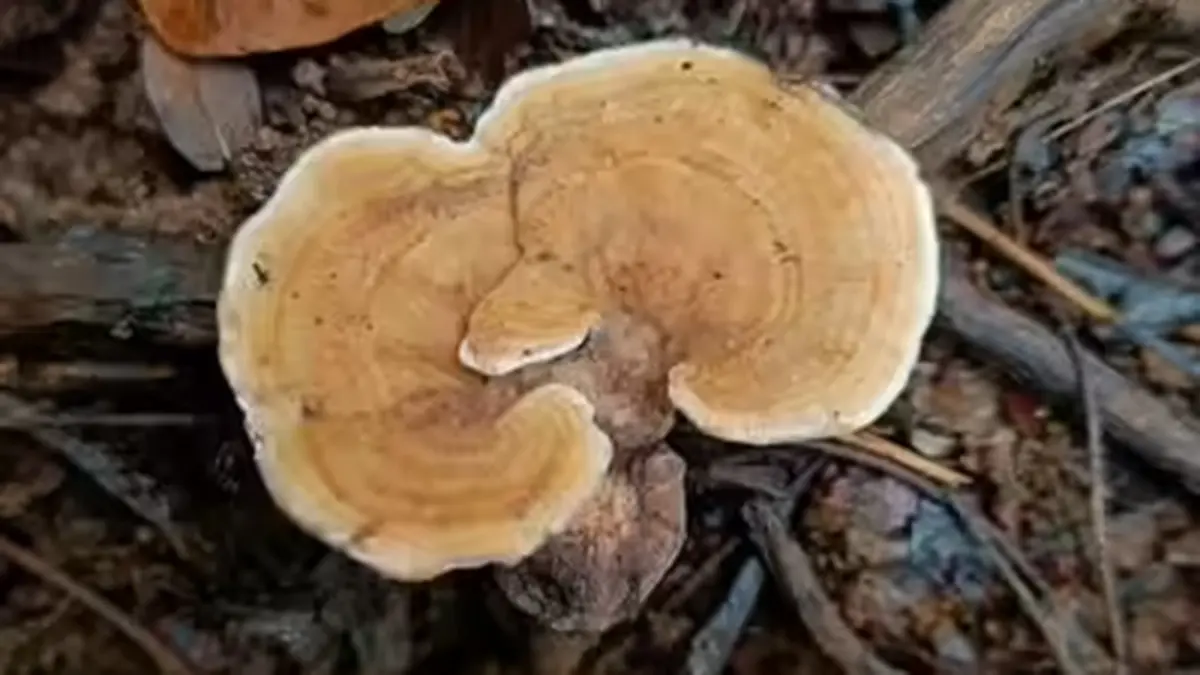
Researchers described a new bracket fungus from Kolhapur district, Maharashtra. They named it Microporellus kolhapurensis after the district. The fungus grows on decomposing wood during the monsoon months. Its description adds to India’s documented fungal diversity.
Background
Fungi form a separate biological kingdom from plants and animals.
They do not make food through photosynthesis like green plants.
Many fungi release enzymes and absorb surrounding nutrients, making them important decomposers in forest ecosystems.
Understanding the visible fungus
Fine fungal threads called hyphae usually grow inside wood or soil.
A network of these threads is called a mycelium, while the visible bracket is its spore-producing fruiting body.
What is a polypore?
A polypore usually forms a firm fruiting body on wood.
Its lower surface carries many small pores instead of gills, and spore-producing tissue lines these tubes.
Many polypores appear like shelves or brackets on tree trunks.
Where was the new species found?
Researchers found it at Bediv, near the Ajra border in Bhudargad taluka of Kolhapur district.
The specimen grew from rotting forest wood and generally produces fruiting bodies from July through September.
Observed fruiting bodies usually grew singly.
Who documented it?
Botanist Anjali Patil and researcher Yogesh Patil studied the specimen through Rajaram College in Kolhapur.
The formal description appeared in Nelumbo, the research journal of the Botanical Survey of India.
Scientific classification
| Rank | Classification |
|---|---|
| Kingdom | Fungi |
| Phylum | Basidiomycota |
| Order | Polyporales |
| Family | Polyporaceae |
| Genus | Microporellus |
| Species | Microporellus kolhapurensis |
Why was it treated as a distinct species?
Taxonomists compare outward form and microscopic structures with published descriptions of related species.
The new fungus showed a distinctive combination of features.
| Feature | Reported description |
|---|---|
| Colour | Yellowish-orange through greyish-brown |
| Cap | Umbrella-like form |
| Stalk | Attached toward one side |
| Pores | Relatively large openings below the cap |
| Spores | Microscopic and teardrop-shaped |
| Cystidia | Specialised thick-walled sterile cells |
Cystidia help taxonomists identify fungi, but they do not produce spores.
The stalked form may appear ground-growing despite its connection with buried wood.
What does its name mean?
The genus identifies its wider relationship, while kolhapurensis records the species’ discovery region.
Scientific names follow a two-part binomial naming system.
The genus begins with a capital letter, while the species does not.
What ecological role does it perform?
The species is saprotrophic, meaning it feeds on dead organic matter.
Its enzymes break complex wood into simpler substances, returning nutrients to soil for reuse.
Wood decomposition also supports insects and other small organisms.
Why does fungal documentation matter?
- Species records reveal the true richness of local ecosystems, and they improve understanding of decomposition and nutrient cycles.
- Accurate names allow later ecological and chemical research, and records create baselines for habitat monitoring.
Published species totals can also change as taxonomic databases are revised.
Therefore, a single worldwide genus count may quickly become outdated.
Conclusion
The discovery shows why monsoon surveys and careful fungal taxonomy remain important.