

Why in news?
Prime Minister Narendra Modi highlighted Modhera's Sun Temple and solar-powered village in his 27 September Mann Ki Baat address. The discussion linked the temple's approximately thousand-year history with a modern system combining solar generation, batteries and the electricity grid. Modhera is in Gujarat's Mehsana district, beside the Pushpavati River. Its temple is a major example of western Indian sacred architecture, while the village's energy project was inaugurated in October 2022. The renewed attention does not mark a new solar-project launch. It also does not make the temple an inscribed World Heritage Site: its current status is a Tentative List entry.
The river setting and the historical period
The temple stands west of the Pushpavati River, in northern Gujarat's historic settlement landscape. The Indira Gandhi National Centre for the Arts places its construction around 1026–27, during the reign of Bhima I. He belonged to Gujarat's Chaulukya dynasty, also commonly known as the Solankis. This is the historical basis for describing the monument's millennium.
Modhera also has religious traditions connecting its sacred landscape with episodes from the Ramayana. Such traditions explain the site's devotional meaning, but they are different from evidence dating the surviving building. Keeping these categories distinct allows both to be discussed clearly. A temple's sacred associations can be older or broader than a particular phase of its construction.
Understanding the complex as a sequence
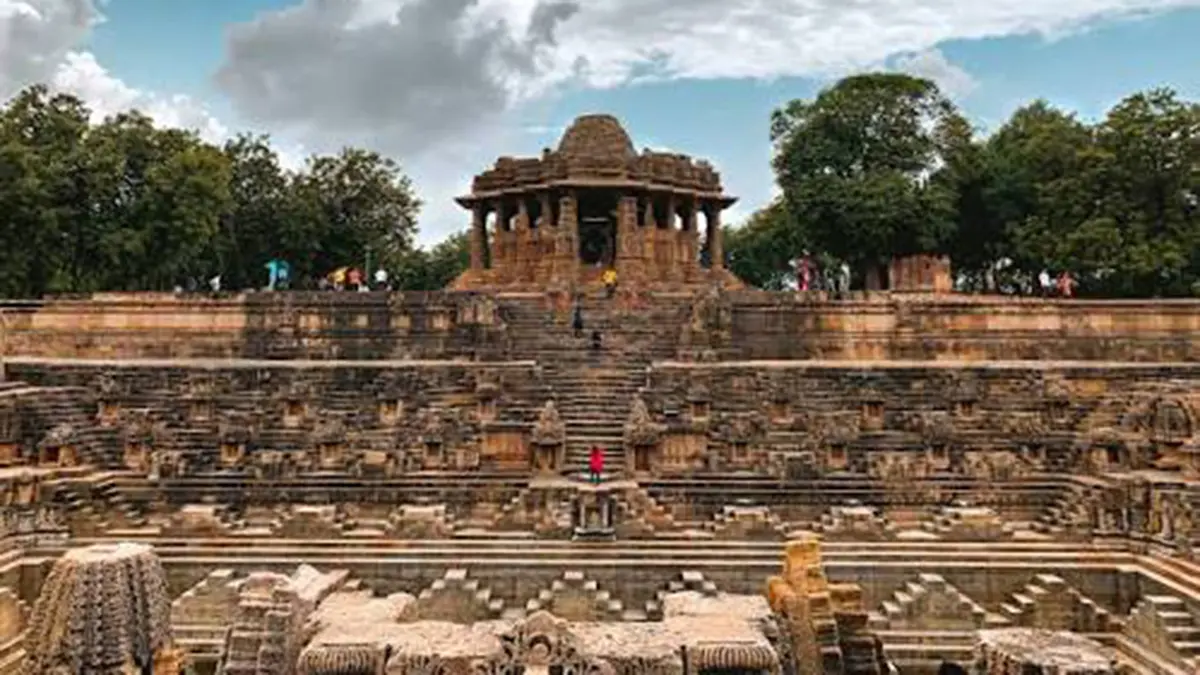
The complex brings together a stepped water tank, an assembly hall and the principal temple. The tank is known as Surya Kund or Rama Kund. Steps descend towards its water, with subsidiary shrines arranged around it. Beyond this water setting, the assembly hall leads the visitor towards the enclosed sacred spaces of the main structure.
The sabha mandapa is the assembly hall; the inner temple includes a hall and the sanctuary. These terms describe different functions rather than interchangeable parts of one room. Carved pillars, architectural openings and sculptural panels organise the experience of moving through the complex. Water, gathering and worship are connected through the arrangement of the site.
The imagery includes Surya, the Sun deity, alongside other religious figures and narrative scenes. The building belongs to the Maru-Gurjara architectural tradition associated with western India. Its importance lies in the relationship between the whole composition and its detailed carving. A list of decorative motifs alone would miss how the tank, halls and sanctuary work together.
What the UNESCO status means
India placed the Sun Temple at Modhera on its Tentative List on 13 December 2022. The United Nations Educational, Scientific and Cultural Organization, or UNESCO, records that submission. Tentative listing is not World Heritage inscription. It identifies a property that a country may consider nominating, rather than recording a completed decision to add it to the World Heritage List.
This distinction matters whenever heritage recognition appears in news. The architectural value of a monument does not depend on confusing the stages of a nomination process. Modhera can be historically important while remaining on a tentative list. The present anniversary discussion should therefore be understood on its own terms, without attaching an international status the site has not received.
How the modern solar project works
The Ministry of New and Renewable Energy approved the solarisation project in March 2020; it was inaugurated on 9 October 2022. Its documented components include a six-megawatt ground-mounted solar plant and a fifteen-megawatt-hour battery system. Household rooftop systems and installations on government buildings supplement the central plant. Smart meters help manage the electricity system.
The two large numbers measure different things. Megawatts describe a rate of power generation or delivery. Megawatt-hours describe an amount of energy, such as that stored in a battery. A battery can shift some daytime solar output to periods when generation is lower, but storage capacity is finite. Its usefulness depends on demand and the way the system is operated.
The project is grid-connected. That connection is important when interpreting the government's description of Modhera as India's first round-the-clock solar-powered village. Continuous electricity service does not mean that sunlight is available at night. It depends on the combined operation of solar equipment, storage and grid integration, rather than a single panel supplying uninterrupted power independently.
Two meanings of a solar landscape
The temple and energy project share an association with the Sun, but their functions are different. One is a historic religious and architectural monument; the other is modern electricity infrastructure. The connection is useful because it brings heritage and energy into one local discussion. It should not imply that the medieval monument itself contained a modern power-generation technology.
Conclusion
Modhera's renewed prominence rests on two substantial stories: a historic temple complex and an integrated solar-electricity project. Understanding the architecture requires attention to its river setting, period and spatial arrangement. Understanding the energy project requires attention to storage and the grid. Keeping their dates and statuses clear makes the connection more meaningful, not less impressive.