

Why in news?
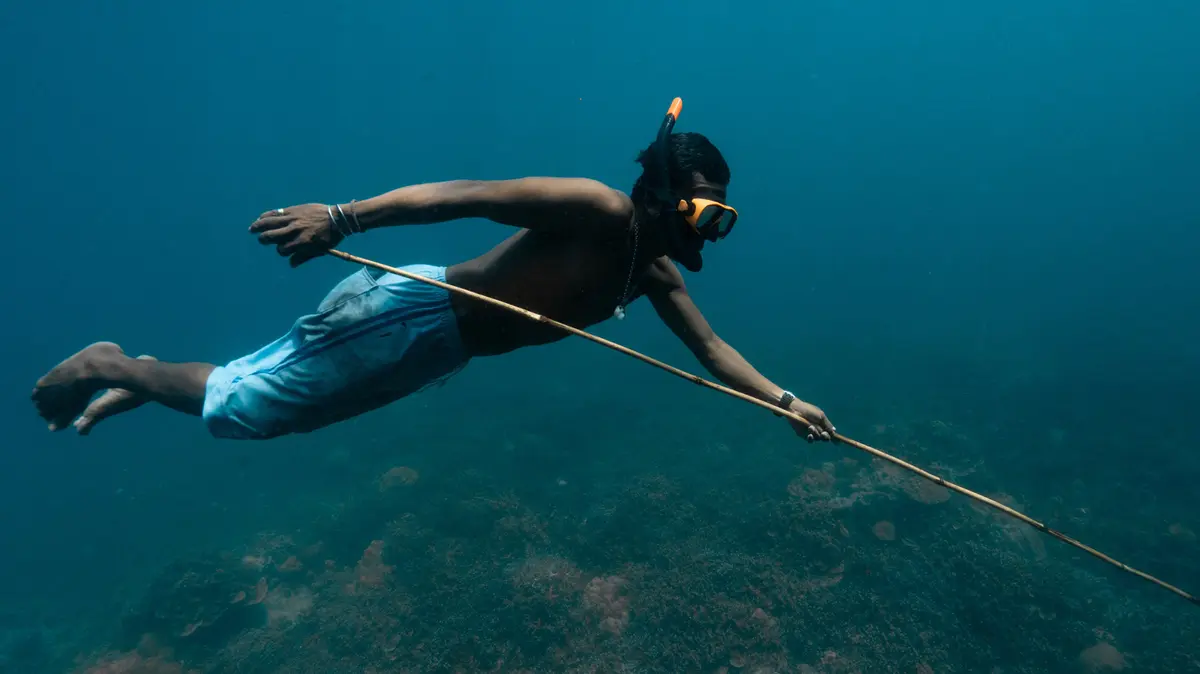
A 2026 report revived interest in the exceptional underwater vision of some Moken children.
The primary experiment appeared in Current Biology during 2003, not during 2026.
Those children resolved underwater patterns more than twice as finely as European children.
Later training evidence supports a learned human skill, not a new genetic superpower.
Background
The Moken are an Indigenous Austronesian-speaking maritime people of the Andaman Sea.
Communities historically moved among islands off southern Myanmar and western Thailand.
The Myeik, also called Mergui, Archipelago contains roughly 800 islands along Myanmar’s coast.
Traditional livelihoods include fishing, free-diving, shellfish gathering and detailed reef knowledge.
Their traditional wooden boats are called kabang, although many families now live ashore.
Why ordinary human vision blurs underwater
In air, the curved cornea provides most of the eye’s focusing power.
Water has a refractive index closer to the cornea than air does.
Submersion therefore removes much corneal refraction and shifts the image behind the retina.
Goggles restore an air layer, allowing the cornea to focus normally again.
The 2003 experiment
Researchers compared Moken children with European children using underwater pattern-resolution tests.
Moken children achieved 6.06 cycles per degree, compared with 2.95 for Europeans.
The Moken group constricted pupils to 1.96 millimetres, against 2.50 millimetres in Europeans.
They also accommodated strongly, changing the eye’s lens to compensate for underwater defocus.
A smaller pupil increases depth of field and reduces optical blur from unfocused rays.
What the later training study showed
A 2006 study trained European children underwater through eleven sessions during one month.
Four months later, their underwater acuity and pupil responses had improved substantially.
After eight months, outdoor testing found acuity comparable with the earlier Moken measurements.
The result supports learning and physiological control rather than a demonstrated inherited mutation.
However, the experiments involved children and cannot establish identical performance in every Moken person.
Traditional ecological knowledge
Moken oral narratives preserve knowledge about waves, winds, tides, reefs and seasonal movements.
During the 2004 Indian Ocean tsunami, many recognised receding water as a danger signal.
Communities used traditional knowledge to reach safer ground before destructive waves arrived.
This survival story complements, but cannot replace, modern regional early-warning systems.
Contemporary pressures
- Citizenship and documentation problems affect some families differently across national jurisdictions.
- Marine restrictions can limit customary access to fishing grounds and island resources.
- Commercial fishing, tourism and environmental change increasingly reshape traditional livelihoods.
- Schooling and settlement policies can interrupt intergenerational transmission of maritime knowledge.
Conclusion
The evidence illustrates human adaptability while highlighting the value of Indigenous maritime knowledge.