

Why in news?
A 43-year-old man died after falling into the Vishwamitri River near Talsat village on 22 August 2026. A mugger crocodile attacked him in the monsoon-swollen water, according to local reports. Residents recovered his body later that night. The incident occurred on Vadodara’s outskirts. It renewed attention to riverbank safety, monsoon awareness and coexistence with a large urban crocodile population.
The river’s course
The Vishwamitri rises near the Pavagadh hills in Gujarat’s Panchmahal district. It flows westwards through Vadodara and nearby rural areas. The river belongs to the wider Dhadhar drainage system. Its waters eventually reach the Gulf of Khambhat on the Arabian Sea.
Vadodara developed on the river’s banks and remains closely connected with it. The channel crosses densely settled and industrial areas. During the dry season, flow can shrink sharply. Monsoon rain can then raise levels quickly and spread water across low-lying ground.
The mugger crocodile
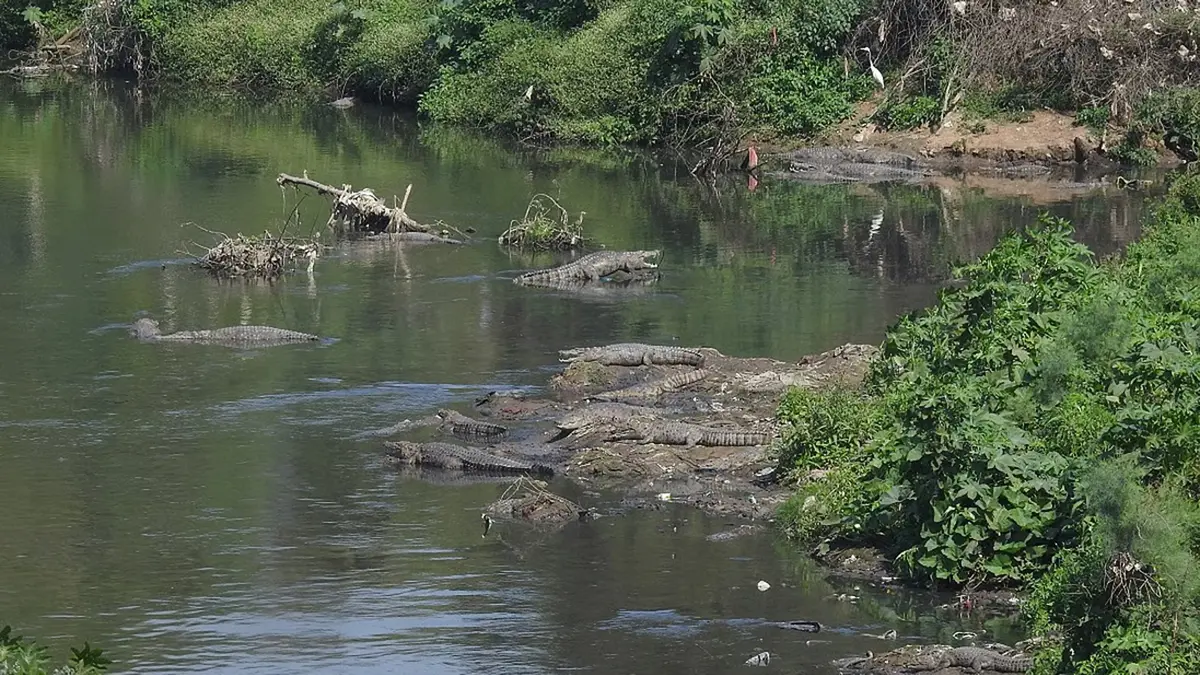
The river supports the mugger, or marsh crocodile. Its scientific name is Crocodylus palustris. The species uses rivers, lakes, reservoirs and marshes across South Asia. It has a broad snout and can rest in burrows during extreme weather.
The International Union for Conservation of Nature lists the mugger as Vulnerable. It also appears in Appendix I of the Convention on International Trade in Endangered Species. Indian law gives it strong protection. Habitat loss and conflict remain important threats across its range.
A remarkable urban population
Vadodara contains one of the best-known urban mugger populations. A February 2026 survey recorded an estimated 417 crocodiles along a city river stretch. Forest officials and university researchers conducted the count. Survey length and method must accompany any comparison with older totals.
Abundant crocodiles do not make every river section equally dangerous. Animals move with water levels, nesting needs and prey. Floods can carry them into drains, streets or ponds. Seasonal warnings should therefore cover both riverbanks and connected water bodies.
Why monsoon conditions increase risk
High water can hide steep banks and reduce visibility. Slippery mud raises the chance of an accidental fall. Strong currents make escape harder. Crocodiles also gain access to areas that remain dry during other months. Night-time movement adds further danger.
People may approach the river for washing, fishing, sanitation or livestock needs. Safety advice must recognise these daily realities. Warning signs alone cannot replace safe water and sanitation facilities. Fenced high-risk points and well-lit access routes can reduce exposure.
Pollution and altered habitat
The Vishwamitri receives sewage and urban runoff. Encroachment can narrow the floodplain and obstruct natural flow. Waste may attract animals that become crocodile prey. These pressures change how humans and wildlife use the same narrow corridor.
Flood-control work must consider crocodile habitat and river ecology. Removing vegetation everywhere can destroy refuge and move animals towards settlements. Unplanned channel modification may increase downstream risk. Engineers, ecologists and local residents need a shared river plan.
Managing conflict without harming wildlife
Forest teams can identify recurring conflict points and seasonal movement routes. Rapid-response groups need boats, lights and trained handlers. Crocodiles entering occupied premises may require capture and suitable relocation. Routine removal from natural habitat is neither practical nor ecologically sound.
Community reporting helps officials respond early. Residents need a simple number and clear advice. People should not surround or provoke a stranded animal. Compensation after death or injury should be prompt and accessible. Families should not face complex procedures during grief.
Safer riverfront planning
Public access should avoid known basking and nesting sites. Banks can use viewing barriers where people gather regularly. Drain outlets and flood channels need special assessment. Seasonal closures may be necessary when water reaches dangerous levels.
Long-term planning must restore sewage treatment and floodplain capacity. A cleaner river will not remove crocodiles, because they are native residents. It can still improve ecosystem health and reduce chaotic contact. Coexistence depends on safer human behaviour and a functioning river system.
Monsoon water changes the risk map
A familiar riverbank can become unsafe after heavy rain. High water hides edges and expands crocodile movement. Warnings and barriers should therefore change with the season.
Conclusion
The Talsat death is both a human tragedy and a warning about shared river space. Vadodara cannot remove risk through wildlife capture alone. It needs safer sanitation, guarded access and seasonal communication. River restoration and floodplain management must include crocodile ecology. Effective coexistence protects residents while conserving a legally protected native species.