

Why in news?
Recent scientific reviews have renewed concern about Myristica swamps in the Western Ghats. These rare freshwater forests survive in fragmented, waterlogged valleys. Researchers highlight pressures from drainage, land conversion and habitat disturbance. Their findings call for conservation that protects water movement, specialised plants and surrounding catchments together.
What makes a Myristica swamp different?
A Myristica swamp is a freshwater forest associated with persistently wet ground. Trees belonging to the nutmeg family, Myristicaceae, are prominent components. The name describes an ecosystem, not a single tree species. Its identity depends on vegetation, soil and water conditions acting together.
These swamps differ from coastal mangroves exposed to tides and saltwater. They occupy inland valleys and stream-linked depressions within the Western Ghats. Their water supply comes from the surrounding landscape. Drainage changes outside a patch can therefore alter conditions inside it.
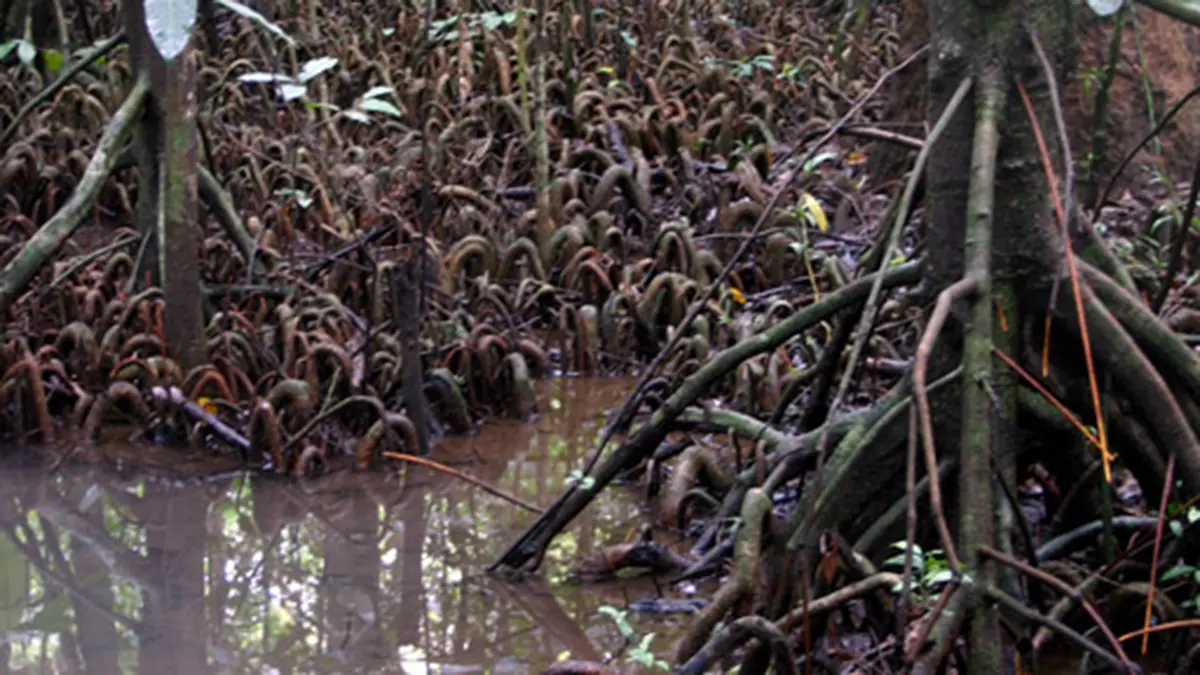
Waterlogged soils contain limited oxygen available to roots. Swamp trees possess specialised structures that help them survive these conditions. Depending on the species, these include raised roots and supporting stilt roots. Their unusual forms reflect adaptation rather than damage or disease.
Where the surviving patches occur
The Western Ghats run broadly along the western side of peninsular India. Their forests contain many streams and high-rainfall catchments. Myristica swamps occupy particular wet valley sites within this larger landscape. They should not be treated as continuous forest stretching across the entire mountain chain.
Kerala’s Forest Department identifies swamps around Kulathupuzha, Shendurney and Anchal in the southern Western Ghats. These places lie in the wider forested landscape of southern Kerala. Their valley setting helps retain freshwater. The surrounding slopes help sustain the water entering the swamp.
Research from the Indian Institute of Science documents additional swamps in Karnataka’s Uttara Kannada district. This shows that their conservation concerns extend beyond Kerala. Patches differ in size, disturbance and species composition. Management should be based on conditions at each site.
A specialised community of plants and animals
Recent literature discusses trees such as Myristica magnifica and Gymnacranthera farquhariana. Scientific names can vary between older and newer treatments. Researchers must reconcile such records when comparing studies. The ecological point remains the importance of trees adapted to wet forest conditions.
The habitat supports more than its dominant trees. Field surveys have recorded amphibians, reptiles, fishes, birds and invertebrates in swamp landscapes. Some species have restricted regional distributions. Small habitat patches can therefore carry conservation importance beyond their apparent area.
Dense vegetation and persistent moisture create conditions different from nearby cleared ground. Changes in shade and water availability can alter this environment. Species adapted to the swamp may not survive simply by moving elsewhere. Maintaining habitat quality is therefore as important as retaining its outline.
These forests also influence local water movement. Vegetation, soil and wet depressions can slow runoff and help maintain stream conditions. Their role depends on the catchment and season. Broad claims about flood prevention should not replace site-specific hydrological assessment.
How a swamp can disappear without complete tree clearance
Draining the ground can remove the conditions needed by swamp specialists. A patch may remain visibly wooded while its ecological character changes. Seedlings may fail to establish as moisture conditions shift. The eventual loss can therefore begin before the mature trees disappear.
Indian Institute of Science fieldwork identified water diversion as a major threat in Uttara Kannada. Agriculture and other land uses can redirect streams or alter drainage. Tree cutting adds another source of disturbance. These pressures can reinforce one another within a small catchment.
Fragmentation also separates patches from surrounding forest. Edges may become more exposed to heat, disturbance and invasive vegetation. Restoration must therefore consider the buffer around the wetland. Protecting only a few conspicuous trees cannot restore the full system.
What effective conservation would involve
First, surviving patches need accurate mapping and field verification. Surveys should document vegetation, drainage and seasonal water levels. Repeated observations can reveal changes that a single visit misses. Local knowledge can help locate less visible or poorly documented sites.
Second, management should protect water entering and moving through the swamp. Proposed roads, drainage works and land conversion need careful assessment. Restoration should address the cause of drying before planting begins. Trees planted into unsuitable conditions may not recreate a functioning swamp.
Third, conservation should involve nearby communities and relevant land-management agencies. People depend on the same streams and surrounding land. Clear agreements can support water protection and reduce damaging activities. Scientific recognition is most useful when translated into practical, locally supported measures.
Conclusion
Myristica swamps are specialised freshwater forests sustained by a delicate relationship between vegetation and water. Their decline cannot be measured through tree cover alone. Protecting catchments, drainage and habitat connections is essential. Research should guide restoration and help communities safeguard local water systems. Conserving these small patches can preserve ecological value far greater than their size suggests.