

Why in news?
A September research paper offers a possible explanation for how an amoeba's ordinary feeding-related behaviour could help a dangerous relative reach the brain. Researchers studied Naegleria gruberi, which is not known to cause human disease, rather than its pathogenic relative Naegleria fowleri. Experiments used artificial spaces with different shapes and degrees of confinement. The cells tended to enter narrow channels and then move persistently along them. The work suggests that behaviours useful for finding bacteria in pond sediments might also assist movement through confined passages during infection. It does not directly demonstrate the entire infection process in humans. The finding links cell movement and environmental adaptation to a rare but devastating disease.
A free-living organism, not a routine human parasite
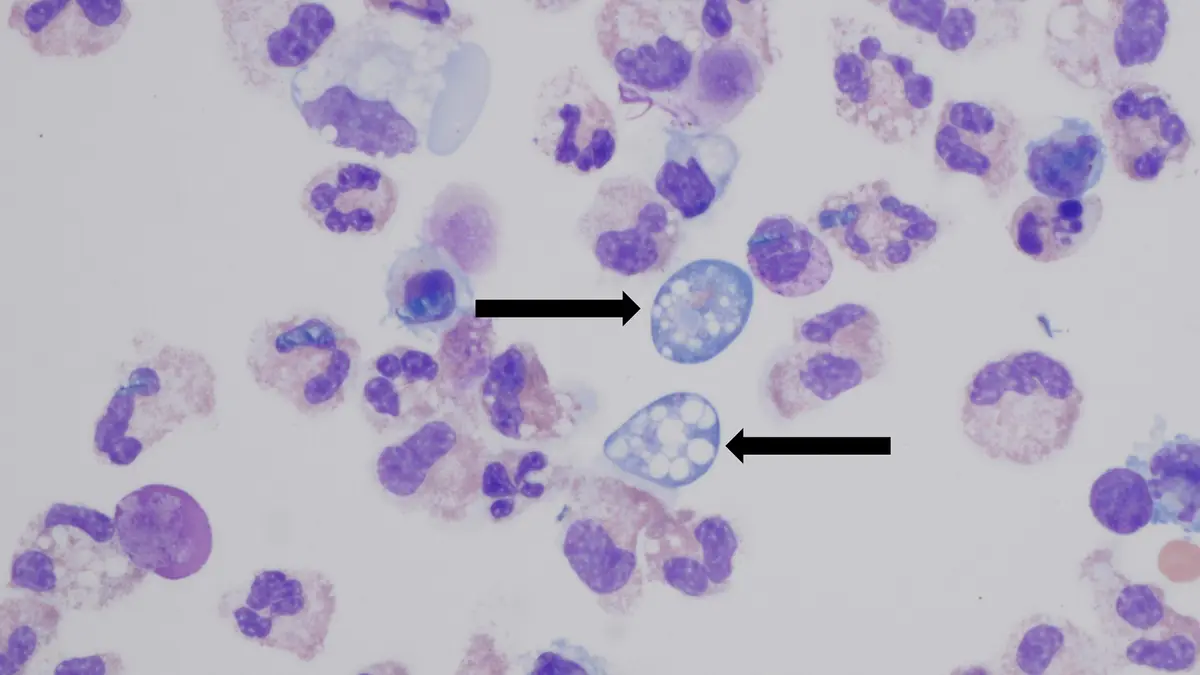
Naegleria fowleri is a microscopic, single-celled amoeba found in warm freshwater environments and soil. In its usual surroundings it feeds on bacteria. Human infection is an exceptional event, not a necessary stage of its normal life cycle. The familiar label “brain-eating amoeba” refers to the severe tissue damage it can cause after reaching the brain. It should not suggest that the organism normally seeks human beings as its food source.
The disease is called primary amoebic meningoencephalitis (PAM). The name refers to infection and inflammation involving the brain and its protective membranes. It is rare, progresses rapidly and is usually fatal. Its rarity does not reduce the seriousness of a suspected case, but severity should not be confused with how commonly infection occurs. Both features are necessary to understand the public-health risk accurately.
The route from water to the nervous system
Infection occurs when water containing the organism enters the nose. The amoeba can then travel towards the brain along structures associated with the sense of smell. Olfactory nerve fibres pass through small openings in a thin bone called the cribriform plate, between the nasal region and the skull cavity. This presents a physical problem for the moving cell: it must navigate spaces very different from an open laboratory surface.
Drinking contaminated water does not cause this form of infection, and it does not spread from one person to another. Most recognised exposures involve warm freshwater entering the nose during swimming or similar activities. Contaminated water used for nasal rinsing is another recognised route. These distinctions matter because prevention must address the actual entry pathway, rather than treating every contact with freshwater as equivalent.
What the experiments actually examined
The paper appeared online on 10 September in the Proceedings of the National Academy of Sciences. The team used the non-pathogenic species N. gruberi as a model for studying movement. The researchers compared its behaviour on surfaces, in narrow channels and within granular materials resembling pond sediments. A model allows a specific biological mechanism to be studied, but it is not identical to investigating the pathogenic species inside a person.
The cells could move using broad, actin-supported extensions and rounded membrane bulges called blebs. Actin is a protein that helps form the cell's internal supporting framework. In narrow channels, the amoebae relied on bleb-based movement and travelled persistently in one direction. They also showed a tendency to probe and enter confined spaces. The finding concerns how geometry changes movement, rather than simply whether a cell can move at all.
The authors propose that these behaviours are adaptations to life among sediment particles, where bacteria provide food. Retaining direction during exploration could help a cell search efficiently, while entering small gaps could provide access to prey. In a human infection, similar behaviour might assist movement along narrow spaces near olfactory nerve fibres. This is a proposed connection between an environmental way of life and disease, not proof that evolution specifically equipped the amoeba to infect people.
What this changes—and what it does not
The study gives researchers a clearer mechanical question to investigate: which movements allow cells to enter and cross confined spaces? That can guide further work on the pathogenic species and on conditions that resemble living tissue more closely. It does not establish a new diagnostic test, demonstrate an effective medicine or measure infection risk in a particular lake. Those questions require different kinds of evidence and, where relevant, clinical investigation.
Existing health precautions remain important. The United States Centers for Disease Control and Prevention recommends reducing the entry of warm freshwater into the nose. For nasal rinsing, the agency advises using distilled, sterile, or appropriately boiled and cooled water. Proper treatment and maintenance of recreational water facilities also matter. These measures address exposure; they should not be confused with a treatment for an infection that has already developed.
Sudden headache, fever, vomiting or neck stiffness requires prompt medical assessment, especially after relevant freshwater exposure. Early symptoms overlap with other illnesses, so a news article cannot diagnose the cause. Medicines are used in treatment and a small number of patients have survived, although outcomes remain very poor. Describing PAM as invariably untreatable would therefore be inaccurate, just as claiming that this movement study has produced a cure would be inaccurate.
Conclusion
The research offers a plausible link between movement in pond sediments and the ability to navigate the body's narrow passages. Its contribution is a testable biological explanation, not a completed account of human infection. Further work must establish how far the model's behaviour applies to N. fowleri in living tissue. Meanwhile, public understanding is best served by precise exposure information, proportionate prevention and urgent assessment of compatible symptoms.