

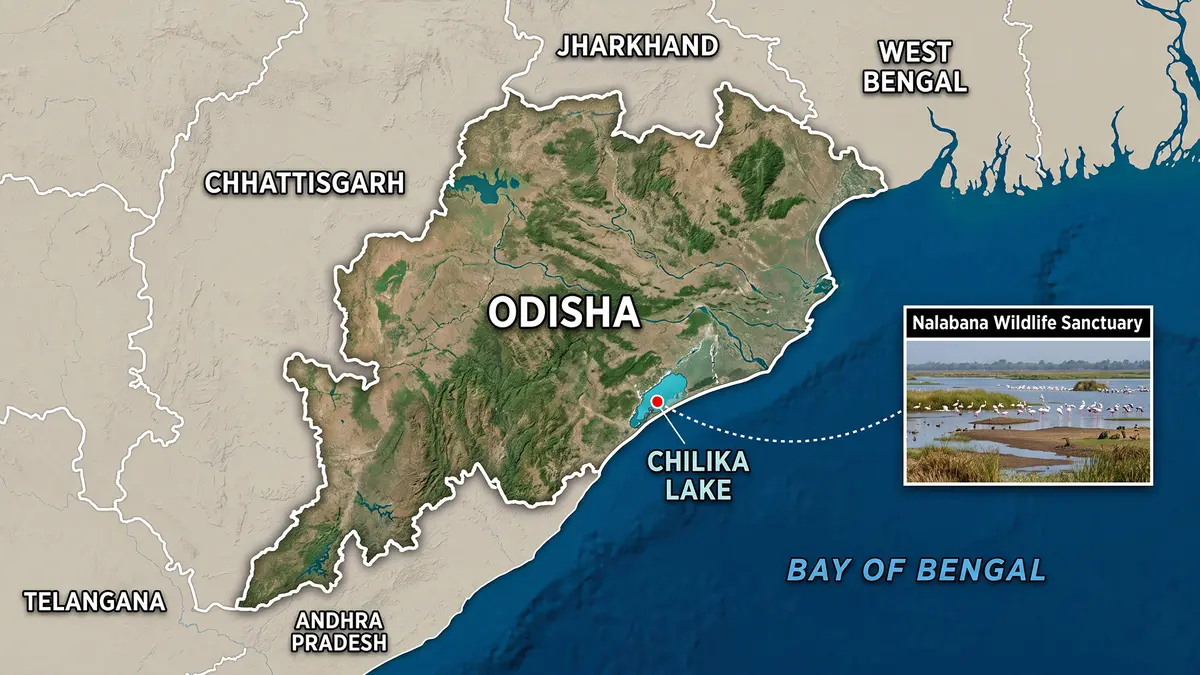
Why in news?
Forest officials arrested 24 people for fishing inside Nalabana sanctuary. Patrol teams also seized three boats, nets and 23 kilograms of fish. Fishing within the protected island sanctuary is prohibited. The incident highlighted conservation rules inside Chilika Lake.
Background
Nalabana Wildlife Sanctuary is a protected bird island within Odisha’s Chilika Lake.
Official records also use Nalbana, and the notified sanctuary covers about 15.5 square kilometres.
Odisha declared it a bird sanctuary on 17 December 1987.
Why is Nalabana a seasonal island?
Monsoon water submerges much of the low island, while falling levels expose mudflats and shallow pools.
These feeding areas attract winter birds, making the island appear and disappear across seasons.
What is Chilika Lake?
Chilika is a vast brackish lagoon, meaning shallow coastal water partly separated from the open sea.
Brackish water contains more salt than freshwater, but less than seawater.
Chilika receives river water and remains connected with the Bay of Bengal.
Hydrology in simple terms
- Rivers bring freshwater, sediment and nutrients, while a sea mouth exchanges water with the Bay of Bengal.
- Wind, tides and rainfall change water movement and salinity, creating several connected habitats.
The Daya and Bhargavi systems provide freshwater, while the shifting sea connection needs careful management.
Protection timeline
| Year | Development |
|---|---|
| 1981 | Chilika received designation under the Ramsar Convention. |
| 1987 | Nalabana received notification as a protected bird sanctuary. |
| 1993 | Chilika entered the Montreux Record after ecological deterioration. |
| 2000 | Managers opened a new sea mouth to improve water exchange. |
| 2002 | Successful restoration enabled removal from the Montreux Record. |
Ramsar facts requiring care
The Ramsar Convention protects internationally important wetlands through designation, cooperation and careful management.
Chilika and Keoladeo were India’s first two Ramsar sites, designated together on 1 October 1981.
The Montreux Record identifies listed wetlands undergoing serious change, while removal recognises ecological improvement.
Chilika became the first Asian Ramsar site removed from this record after restoration.
Why is Chilika exceptional?
- Official state sources describe it as Asia’s largest brackish-water lagoon.
- Its salinity gradient supports winter migrants arriving from distant parts of Eurasia.
- Irrawaddy dolphins inhabit outer channels, while fish and shellfish support many local families.
Important birds around Nalabana
- Flamingos use shallow feeding areas, while ducks, geese and coots gather across open waters.
- Waders search exposed mud for small animals, while raptors follow seasonal bird gatherings.
Exact species counts vary with rainfall, salinity, food and survey timing.
Why is fishing prohibited inside the sanctuary?
Boats and nets disturb birds, while fishing may remove food from sensitive sanctuary habitats.
Repeated movement can displace feeding groups, so lawful fishing elsewhere does not permit Nalabana entry.
What happened during the enforcement action?
- Patrol teams found fishermen in prohibited sanctuary waters and arrested 24 people from nearby villages.
- They seized three mechanised boats, engines, fishing nets and about 23 kilograms of fish.
- Authorities began action under applicable wildlife protection law.
Conservation and livelihoods must work together
Chilika supports biodiversity and fishing livelihoods, while clear boundaries protect sensitive sites without closing everything.
Community participation, alternative income and fair enforcement can improve compliance while supplying valuable local knowledge.
Continuing threats
- Silt blocks channels, while invasive plants can change open-water and wetland habitats.
- Pollution enters from settlements, while unregulated tourism can disturb dolphins and bird gatherings.
- Illegal aquaculture changes access, while climate change may alter rainfall, salinity and sea exchange.
Conclusion
Nalabana’s changing mudflats require strong protection and sensitive livelihood management.