

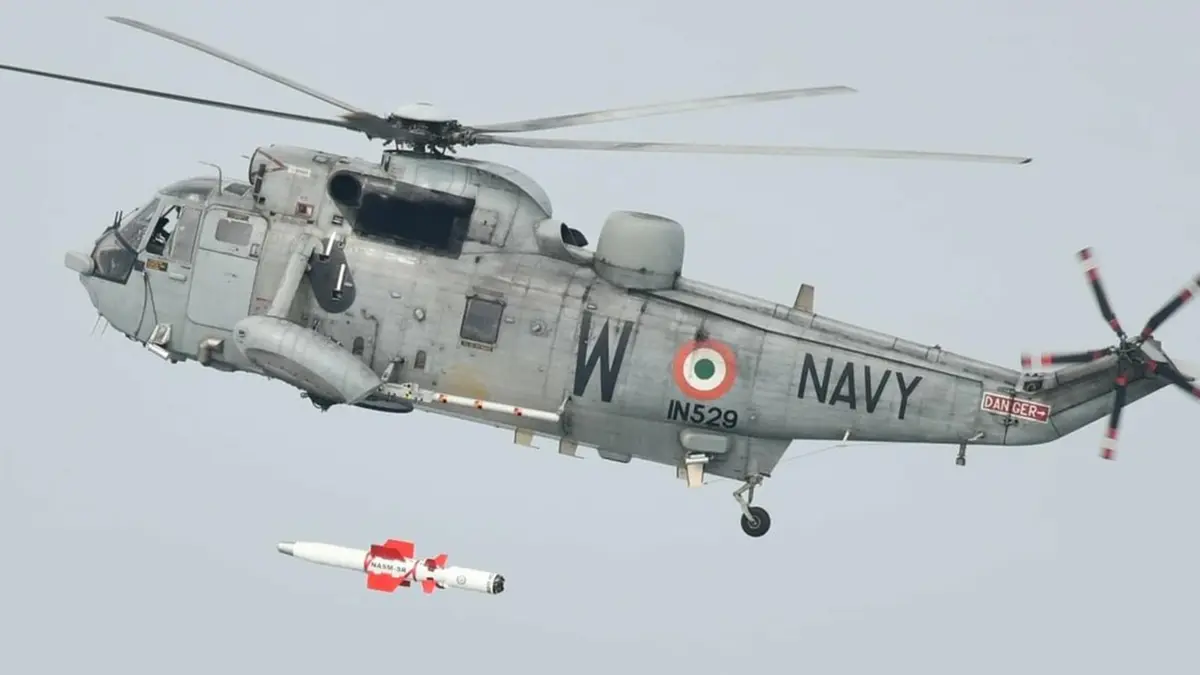
Why in news?
The Defence Research and Development Organisation (DRDO) and the Indian Navy carried out the first salvo launch of the Naval Anti‑Ship Missile – Short Range (NASM‑SR) from a naval helicopter over the Bay of Bengal. The test demonstrated India’s capability to fire multiple missiles in quick succession at hostile ships.
Background
NASM‑SR is an air‑launched anti‑ship missile being developed indigenously for naval helicopters and aircraft. It uses solid rocket motors to accelerate and a long‑burn sustainer engine to maintain speed over a short range. Research Centre Imarat (Hyderabad) is the lead laboratory, working with other DRDO units and Indian industries.
Features
- Guidance and navigation: The missile carries an advanced seeker, a fibre‑optic gyroscope‑based inertial navigation system and a radio altimeter to maintain low‑altitude flight. A high‑bandwidth two‑way data link allows mid‑course corrections from the launch platform.
- Warhead and flight profile: It follows a sea‑skimming trajectory, flying just above the water surface to evade radar detection. The warhead is designed to strike near the target’s waterline, maximising damage.
- Indigenous content: Most subsystems are made in India, including propulsion, avionics and jet‑vane control for manoeuvring. The system is produced by a consortium of DRDO laboratories and private industry.
Significance
- Force multiplier: The ability to fire multiple missiles quickly gives naval helicopters a potent anti‑ship capability, deterring enemy surface vessels.
- Self‑reliance: Developing the missile domestically reduces dependence on imported weapons and strengthens the indigenous defence industry.
- Operational testing: Successful trials pave the way for integration with various naval platforms, enhancing fleet readiness.
Source: Press Information Bureau