

Why in news?
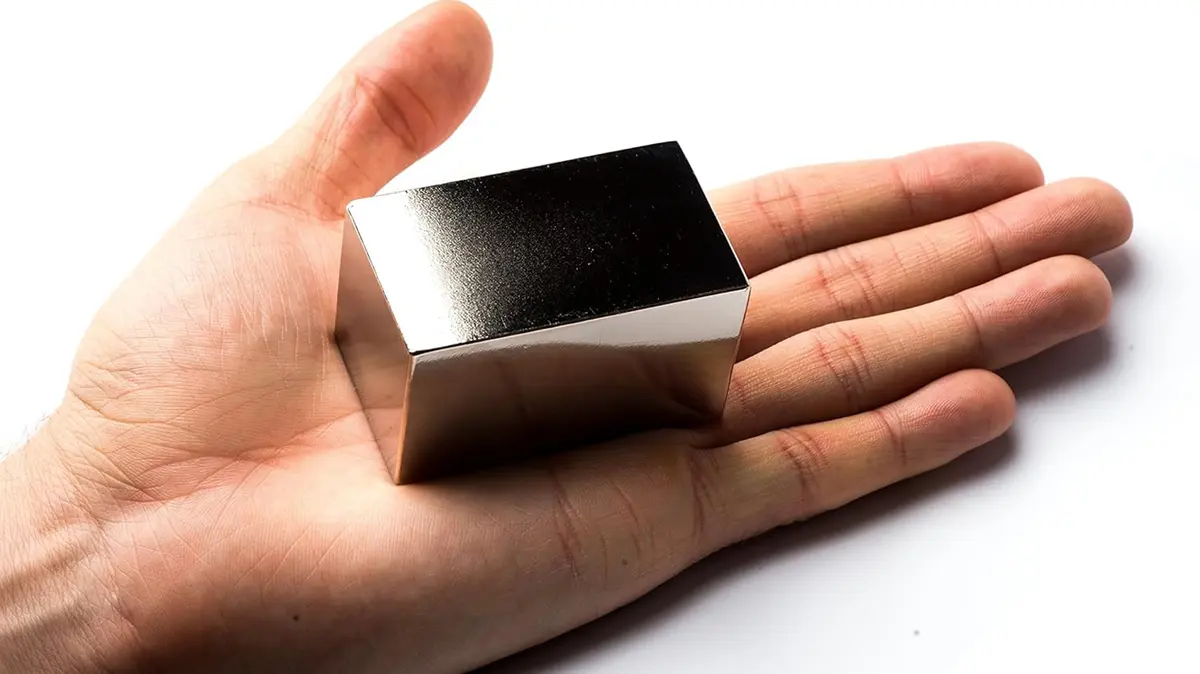
A policy analysis in The Hindu on 21 September questioned how well India measures its permanent-magnet industrial capabilities. The authors argued for mapping the whole production chain, rather than judging readiness from mineral resources alone. Neodymium–iron–boron magnets, commonly written as NdFeB magnets, produce strong magnetic fields in compact components. They are used in many electric motors, generators and electronic devices. India has already approved support for integrated rare-earth magnet manufacturing, but possessing minerals does not establish every required processing capability. The analysis draws attention to these intermediate stages. Its proposed mapping framework is an analytical recommendation, not a newly notified government scheme or evidence that planned factories are already operating.
What a permanent magnet actually contributes
A permanent magnet maintains a magnetic field without a continuous electric current being supplied to create that field. An electric motor can use it alongside coils carrying current. The interaction produces mechanical turning force. A generator works through the corresponding relationship between motion and electricity. The magnet itself is not an energy source. A motor still needs electrical power, while a generator needs mechanical input from something such as a turbine.
NdFeB identifies the principal elements: neodymium, iron and boron. An important magnetic crystal phase has the formula Nd2Fe14B. The numbers describe the atoms in that compound, not the mass percentage of each element in every commercial magnet. Actual products also depend on small additions, the arrangement of microscopic grains and surface treatment. Manufacturing quality can therefore change performance even when products carry the same broad material name.
Why strength alone is not enough
These materials allow powerful magnets to fit into small spaces, helping designers reduce the size of certain motors and actuators. However, a useful magnet must also resist losing its magnetisation during service. Coercivity describes resistance to demagnetisation by an opposing magnetic field. Heat is another important operating constraint. A component that performs well at room temperature may become unsuitable inside a hot motor. The magnet grade and motor design must account for that environment.
Some grades use dysprosium or other additions to improve performance under demanding conditions. Manufacturers have also developed ways to place such material where it contributes most, reducing the quantity required. This illustrates why supply security is partly a materials-engineering problem. It cannot be solved only by obtaining more ore. Corrosion protection, dimensional accuracy and repeatable magnetic properties also matter when a magnet must function reliably for years.
From a mineral deposit to a finished component
The production chain begins with mineral extraction and concentration, but it does not end there. Rare-earth elements must be separated and processed into suitable compounds. Oxides are converted to metals, metals become alloys, and the alloy is manufactured into magnets. A motor producer then has to qualify those magnets for a particular application. These stages require different equipment, chemical processes, skills and quality controls. Having strength at one stage does not remove a weakness at another.
In a common sintered-magnet route, alloy powder is aligned, pressed and heated so that the particles join into a solid body. Control over oxygen, particle size and grain structure affects the result. Finishing and protective treatment follow before the component reaches its user. This is why a mine's output, a separation plant's output and a magnet factory's output are not interchangeable measures of capacity. They refer to different products at different points in the chain.
What India has approved
On 26 November 2025, the Union Cabinet approved a ₹7,280-crore scheme for manufacturing sintered rare-earth permanent magnets. Its stated objective is 6,000 tonnes of integrated annual manufacturing capacity. The approved design covers conversion from rare-earth oxides through metals and alloys to finished magnets. The outlay includes capital support and sales-linked incentives. These are the scheme's approved provisions and objectives; they do not establish that the entire capacity had been commissioned by this edition's date.
The policy analysis raises a related measurement problem. If industrial categories combine unlike products, a broad output number may conceal a missing specialised capability. Its authors recommend linking technical requirements with costs, capacity and demand across successive stages. For example, a downstream producer may have customers but lack a dependable source of qualified alloy. Mapping that relationship would identify a different intervention from simply subsidising additional extraction. This is the reasoning behind their proposed framework.
Reducing dependence has several routes
Recycling can recover valuable rare-earth materials from discarded equipment, but collection, separation and product quality remain practical challenges. Research also explores using less rare-earth material or designing motors without permanent magnets. These are not equivalent replacements for every application. A change in motor design can affect efficiency, weight, control systems and cost. The useful comparison is the performance of the whole machine, rather than the price of one material considered in isolation.
Conclusion
A resilient magnet industry requires a functioning chain from processed material to a component accepted by manufacturers. India's approved scheme addresses important parts of that chain, while the new analysis asks how its gaps should be measured. Progress should be judged through qualified production, reliable inputs and actual customer use. Mineral availability and announced capacity are starting conditions, not substitutes for those outcomes.