

Why in news?
New Zealand’s Parliament passed legislation implementing its trade agreement with India by 93 votes to 29, Reuters reported on 16 September. The agreement, signed on 27 April 2026, is intended to lower trade barriers and expand commercial ties. A free trade agreement sets preferential conditions between participating economies; it does not automatically remove every border rule or tariff. The parliamentary vote advances New Zealand’s domestic implementation process. It is not, by itself, proof that the agreement has entered into force. The distinction matters because some tariff benefits begin only on that later date, while others are phased in. Businesses must therefore distinguish the completed vote from the timetable under which particular goods will receive preferential treatment.
Locating an island economy in the Pacific
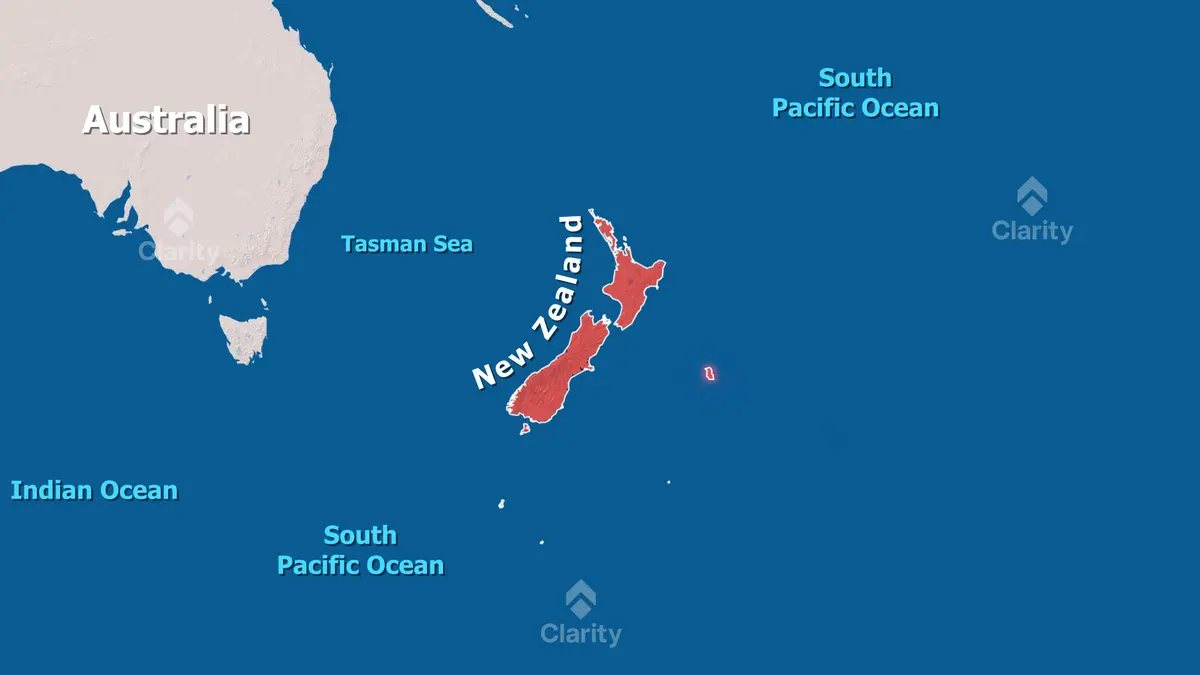
New Zealand is an archipelago in the southwestern Pacific Ocean, southeast of Australia. It has no land-border neighbours; the Tasman Sea separates it from Australia. Its principal landmasses are the North Island and South Island, with smaller islands including Stewart Island farther south. Its geographical separation makes maritime and air connections fundamental to international trade.
Cook Strait lies between the North and South Islands, linking the Tasman Sea side with the Pacific. The South Island is dominated by the Southern Alps. The Department of Conservation gives Aoraki/Mount Cook’s height as 3,724 metres, making it the country’s highest mountain. The North Island includes major volcanic landscapes, reflecting the country’s position along an active tectonic boundary.
Mountains also influence rainfall. Prevailing westerly winds bring moist air towards the Southern Alps, producing wetter conditions on western slopes and drier conditions farther east. The national Te Ara encyclopaedia describes the surrounding ocean’s moderating effect on temperature. These physical differences help explain why the country contains varied farming and natural environments within a relatively narrow island chain.
From negotiations to an operating agreement
New Zealand’s Foreign Affairs and Trade Ministry records the launch of negotiations in March 2025 and their conclusion in December. Signing followed in April 2026. Signature establishes the agreed text, while each country must complete the steps needed to implement it. The September parliamentary vote belongs to that implementation process rather than reopening the negotiations.
Reuters reported that the New Zealand government expected entry into force later in 2026. That expectation is not an effective date already reached. Until the necessary requirements are completed and the agreement begins operating, traders cannot assume every promised preference is available. The relevant date must be checked against the agreement’s formal implementation announcements.
What the tariff percentages actually measure
The Ministry’s published outcomes say tariffs will be eliminated immediately on 57 per cent of New Zealand’s current exports to India. Eventual elimination covers 82 per cent, with reductions covering a further 13 per cent. Together, those two categories account for 95 per cent. These shares describe trade coverage, not a promise to cut every product’s tax by 95 per cent.
The timing and treatment differ by product. Some exports receive immediate elimination, others phased reductions, while certain agricultural products receive quota-based arrangements. A tariff quota generally gives a stated quantity preferential treatment, with different treatment outside it. It is therefore different from unlimited duty-free access for every shipment.
On New Zealand’s side, the agreement provides duty-free access for qualifying Indian-origin goods when it enters into force. The word “qualifying” matters. Rules of origin determine whether a product genuinely meets the agreement’s requirements rather than merely being shipped through one partner. Firms need documentation showing that their goods satisfy those rules.
Market access still has limits
New Zealand’s official summary identifies gains for sectors including forestry and selected agricultural exports, but significant dairy interests remain outside broad tariff liberalisation. A trade agreement can create opportunities while leaving sensitive sectors protected. Its effects must therefore be assessed product by product, rather than inferred from a headline about the two economies.
Lower tariffs also do not remove biosecurity and food-safety requirements. Goods may still need to satisfy inspection, certification and other legitimate entry conditions. For an agricultural shipment, a reduced customs duty is only one part of reaching a customer. Product approval, transport costs and compliance can still determine whether the opportunity is commercially useful.
Investment ambitions are not a government payment
The agreement aims to promote private-sector investment from New Zealand into India. Its stated ambition is an increase of 20 billion United States dollars over 15 years. This is not an announcement that New Zealand’s government will transfer that amount from its budget. Private investment depends on firms finding viable projects and committing funds. The distinction separates a policy ambition from money already invested or guaranteed.
Conclusion
The parliamentary vote brings the India–New Zealand agreement closer to operation, but entry into force remains the next decisive stage. Once effective, benefits will depend on product-specific schedules, origin rules and other entry conditions. The agreement’s value should ultimately be judged through actual access, trade and investment, rather than treating its broad percentages as immediate results.