

Why in news?
Denmark's Greensand Future project inaugurated its carbon-storage facilities on 18 September 2026, bringing the North Sea into focus. The project links carbon dioxide handling at Esbjerg with storage in the depleted Nini West oil reservoir offshore. It is intended to receive captured carbon dioxide, transport it by ship and inject it into suitable geological formations. The European Climate, Infrastructure and Environment Executive Agency announced the inauguration and its support for the project. Promoters describe it as a commercial milestone, but this is not the first carbon-storage activity anywhere in the North Sea. The important development is a new transport-and-storage chain, whose operating performance will need to be measured over time.
A shallow sea connecting several European coasts
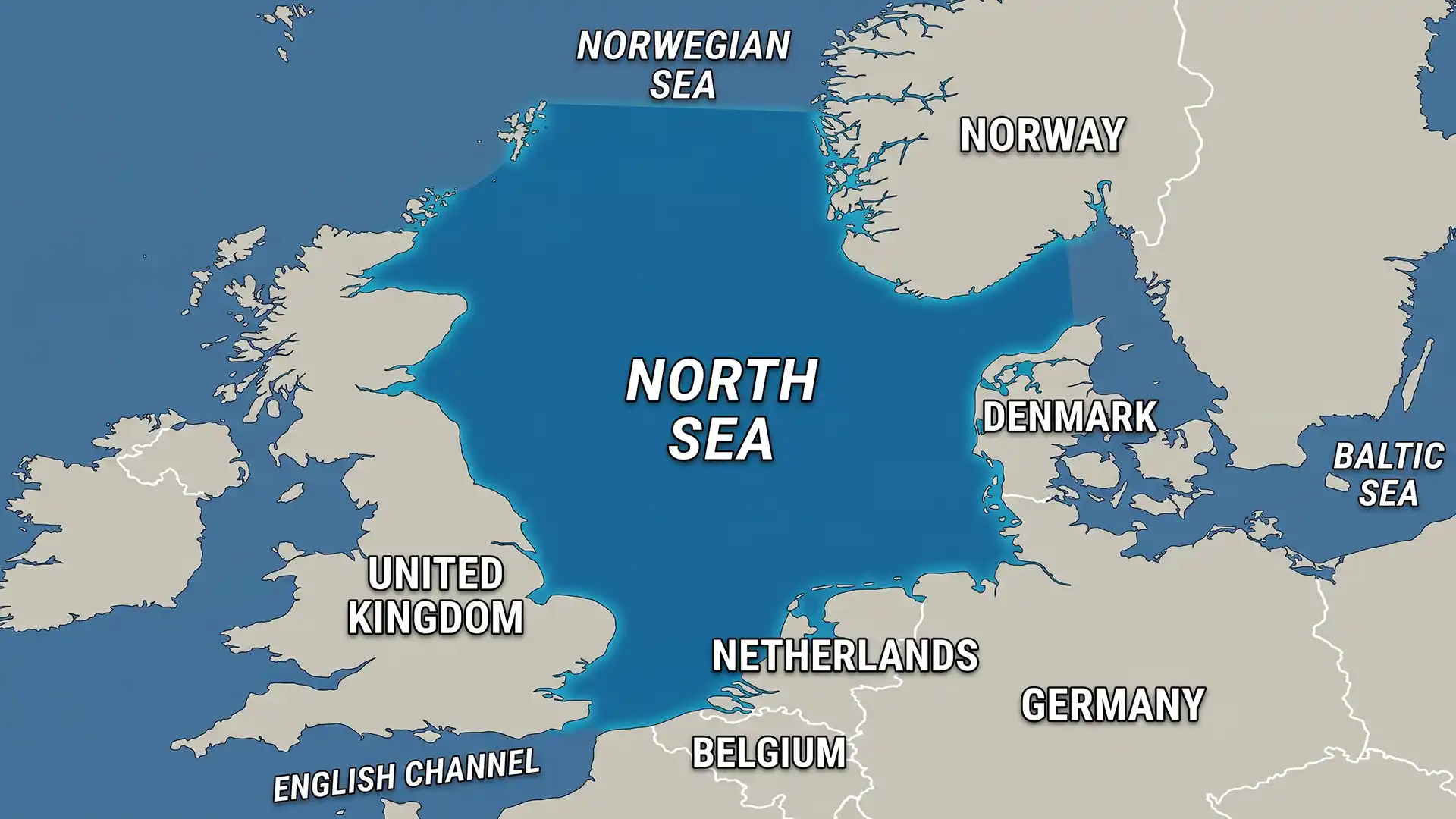
The North Sea occupies part of the continental shelf off north-western Europe. Great Britain lies to its west, Norway to the north-east and Denmark to the east. Germany, the Netherlands and Belgium border its southern and south-eastern waters. France meets its south-western approaches. Atlantic connections lie to the north and through the English Channel to the south-west. These routes make it both a regional sea and a major transport space.
Its eastern connections lead through the Skagerrak and Kattegat towards the Baltic. Sweden borders these connecting waters. The regional marine convention's Greater North Sea includes them, so country lists can differ depending on the boundary being used. Naming that distinction is more useful than treating every map as though it shows precisely the same sea area.
The North Sea supports shipping, fisheries, offshore energy and coastal economies within a comparatively confined space. Carbon-storage infrastructure must therefore coexist with other uses. A depleted petroleum field is not simply vacant space available without assessment. Its geology, old wells, surrounding environment and connections to shore all affect whether it can become a suitable storage site.
How the Greensand chain is intended to work
Carbon capture and storage (CCS) separates carbon dioxide from a source and places it in long-term geological storage. In this project, carbon dioxide is collected and prepared for transport, including liquefaction. Facilities at Esbjerg provide a shore-side link before a dedicated vessel carries the cargo offshore. Injection then places it into the Nini West formation, roughly 1.8 kilometres beneath the sea.
This is different from releasing carbon dioxide into open seawater. The intended destination is a porous rock formation beneath the seabed, covered by layers that restrict upward movement. Porosity provides small spaces within the rock; permeability describes how fluids can move through connected spaces. A suitable store needs both capacity to receive the carbon dioxide and geological barriers that can retain it.
The European agency describes a programme expected to store 2.4 million tonnes over eight years with its support. That is a multi-year project figure, not an annual injection rate. The operator separately describes initial capacity of up to 400,000 tonnes a year and ambitions for later expansion. Capacity, planned throughput and the quantity actually stored are different measures. None should be substituted for verified operating results.
A new commercial step within a longer history
Greensand builds on earlier testing, including a cross-border demonstration in 2023. Its latest inauguration is an important step towards a more regular service for customers. However, broad promotional claims about being “first” require careful boundaries. The operator's claim concerns a particular European Union commercial configuration and scale. It should not erase earlier offshore storage projects or imply that geological carbon storage began in September 2026.
The Danish Energy Agency notes that Norway's Sleipner project has stored carbon dioxide since 1996. That earlier experience helps place the new project in context. Greensand's distinctive contribution concerns its own reservoir, transport arrangements and intended customers. Commercial chains can differ in where carbon dioxide is captured, whether it crosses borders and how it reaches the storage site. Those differences matter more than an unqualified record claim.
What determines whether storage helps the climate
Captured carbon dioxide is not automatically equivalent to an equal quantity of net emissions avoided. Capture, liquefaction and transport use energy. The original source of the carbon and any leakage also affect the overall result. Carbon dioxide from a fossil process and carbon dioxide of biological origin have different accounting implications. Claims of negative emissions require a complete assessment, rather than the simple observation that a vessel delivered a cargo.
Long-term performance also depends on site selection and monitoring. Geological surveys help identify the reservoir and sealing layers. Operators must assess pressure changes and potential pathways through old wells or faults. Monitoring is intended to test whether the stored material behaves as expected and whether corrective action is needed. Reusing an oilfield can provide valuable geological knowledge, but it does not remove the need for these safeguards.
Conclusion
Greensand Future illustrates how the North Sea's energy infrastructure and geology are being adapted for carbon management. The inauguration establishes a new project milestone, while the climate value depends on actual storage, reliable containment and full-chain accounting. Its progress should be measured against those outcomes. Clear geographical and technical boundaries allow the achievement to be recognised without confusing planned capacity with delivered climate benefits.