

Why in news?
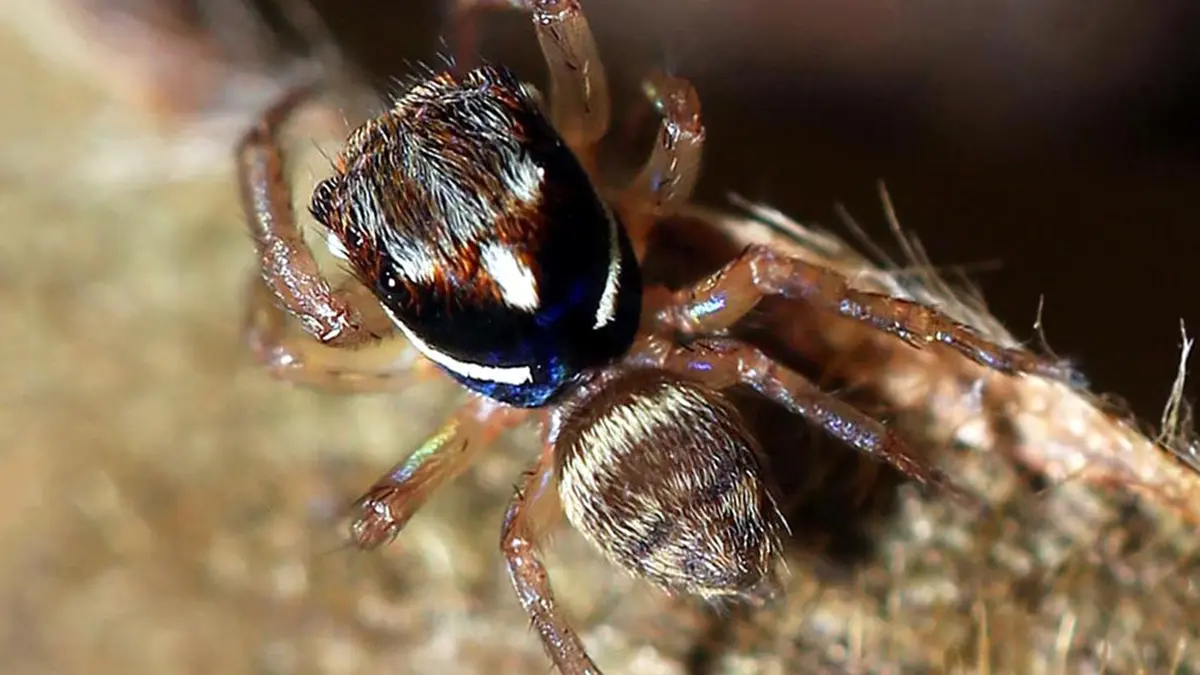
Researchers described three new species of Onomastus jumping spiders from India and Sri Lanka. Two came from Kerala’s Western Ghats, while one came from Sri Lanka. The team also redescribed a species unseen for over a century. The findings show how isolated mountain forests create distinct evolutionary lineages.
Background
Jumping spiders belong to the family Salticidae. It is the world’s largest spider family by the number of described species.
These spiders have large forward-facing eyes and excellent vision. They stalk prey and jump instead of trapping it in a capture web.
Silk still remains important for them, and they use it for safety lines, shelters, eggs and protected resting places.
The genus Onomastus was established by Eugène Simon in 1900, and its members live mainly in humid Asian forests.
Why is Onomastus scientifically important?
The genus represents an early branch within jumping-spider evolution, and researchers describe this position as basal.
Terminology caution: “Basal” means an early-diverging branch, and it does not mean primitive, inferior or unchanged.
These spiders are small and delicate, with relatively long legs and a translucent appearance unlike many familiar jumping spiders.
Most species have narrow geographic ranges, and such restricted distribution makes mountain forests especially important for their survival.
Which three species were described?
- Onomastus brahmagiri: Researchers found it in the Brahmagiri Hills of Wayanad, Kerala.
- Onomastus silentvalley: It came from shola forests inside Silent Valley National Park.
- Onomastus wijesinghei: The team recorded it in Sri Lanka’s montane forests.
The first two names refer to their Indian localities. The third honours a researcher associated with Sri Lankan spider studies.
Athira Jose, A.V. Sudhikumar and S.P. Benjamin conducted the research. Their paper appeared in the journal Zootaxa on 30 June 2026.
Which older species was found again?
Researchers studied Onomastus patellaris from Pampadum Shola National Park after confirmed material remained unavailable for more than a century.
Fresh specimens allowed a modern redescription, and clear diagnostic features help later researchers identify the species correctly.
A rediscovered species is not new to science because it already has a name but lacked recent confirmed records.
How do scientists recognise a new spider species?
Colour alone is usually insufficient because age, sex and preservation can change appearance, and taxonomists therefore examine several stable structures.
- They record body proportions, eye arrangement, hairs and leg structures.
- They closely compare reproductive organs, which often provide reliable differences.
- They study museum specimens and earlier scientific descriptions.
- They compare each candidate with every similar known species.
- They deposit reference specimens in recognised scientific collections.
- They publish a name, locality and features separating it from relatives.
A taxon is a named biological group, while taxa is its plural. The study compared 36 features across 25 taxa.
The results supported one common ancestral branch containing all Onomastus species, and biologists call such a group monophyletic.
They also found separate South Asian and Southeast Asian branches, and Indian species formed their own closely related group.
What are shola forests and sky islands?
Sholas are evergreen forest patches among high-elevation grasslands in southern India. Cool and moist conditions support specialised plants and animals.
Warmer valleys separate one mountain habitat from another. Each cool summit then behaves like an ecological island in the sky.
Small forest species may struggle to cross hot, dry lowlands, and isolated populations gradually develop unique traits through evolution.
This process can produce several closely related species across neighbouring mountains, and it also creates very small geographic ranges.
Why are the Western Ghats important?
The Western Ghats run along India’s western side, and they are older than the Himalayas and hold many unique species.
An endemic species naturally occurs only in a defined region. Habitat loss there can therefore threaten its entire global population.
Silent Valley and Pampadum Shola protect different elevations and forest types, and their protected status supports long-term taxonomic research.
What threatens these spiders?
- Rising temperatures can shrink cool mountain habitat.
- Forest fragmentation can isolate already small populations.
- Fires can damage moist forest edges and grassland mosaics.
- Invasive plants can alter native vegetation and microclimates.
- Tourism infrastructure can disturb small habitat patches.
- Pesticides can reduce insects and directly harm spiders.
The new species have not automatically received a threatened category. A formal risk assessment needs population, range and threat data.
Remember: “New species” means newly described by science, and it does not mean the organism recently evolved or appeared.
Why does taxonomy matter?
Conservation cannot protect a species that science has not distinguished, and accurate names connect ecological observations, laws and management plans.
Cross-border research also matters because ecosystems do not follow political boundaries. India and Sri Lanka share several ancient biological connections.
Conclusion
The discoveries reveal hidden diversity within small mountain forests. Protecting these habitats preserves both known species and undiscovered evolutionary history.