

Why in news?
Scientists formally described a new porcelain crab species from Lakshadweep. They named the tiny animal Pachycheles ravichandrani in a July 2026 publication. Researchers had collected it from Agatti Island during November 2024.
Background
Lakshadweep’s Arabian Sea coral islands contain reefs rich in corals, algae, fishes, molluscs and crustaceans.
Scientists collected the crab from rocky shores around Agatti, an inhabited Lakshadweep island with extensive reefs.
It hid below shallow, coralline-algae-covered boulders, a habitat containing many unnoticed species.
What are porcelain crabs?
Porcelain crabs resemble true crabs but belong to Anomura, making them closer to squat lobsters.
Unlike flattened porcelain crabs, true crabs belong to the separate infraorder Brachyura.
Their fourth walking-leg pair is greatly reduced and often hidden beneath the body.
They use feathery mouthparts to filter tiny food particles from moving water.
They also scrape food, while relatively fragile limbs inspire the name “porcelain.”
Controlled limb shedding helps escape predators, while lost limbs can partly regrow during later moults.
What does the new species look like?
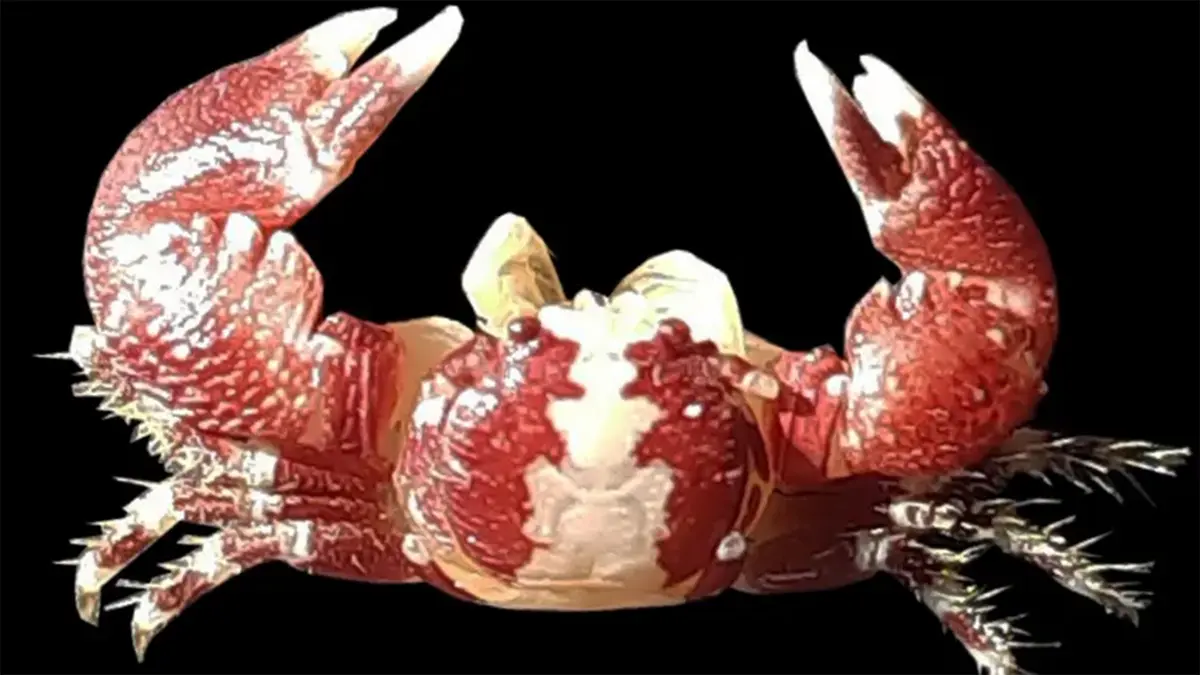
- The collected crab was extremely small, measuring roughly three millimetres.
- Its body showed a deep carmine-red colour with contrasting white blotches.
- Its claws carried white spots, while its walking legs appeared striped.
- The carapace was nearly circular and carried distinctive ridges and fine hairs.
- The smaller claw had a narrow finger gap and a blunt cutting edge.
These features separated the specimens from previously known members of the same genus.
How did scientists confirm a new species?
Modern taxonomy combines visible anatomy, microscopic body structures and genetic evidence.
They then analysed two sections of mitochondrial genetic material from each specimen.
One marker was cytochrome c oxidase subunit I, commonly shortened to COI.
The other marker came from the 16S ribosomal ribonucleic acid gene.
Comparisons separated the specimens from relatives, with COI differences reaching 12.6–21.7 per cent.
The 16S differences reached 4.0–13.7 per cent, supporting recognition alongside unique anatomy.
Method point: Deoxyribonucleic acid, or DNA, cannot automatically name every organism. Taxonomists also examine anatomy, variation, related species and naming rules.
Scientific classification
| Rank | Classification |
|---|---|
| Kingdom | Animalia |
| Phylum | Arthropoda |
| Subphylum | Crustacea |
| Order | Decapoda |
| Infraorder | Anomura |
| Family | Porcellanidae |
| Genus | Pachycheles |
Who conducted the research?
The Indian Council of Agricultural Research’s National Bureau of Fish Genetic Resources led the research.
The Kerala University of Fisheries and Ocean Studies and Centre for Marine Living Resources and Ecology collaborated.
Why was this name chosen?
It honours former Earth Sciences Secretary M Ravichandran for supporting marine biodiversity and the Deep Ocean Mission.
Date clarification: Scientists collected the crab during 2024. It became a formally described species only after the 2026 scientific publication.
Why does this discovery matter?
Reef animals support food webs, while accurate inventories reveal biological wealth hidden within Indian coral reefs.
They also establish baseline knowledge before warming, pollution or construction alters habitats.
Conclusion
This discovery highlights Lakshadweep’s poorly documented biodiversity and supports protection before vulnerable habitats change further.