

Why in news?
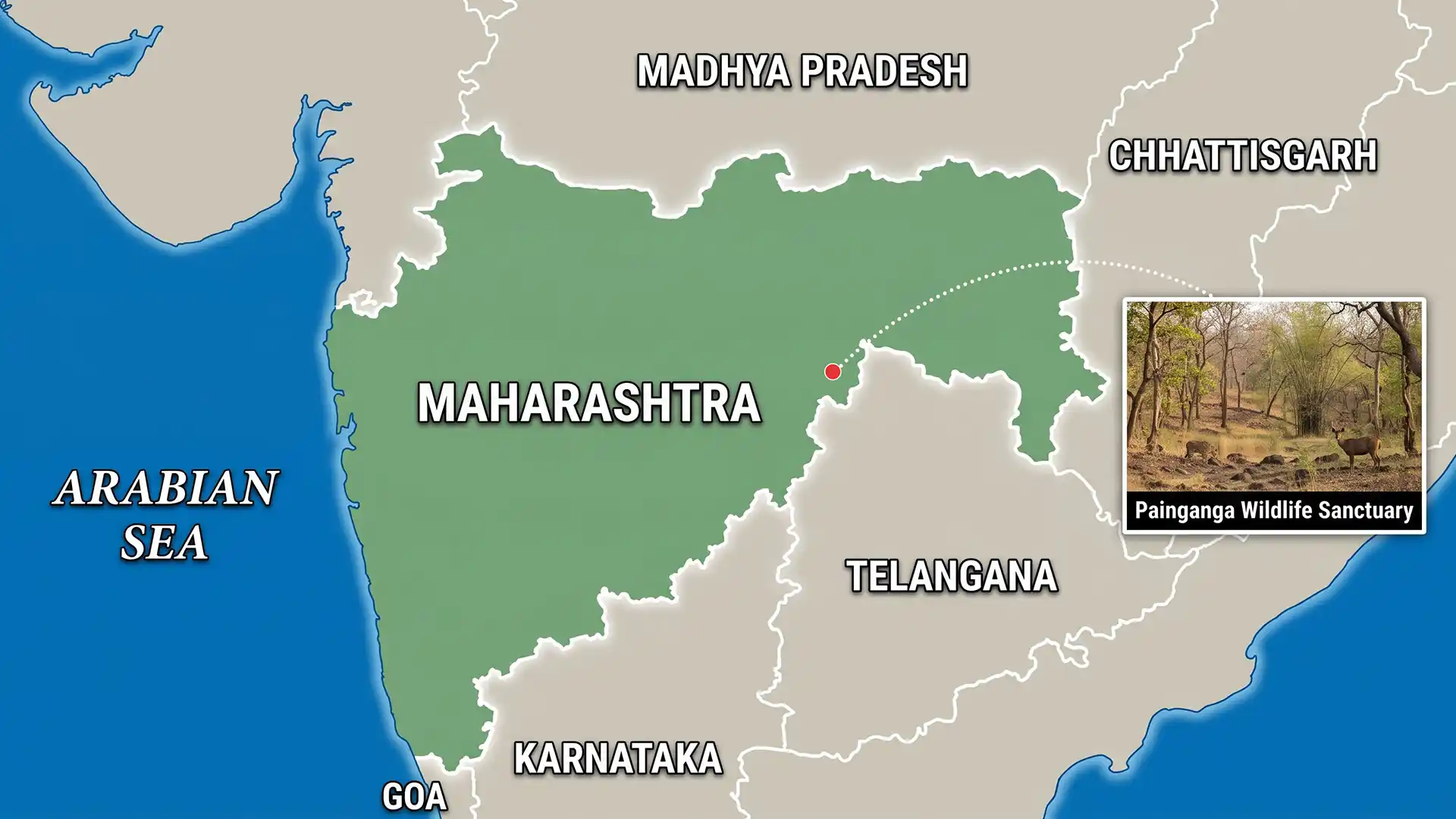
Maharashtra has moved a young tigress from Tadoba-Andhari Tiger Reserve to Painganga Wildlife Sanctuary. The Times of India reported the relocation on 20 September, citing the reserve's field director. The animal, identified as T163-SAF2, is the third tiger reported translocated to Painganga during 2026. The three releases comprise two females and one male, intended to help establish a breeding population outside the state's better-known tiger reserves. Painganga is an existing protected forest landscape near the Maharashtra–Telangana border, not a newly declared tiger reserve. The release is one stage in a conservation programme. Survival, successful breeding, adequate prey and coexistence with neighbouring communities remain the tests of its longer-term result.
A sanctuary shaped by its river
Painganga lies in southern Vidarbha, along the Yavatmal–Nanded district boundary in Maharashtra, close to Telangana. It takes its name from the river that curves around much of its perimeter. Painganga, also written as Penganga, joins the Wardha. The Wardha and Wainganga together form the Pranhita, which joins the Godavari. This places the sanctuary in the Godavari drainage system, connecting its local river setting to the larger east-flowing peninsular basin.
The Wildlife Institute of India describes the habitat as southern tropical dry-deciduous forest, with teak prominent among its trees. Such forests change markedly between wet and dry seasons. Leaf fall and seasonal water availability affect cover and the distribution of animals. Riverine patches provide another set of conditions within the wider forest. A map showing protected boundaries therefore needs to be read alongside the availability of water, prey and usable habitat inside them.
Why move a tiger?
A conservation translocation deliberately moves an animal to achieve a conservation benefit. It can help rebuild or strengthen a population where habitat is available but natural recovery faces difficulties. Moving a tiger is not equivalent to releasing an animal into any empty patch of forest. The destination must provide adequate prey, space and security. Managers also need to consider the source population, the animal's health and behaviour, and possible effects on people around the release area.
The latest tigress came from Tadoba-Andhari's Moharli area. The newspaper identifies her as a sub-adult, meaning she is beyond early cubhood but not yet a fully mature breeding adult. Its account places her release after earlier translocations from the wider Pench conservation programme. These details explain the management sequence. They do not demonstrate that the released animals have already formed a stable population or produced surviving cubs.
A release count is not a population estimate
The distinction matters particularly at Painganga. A Wildlife Institute of India survey conducted in February–April 2021 had already photographed at least two individual tigers. That is historical evidence of tiger presence, not a current count for September 2026. It means the latest releases should not be described as the first tigers ever recorded there. Nor can the old detections simply be added to the three releases to calculate today's population.
Camera trapping uses automatically triggered cameras to record animals without a person standing beside them. Tigers' stripe patterns allow researchers to distinguish individuals in suitable photographs. Repeated sampling helps separate the number actually detected from a wider statistical estimate. The 2021 report did not estimate tiger density because its sample was too small. That limitation is instructive: a precise-looking number is not useful if the observations cannot support the calculation.
Prey, space and movement determine persistence
Tigers are large predators whose survival depends on sufficient wild prey. Forest area alone does not reveal how many can live there. Depleted prey, frequent disturbance or unsafe movement routes can make apparently suitable forest difficult to use. The International Union for Conservation of Nature lists the tiger as Endangered. Its specialist account identifies threats including habitat loss, fragmentation and poaching. Increasing tiger numbers at one site therefore needs protection of the ecological system supporting them.
A breeding population must also persist beyond a single successful litter. Cubs have to survive, and dispersing animals need access to suitable areas. If movements lead mainly into dangerous or heavily disturbed land, the benefit of reproduction can be lost. Connected habitat can help animals move between populations, but connectivity itself requires management. Roads, settlements and other land uses influence where a corridor remains functional rather than merely appearing continuous on a map.
People and monitoring belong in the same plan
International conservation-translocation guidance calls for risk assessment, monitoring and a response if outcomes differ from expectations. In a tiger landscape, that includes livestock losses, encounters near settlements and the ability to respond promptly. Local communities experience those costs directly. Their concerns cannot be treated as a separate publicity issue after release. Clear communication and an operational response system are part of making the intervention viable over time.
Monitoring should establish whether the animals remain healthy, find natural prey and settle into the landscape. It should also identify unexpected movement or conflict early enough for managers to act. Such observations allow a release plan to be adjusted when the animals behave differently from expectations. Following the results across seasons would show whether a successful transfer develops into a lasting conservation gain.
Conclusion
The third reported translocation strengthens Maharashtra's effort to support tigers beyond its established reserves. The important outcome, however, is not the number of animals delivered. It is a population that survives and reproduces within a secure, connected landscape. Painganga's river, forest, prey and surrounding communities all belong in that assessment. Long-term evidence will show whether the release has produced the intended conservation benefit.