

Why in news?
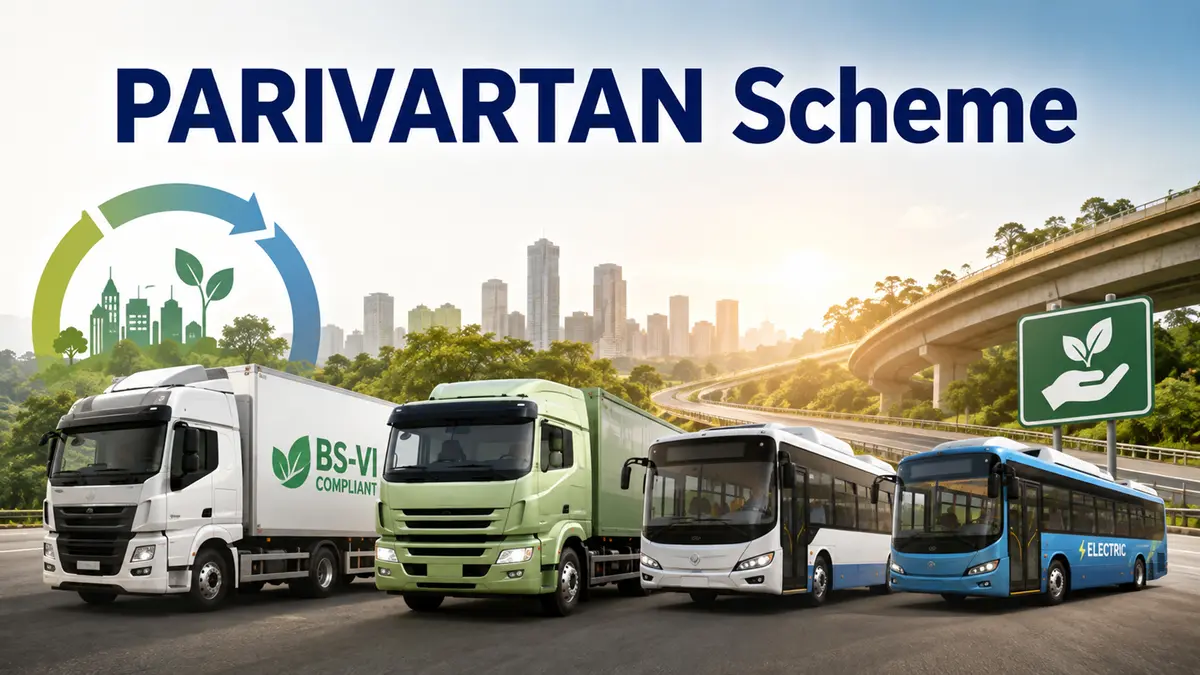
The Union government reported more than 1,300 registrations under its PARIVARTAN vehicle-renewal scheme. Forty-two lenders and fifteen vehicle manufacturers had joined by 27 August. The scheme supports replacement of older trucks and buses across Delhi-NCR. Registration shows interest, but it does not mean every vehicle has already been replaced.
Purpose and coverage
PARIVARTAN expands as Programme for Accelerated Renewal and Incentivization of Vehicle Assets for Reducing Transport Air Pollution and Network Emissions. The Union Cabinet approved it on 3 June 2026. The scheme launched on 14 July. Its announced outlay is ₹9,585 crore.
Central budget support forms ₹5,041 crore of that total. The National Capital Region Planning Board provides the financing framework. It functions under the Ministry of Housing and Urban Affairs. The Ministry of Road Transport and Highways implements the programme.
The target covers more than two lakh trucks and buses. Eligible vehicles meet Bharat Stage IV or earlier emission norms. They must be registered in Delhi or participating National Capital Region districts. Replacement vehicles must meet Bharat Stage VI or stricter norms, or use electric power.
The incentive package
Eligible loans receive interest savings of five per cent for five years. Participating states waive road tax for ten years. They also waive registration fees. Vehicle manufacturers must offer at least eight per cent off the ex-showroom price.
Buyers choosing Bharat Stage VI diesel or compressed natural gas vehicles can receive monthly fuel vouchers. The amount ranges from ₹1,200 to ₹4,800 by vehicle category. Support can continue for five years. The design lowers both purchase and early operating costs.
Electric vehicle buyers receive a one-time incentive instead of monthly fuel vouchers. It ranges from ₹64,000 to ₹2.56 lakh. The exact amount depends on vehicle category. Buyers must compare this support with vehicle price, route length and charging access.
Early implementation
More than 1,300 beneficiaries had registered by 27 August. Forty-two banks and non-banking financial companies were onboarded. Fifteen original equipment manufacturers signed agreements for the discount. Mahendra Singh of Alwar became the first reported purchaser on 19 August.
The government is advertising through fuel stations, transport centres and toll plazas. Regional Transport Offices also form part of the campaign. These locations reach commercial vehicle owners during routine work. Clear help desks can reduce errors in eligibility and loan documentation.
The early numbers should be read carefully. Registration is the first step, not a completed replacement. Loan approval, scrapping and new vehicle delivery follow later. Public dashboards should separate each stage.
Geography of the National Capital Region
The National Capital Region has Delhi as its core. It also includes notified districts of Haryana, Uttar Pradesh and Rajasthan. The notified area covers about 55,083 square kilometres. This makes its transport network strongly inter-state.
Freight vehicles move through Delhi, Gurugram, Faridabad, Ghaziabad, Noida and surrounding logistics centres. Alwar and Bharatpur form the Rajasthan sub-region. Haryana contributes fourteen districts. Uttar Pradesh contributes eight districts under the current official listing.
Air pollution also crosses administrative boundaries. Winds, road corridors and daily travel connect the wider airshed. Replacing vehicles only within one city would miss many regular entrants. The regional design therefore matches the geography of commercial transport.
Why vehicle standards matter
Bharat Stage norms limit pollutants from vehicle exhaust. India moved directly from Stage IV to Stage VI for new vehicles. Stage VI requires much tighter control of particulate and nitrogen oxide emissions. Fuel quality and emission-control technology work together.
Older commercial vehicles often travel long distances and carry heavy loads. Their annual use can be high. Replacing a heavily used truck may therefore produce more benefit than replacing a lightly used vehicle. Scheme evaluation should record kilometres and real-world emissions.
Transport is only one source of Delhi-NCR pollution. Industry, road dust, construction and biomass burning also contribute. Vehicle renewal cannot replace action on these sources. It can still reduce one important and mobile source.
Economic and implementation concerns
Small operators may struggle with the remaining purchase cost. A new loan can create repayment pressure even after subsidies. Used-vehicle value and scrapping terms will influence participation. Lenders should examine cash flow rather than demand excessive collateral.
Electric trucks and buses need reliable charging and suitable routes. Diesel and compressed natural gas replacements still create emissions. The scheme should therefore avoid treating every cleaner option as identical. Incentives can evolve as zero-emission technology becomes practical.
Fraud controls are also necessary. Old vehicles should not simply move to another region and continue polluting. Scrapping records must connect with the national vehicle database. Audits should verify manufacturer discounts and tax waivers.
1,300 registrations do not equal 1,300 replacements
The official figure counted registered beneficiaries. It did not count completed fleet replacements. Future reporting should distinguish registration, loan sanction, scrapping and delivery.
Conclusion
PARIVARTAN addresses a real regional source of transport pollution. Its package reduces several costs faced by commercial operators. Early registrations show interest but not completed environmental gains. Strong tracking must follow each old vehicle to verified scrapping. Cleaner fleets should form one part of a wider Delhi-NCR air-quality strategy.