

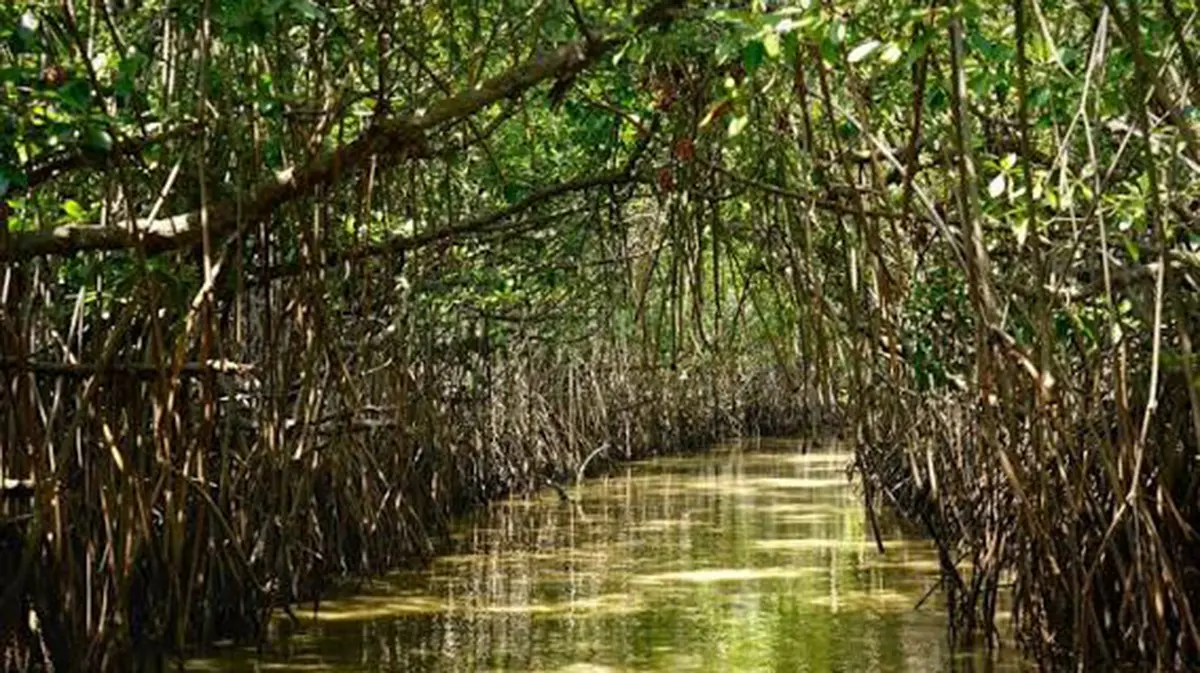
Why in news?
A new assessment has valued Pichavaram’s ecosystem services at ₹2,485.38 crore. This equals about ₹1.83 crore for each assessed hectare. The study combined ecological information with a survey of 302 nearby households. Its estimate highlights benefits that ordinary market accounts often ignore.
Where Pichavaram is located
Pichavaram lies in Cuddalore district on Tamil Nadu’s Coromandel Coast. The Vellar estuary borders it to the north. The Coleroon, also called Kollidam, lies to the south. Their connected estuarine waters form the Killai backwater before reaching the Bay of Bengal.
Fresh water, river sediment, tides and seawater meet across this landscape. Their interaction creates brackish channels and intertidal mud. Mangrove trees tolerate salt and periodic flooding through specialised adaptations. Changes in any water source can affect the whole ecosystem.
The Pichavaram Ramsar site covers about 1,478 hectares. It received international wetland recognition in 2022. Ramsar status identifies ecological importance but does not create immunity from local pressure. Effective protection still depends upon water management, enforcement and community participation.
What total economic value means
Total Economic Value estimates several kinds of benefit from one natural asset. Provisioning services include fish, crabs and prawns taken for use. Regulating services include carbon storage and coastal protection. Cultural services include tourism, while supporting services sustain biodiversity and nutrient cycles.
Many of these benefits have no daily market price. A seawall appears in financial accounts because someone pays to build it. Natural storm protection may remain invisible until it disappears. Valuation tries to place both benefits within the same planning discussion.
The estimate is not a proposed sale price for the forest. Nor is the full amount annual cash income. Some components value existing natural stocks, while others concern continuing service flows. Any comparison must retain the study’s methods and time assumptions.
How the assessment was prepared
M. Balasubramanian of the Institute for Social and Economic Change led the work. The Forest Genetics Division in Coimbatore funded the assessment. Researchers used primary and secondary information. Household interviews covered five mangrove-dependent settlements around Pichavaram.
The team applied several valuation methods to different services. Market prices helped estimate fisheries and tourism-related use. Avoided damage can inform coastal-protection value. A social cost of carbon converted stored carbon into an estimated economic benefit.
Every valuation method contains assumptions. Market prices change, and households may use resources differently. Damage avoided by mangroves depends upon storm conditions and exposed assets. Carbon values also depend upon the selected price and storage duration.
What the figures show
The study estimated total blue-carbon value at ₹1,612.40 crore. Vegetation held an average 79.449 tonnes of carbon per hectare. Mangrove soils held a much larger 251.14 tonnes per hectare. This makes the sediment as important as the visible trees.
The soil-carbon component was valued at ₹1,224.63 crore. Vegetation carbon was valued at ₹387.77 crore. Tourism and recreation contributed an estimated ₹484.25 crore. Coastal protection was assigned ₹147.17 crore within the total.
Smaller monetary components are not ecologically unimportant. Nutrient cycling supports food webs and fisheries. Biodiversity also maintains resilience under changing conditions. A valuation can only approximate relationships that remain scientifically complex.
Policy value and cautions
The estimate can improve cost-benefit analysis for nearby development. Destroying mangroves creates losses that a narrow project budget may omit. Their protection can support fishing, tourism and disaster resilience together. This strengthens the case for treating them as natural infrastructure.
Blue-carbon finance may help fund conservation and restoration. However, a carbon credit needs a credible baseline and long-term monitoring. It must show that claimed storage is additional and durable. Community rights and benefit-sharing also require clear safeguards.
Conservation must protect water and sediment connections beyond the mapped forest. Upstream diversion, pollution and poorly planned aquaculture can change those flows. Sea-level rise can also squeeze mangroves against hard development. Space for landward movement may become increasingly important.
Conclusion
Pichavaram’s valuation makes normally hidden ecosystem services visible. The ₹2,485.38 crore estimate is analytical, not a sale price. Its largest component comes from carbon stored in vegetation and soil. Planning should also protect fisheries, hydrology and local livelihoods. Long-term monitoring and community participation must turn monetary recognition into durable conservation.