

Why in news?
Media reports again highlighted Gujarat’s Pithora painting and its Geographical Indication status. However, the registration was not granted in 2026. The official certificate is dated 14 September 2021. The July report therefore revived an existing recognition rather than announcing a new tag.
Background
Pithora is a living ritual painting tradition closely associated with Gujarat’s Rathwa Adivasi community.
Related traditions also occur among Bhil and Bhilala communities across adjoining western and central India.
The paintings combine religious duty, community memory, household life and changing local experience.
They should not be understood merely as decorative wall art.
The correct official record
| Registered name | Pithora |
|---|---|
| Application number | 644 |
| Applicant | Rathwa Adivasi Samuday Trust |
| Filing date | 23 January 2019 |
| Goods and class | Handicraft, Class 16 |
| Geographical area | Gujarat |
| Certificate | Certificate 385, dated 14 September 2021 |
| Current validity | Up to 22 January 2029, subject to renewal. |
What does a Pithora ritual involve?
A family may commission Pithora after making a vow or seeking divine help.
A ritual specialist commonly called the badva guides the occasion and interprets its religious requirements.
Specialist painters called lakharas traditionally execute the mural after preparing the household wall.
The work may express gratitude to Baba Pithora after the fulfilment of a vow.
Songs, offerings and community participation can accompany the painting process.
Exact practices vary across villages, lineages and contemporary settings.
Visual language
Rows of horses often form the painting’s most recognisable central element.
The riders can represent deities, ancestors and other figures within the community’s cosmology.
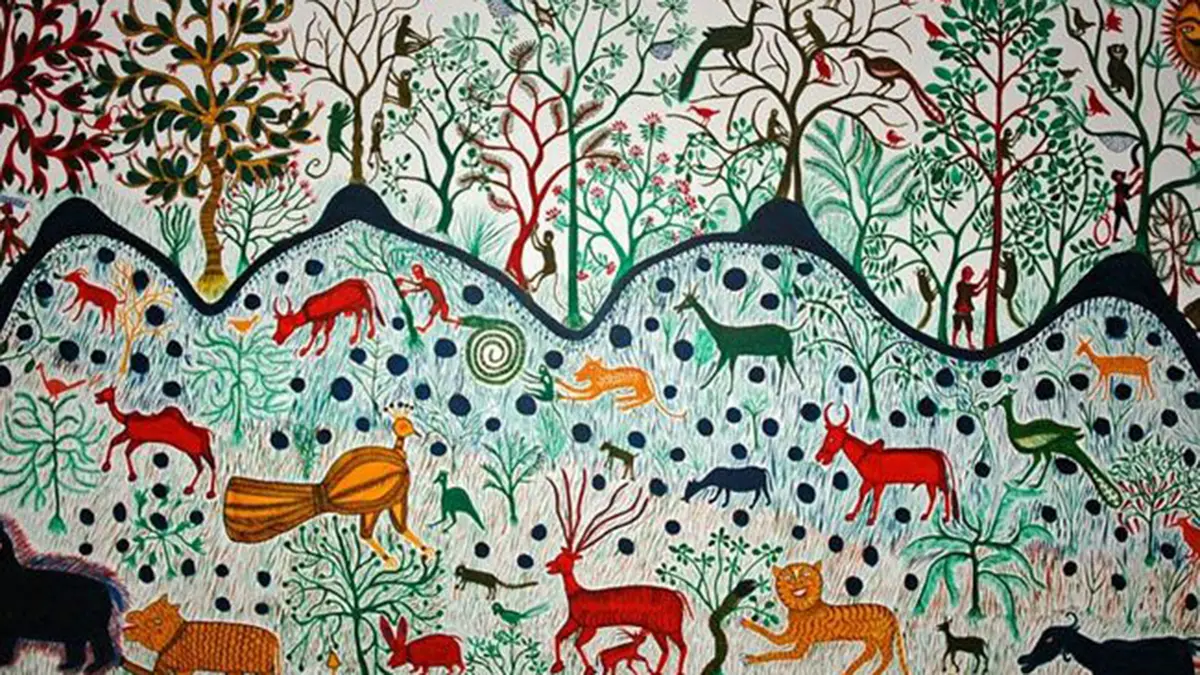
Animals, crops, trees, farming, processions and household events surround these central forms.
Modern vehicles, machines or current experiences may also enter newer compositions.
This flexibility allows the tradition to remain living rather than frozen in one historical form.
Traditional and commercial forms
| Ritual mural | Portable adaptation |
|---|---|
| Created inside a household for a specific religious purpose. | Created on paper, cloth or canvas for display and sale. |
| Follows community ritual roles and preparatory practices. | May use individual artistic authorship and market formats. |
| Meaning comes from the complete ceremony and social setting. | Meaning may be communicated mainly through motifs and explanation. |
Commercial adaptation can create income, but it can also detach motifs from ceremonial meaning.
Community-led documentation helps balance market access with cultural authority and accurate attribution.
What is a Geographical Indication?
A Geographical Indication, or GI, identifies goods whose qualities or reputation relate to their origin.
India protects such names under the Geographical Indications of Goods (Registration and Protection) Act, 1999.
The registration system distinguishes eligible regional goods from misleading commercial representations.
It does not transfer ownership of an entire cultural tradition to an unrelated private company.
Producer organisations can register eligible makers as authorised users under the law.
Registration lasts ten years and can be renewed for further ten-year periods.
Potential value and limits of a GI
- A GI can improve product recognition and reduce false commercial geographical claims.
- Well-designed collective marketing may strengthen income for eligible community artists.
- Careful documentation can preserve names, methods and links with the producing community.
- Legal registration alone cannot guarantee fair prices or prevent wider cultural appropriation.
- Real benefits require authorised-user registration, awareness, quality control and reliable market access.
Avoiding weak historical claims
Popular descriptions give very different dates for Pithora’s origin.
The current registry proves legal registration, not an exact archaeological starting year.
It is safer to describe Pithora as a long-established living ritual tradition.
Conclusion
Pithora’s genuine 2021 registration deserves attention without inventing a new 2026 award date.