

Why in news?
The Production Linked Incentive Scheme for the Food Processing Industry has recorded investment and job creation figures that have exceeded initial commitments. Recent updates from the Ministry of Food Processing Industries show that companies are investing more than they had pledged, adding processing capacity and creating thousands of jobs. This momentum has brought the scheme back into discussion among policymakers and the public.
Background
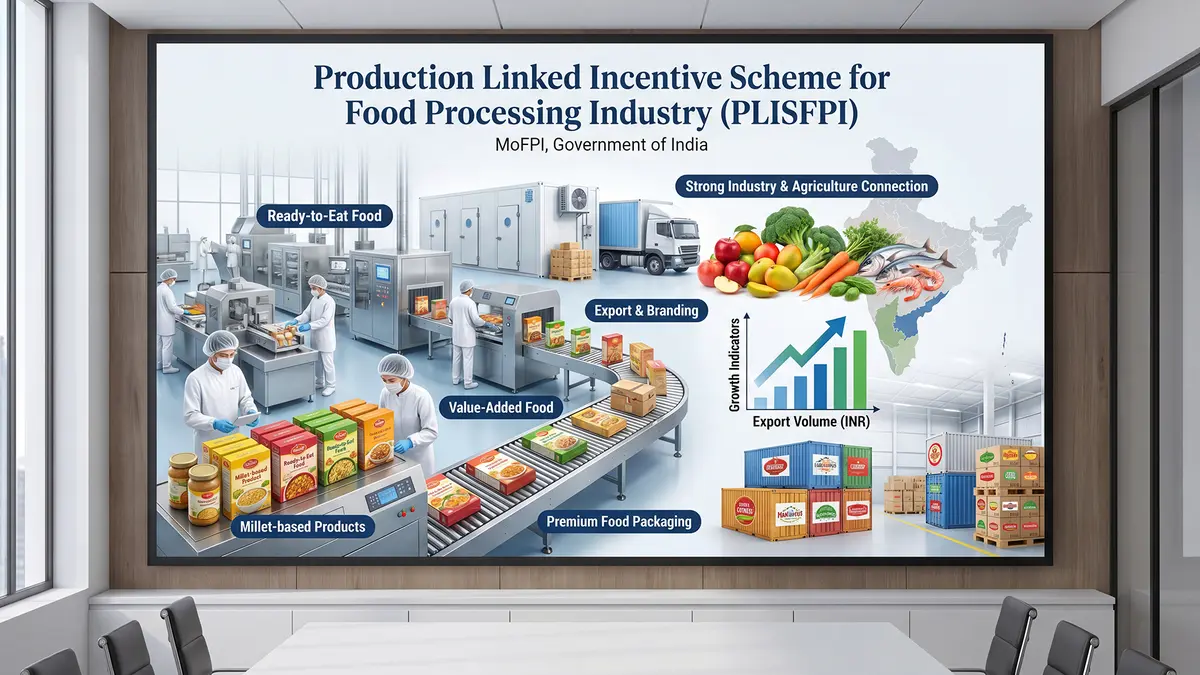
The Production Linked Incentive Scheme for the Food Processing Industry (PLISFPI) was launched by the Ministry of Food Processing Industries in 2021–22 as part of the Aatmanirbhar Bharat initiative. With a financial outlay of ₹10,900 crore, the scheme runs until 2026–27 and aims to strengthen the food processing sector, promote Indian brands globally and create global food‑manufacturing champions. It offers incentives to companies that expand processing capacity, invest in innovative or organic products and build Indian brands abroad. In line with the United Nations’ International Year of Millets in 2023, the scheme also provides additional encouragement for millet‑based products.
Key components
- Targeted product segments: Incentives are provided for four major categories – ready‑to‑cook and ready‑to‑eat foods, processed fruits and vegetables, marine products and mozzarella cheese. Small and medium enterprises producing innovative or organic foods are also supported.
- Branding and marketing: The scheme assists companies in promoting Indian brands overseas through support for in‑store branding, shelf space rental and marketing campaigns.
- Encouraging millets: To mark the International Year of Millets, manufacturers of millet‑based ready‑to‑eat products receive additional incentives to promote value addition and increase sales of these nutritious grains.
Achievements so far
- Investment and capacity: By early 2026, 128 companies had been approved under the scheme, covering 274 units across 22 states. Against a committed investment of ₹7,722 crore, businesses have invested over ₹9,200 crore. This has created additional processing capacity of around 34 lakh tonnes per year.
- Participation of MSMEs: The scheme has encouraged micro, small and medium enterprises by approving 68 MSME applicants and 40 contract manufacturing units. This inclusive approach helps both large corporations and smaller businesses upgrade technology and expand operations.
- Employment generation: The increased investment has generated employment for about 3.3 lakh people, both directly and indirectly, supporting rural economies and off‑farm livelihoods.
- Sales and exports: Sales of products manufactured under the scheme have grown at an annual rate of over 10 percent, while export sales have risen by more than 7 percent. Millet‑based products alone have seen sales jump from ₹345 crore in 2022–23 to over ₹1,845 crore in 2024–25.
Significance
- Boosting value addition: By encouraging investment in processing, the scheme helps farmers secure better prices for their produce and reduces post‑harvest losses.
- Creating global champions: Support for branding and marketing abroad aims to build strong Indian food brands, enhancing the country’s visibility in international markets.
- Inclusive growth: The participation of MSMEs and contract manufacturers ensures that benefits are distributed across the industry, not just to large corporations.
- Rural employment: New processing facilities generate off‑farm jobs, providing an alternative source of income in rural areas.
Conclusion
The PLISFPI demonstrates how targeted incentives can stimulate investment, technology up‑gradation and market expansion in a critical sector. Continued support and timely disbursal of incentives will be important to sustain the momentum and help Indian food brands compete globally while empowering farmers and rural workers.
Source: Press Information Bureau