

Why in news?
External Affairs Minister Subrahmanyam Jaishankar visited Warsaw and met Poland's senior leadership on 4 September 2026. His talks with Deputy Prime Minister and Foreign Minister Radosław Sikorski reviewed their strategic partnership. Both sides discussed defence, trade, technology, connectivity and the war in Ukraine. They also advanced planned cooperation in cyber security, space and cleaner coal technologies.
What the two sides discussed
India and Poland elevated their relationship to a strategic partnership in August 2024. They also adopted an action plan covering the period from 2024 to 2028. The Warsaw meeting assessed progress under that framework. It sought practical projects rather than another broad declaration.
Poland's Foreign Ministry reported bilateral trade worth about €5.6 billion in 2025. Machinery and equipment formed its largest reported segment. Chemicals were another substantial component. Different national databases may present other totals because currencies, periods and methods can vary.
The ministers discussed defence industry links and space cooperation. Poland also highlighted the India–Middle East–Europe Economic Corridor and its Three Seas Initiative. Any connection between these plans remains prospective. It would require finance, infrastructure and agreement across several countries.
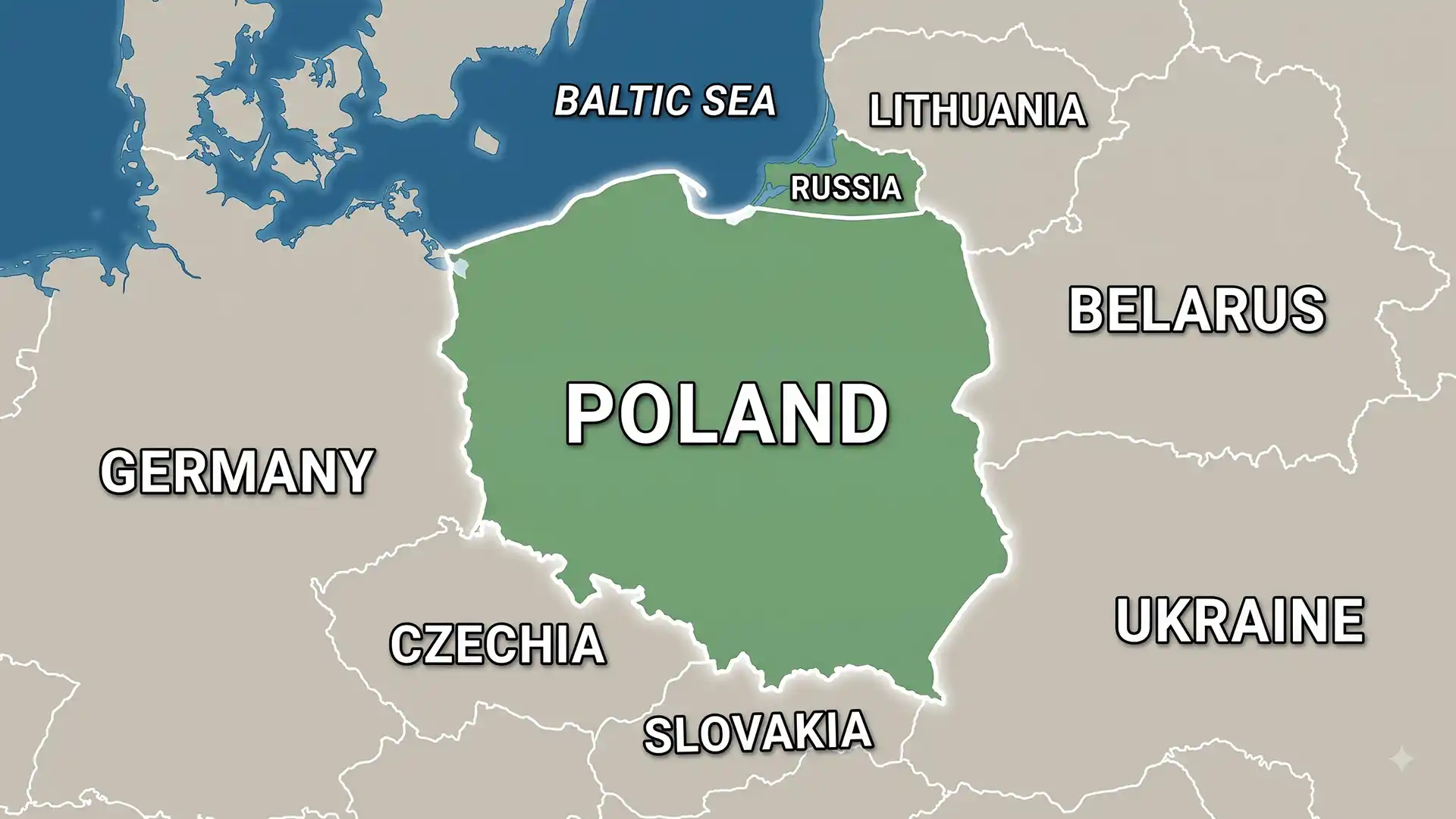
Poland's geographical setting
Poland lies in Central Europe with a coast on the Baltic Sea. It borders Germany, Czechia, Slovakia, Ukraine, Belarus and Lithuania. The Russian exclave of Kaliningrad also touches its north-eastern frontier. Warsaw stands on the Vistula River in the country's east-central region.
Much of Poland consists of the North European Plain. The Sudeten and Carpathian mountains rise along parts of its southern boundary. The Vistula and Oder are its main river systems. This landscape has long supported transport between western and eastern Europe.
Poland is a member of the European Union and the North Atlantic Treaty Organization. Its borders with Ukraine, Belarus and Kaliningrad place it on the alliance's eastern flank. The narrow Suwałki region links Poland with Lithuania between Belarus and Kaliningrad. That position gives Polish security policy wider European importance.
Why Poland matters to India
Poland offers India access to a large European manufacturing and consumer market. Its strengths include machinery, transport equipment, information technology and food processing. Indian companies use Poland as a base for some European operations. Polish firms can participate in India's infrastructure and industrial growth.
Direct air links and easier mobility can deepen business and academic exchange. Polish universities have maintained a long interest in Indian languages and Indology. Cultural familiarity can support a relationship beyond contracts. However, labour and education arrangements need clear rules and student protection.
Poland's location also shapes diplomatic discussions about Ukraine. It shares a long border with Ukraine and has supported its defence and displaced population. India has maintained engagement with both Ukraine and Russia. Regular dialogue with Warsaw helps India understand an important European security perspective.
Areas of emerging cooperation
The joint action plan identifies cyber security, space and advanced technologies. These fields require trusted institutions and protection for sensitive data. Cooperation should include research standards, incident reporting and skilled personnel. Announced intentions will matter only when agencies implement them.
Both sides have also discussed mining and critical minerals. Poland has industrial knowledge in coal and underground mining. India can learn from safety, reclamation and transition experience. Commercial cooperation must still meet climate obligations and local environmental standards.
“Clean coal” usually refers to technologies that reduce particular emissions or improve efficiency. It does not remove every climate or pollution impact from coal. Projects should publish their expected reductions and full costs. Renewable energy and grid modernisation must remain part of the wider transition.
Conclusion
The Warsaw talks moved the India–Poland partnership towards practical cooperation. Poland's economy and Central European location give the relationship strategic depth. Trade, technology and education offer benefits beyond immediate security concerns. New projects require transparent implementation and realistic environmental standards. Sustained contact can turn the 2024 partnership into durable institutional ties.