

Why in news?
Science and Technology Minister Jitendra Singh announced the commercial use of bio-based polylactic acid on 24 September. Polylactic acid, or PLA, is a plastic that can be manufactured from sugars obtained from biological feedstocks. The announcement concerned Balrampur Chini Mills and also described support for a separate research pilot at Kumbhi in Uttar Pradesh. The proposed pilot is intended to develop specialised material grades and improve domestic technological capability. This matters because replacing a fossil feedstock requires an entire manufacturing and disposal system, not merely a different raw material. The commercial-use announcement does not establish that the funded pilot is already operating, or that every PLA product decomposes harmlessly anywhere.
From a biological feedstock to a manufactured polymer
A polymer is a material made from long chains of repeating molecular units. Plastics obtain many useful properties from these chains and the way they are processed. PLA belongs to the polyester group of polymers. Its biological origin concerns the material used to make it; the finished product still requires industrial chemical processing.
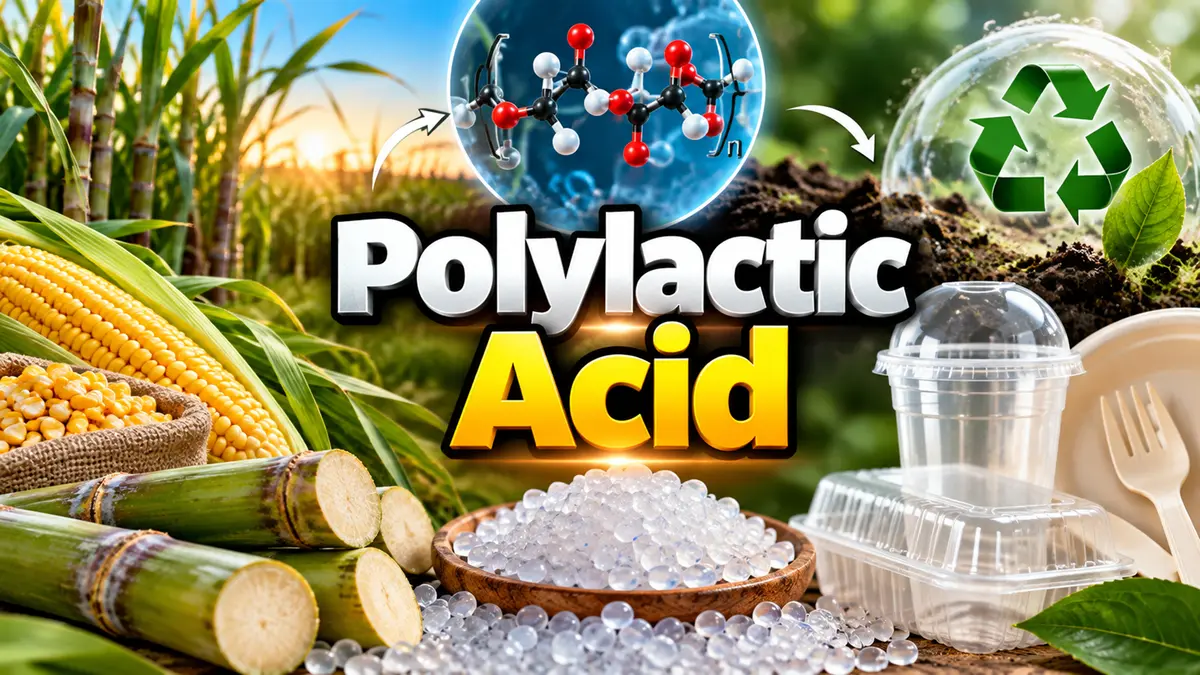
One established manufacturing route begins with plant-derived sugars. Microorganisms ferment these sugars to produce lactic acid. Further processing creates a ring-shaped intermediate called lactide, which is converted into long polymer chains. The polymer can then be supplied as pellets for making products. NatureWorks describes this sequence for its own PLA technology; it is an industrial example, not a verified equipment list for the Indian project.
Why a pilot plant has a different job
The government described a ₹75 crore grant through the Biotechnology Industry Research Assistance Council, under the Department of Biotechnology. It supports a proposed pilot research facility with a capacity of 100 tonnes a year. That capacity belongs to the pilot, not to every commercial plant associated with the company. The announcement places the support within India's biotechnology-led manufacturing effort.
A pilot bridges laboratory work and production at a larger scale. It can help researchers examine how a process behaves when equipment, material volumes and operating conditions change. Different uses also require different grades of a polymer. A material suitable for one packaging application may not automatically meet the demands of another product or a specialised medical application.
Consequently, announcing a material is only part of commercial development. Producers must achieve consistent properties and demonstrate that the product suits its intended use. Buyers also need dependable supply and clear instructions for handling and disposal. These are practical conditions for adoption, not outcomes guaranteed by a grant announcement.
Three terms that should not be treated as synonyms
Bio-based describes origin; biodegradable describes breakdown under specified conditions. A plastic may be partly or wholly made from biological resources without being readily biodegradable. Conversely, some biodegradable plastics can be made using fossil resources. The two descriptions answer different questions and should not be combined into an automatic claim of environmental safety.
Compostability is more specific still. It concerns whether a material meets requirements for breakdown in a composting system. Industrial composting provides controlled conditions that differ from those in a home garden, roadside or sea. A label referring to industrial compostability therefore cannot be read as permission to discard an item outdoors.
The disposal system is part of the technology
The European Environment Agency stresses that temperature, moisture, microorganisms and time affect biodegradation. The material must reach an appropriate treatment route for the intended result. Collection and sorting therefore matter alongside chemistry. A compostable item placed in the wrong waste stream can create problems instead of delivering its expected environmental benefit.
This also means that a plastic's appearance is a poor disposal guide. Similar-looking containers can require different treatment. Mixing materials into an unsuitable recycling stream can reduce the quality of recovered material. Clear labelling and locally available collection arrangements are therefore necessary companions to any large-scale introduction of a new polymer.
Assessing the whole environmental balance
Using biological carbon can reduce dependence on fossil raw materials, but it does not make production impact-free. Feedstock cultivation can require land, water and other inputs. Processing consumes energy, and transport and disposal add further effects. The European Commission's policy framework therefore calls for examining the full life cycle rather than judging a material by its feedstock alone.
The useful comparison is between products performing the same job under realistic conditions. Durability, the amount of material needed, reuse possibilities and the available end-of-life route all influence that comparison. A technically promising substitution can perform poorly if its collection system is absent. Equally, a well-chosen application can benefit from a material designed for that specific use.
Conclusion
The PLA announcement concerns both a commercial material and support for further domestic process development. Its value will depend on reliable grades, suitable applications and an effective route after use. Bio-based production is one part of that chain, not a complete environmental verdict. The strongest approach joins material innovation with clear product standards and workable waste management.