

Why in news?
On 24 June 2026 a news report revealed that a captive‑bred long‑ billed vulture released in Maharashtra’s Melghat Tiger Reserve in January had travelled 3,334 kilometres across central India and reached Ranthambhore Tiger Reserve in Rajasthan. The bird, tagged X67, survived without supplemental feeding and made stops at Satpura Tiger Reserve and Kuno National Park along the way. Conservationists hailed the journey as proof that reintroduced vultures can adapt to the wild and locate carrion over large distances.
Background
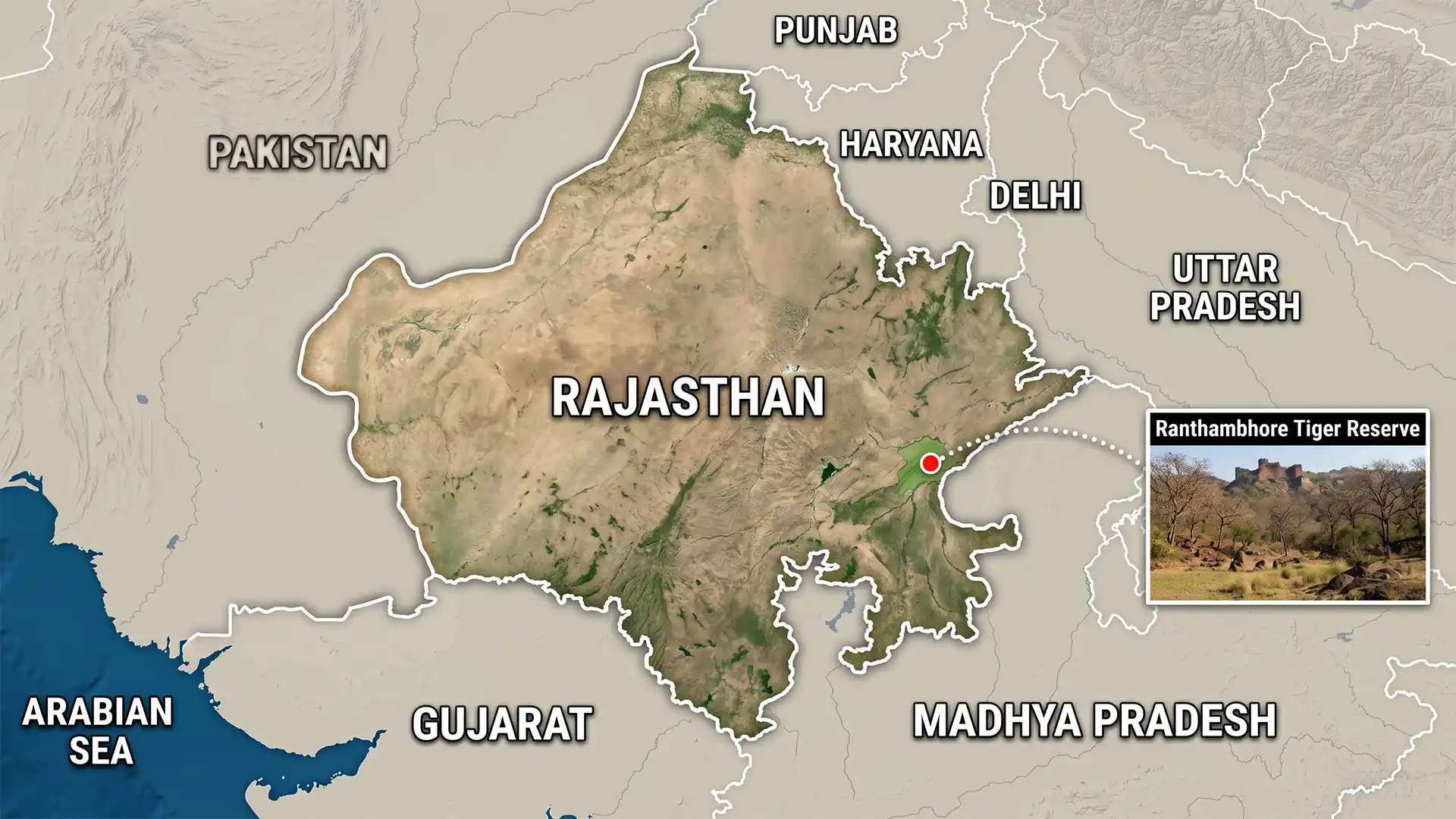
Ranthambhore Tiger Reserve lies in the Sawai Madhopur district of southeastern Rajasthan at the junction of the Aravalli and Vindhyan ranges. It spans about 1,411 square kilometres and includes the historic Ranthambhore Fort. Once the private hunting grounds of the Jaipur royalty, it became a wildlife sanctuary in 1955 and was incorporated into Project Tiger in 1973. The park’s dry deciduous forests, lakes and rocky plateaus support tigers, leopards, caracals, deer, wild boar and more than three hundred bird species. Vulture populations crashed across India in the 1990s due to the veterinary drug diclofenac, leading to breeding programmes run by the Bombay Natural History Society and forest departments.
Highlights of the vulture’s journey
- Captive breeding: Fifteen long‑billed vultures were raised at the Melghat facility and fitted with solar‑powered tracking tags. X67 was released on 2 January 2026.
- Long‑distance flight: After spending four months near the release site, the bird began its journey on 28 May, moving through Maharashtra, Madhya Pradesh and Rajasthan. It covered 3,334 kilometres in twenty‑seven days.
- Use of protected areas: The vulture rested at Satpura Tiger Reserve and Kuno National Park before reaching Ranthambhore. Conservationists say the route shows vultures seek out protected landscapes where carcasses are available and disturbance is low.
- Conservation value: The successful adaptation of captive‑bred vultures offers hope for restoring populations of critically endangered species. India’s vulture population declined by more than 90 percent due to diclofenac; reintroduction and safe veterinary practices are slowly reversing the trend.
Conclusion
The epic flight of vulture X67 underscores the importance of connected networks of protected areas. With careful breeding, tracking and habitat management, India can revive its vulture populations and strengthen ecosystem health in reserves like Ranthambhore.