

Why in news?
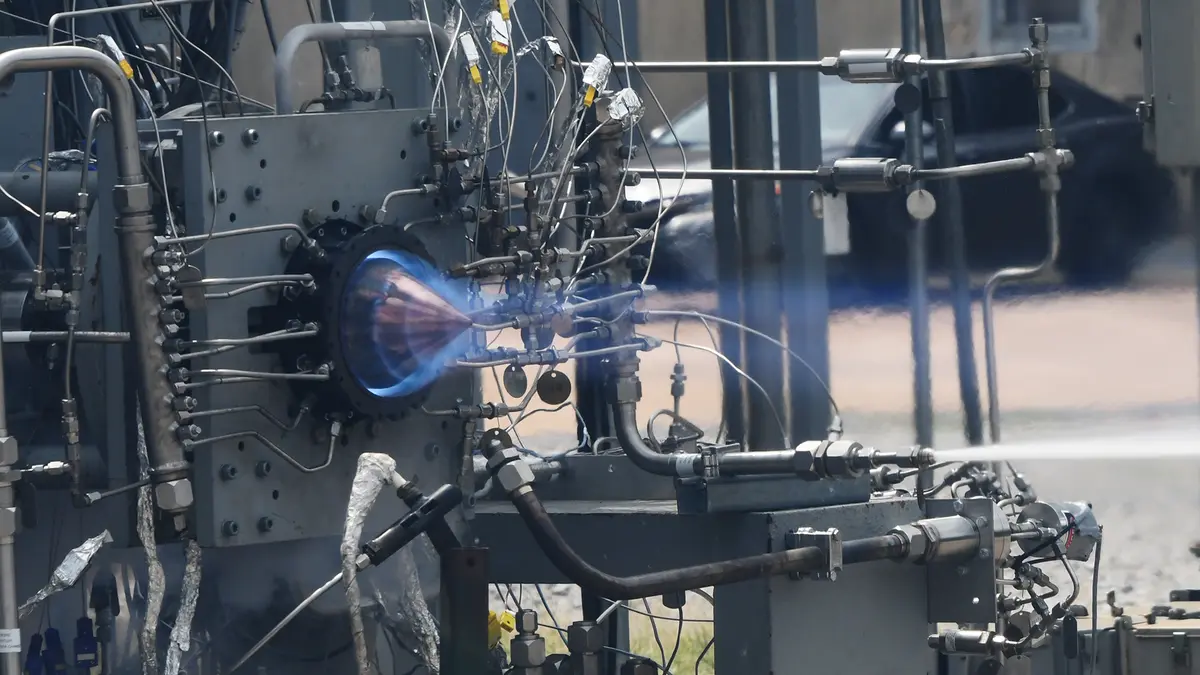
Defence start-up D-Propulse announced a ground test of its five-kilonewton rotating detonation engine in Hyderabad.
What the company reported
D-Propulse said testing occurred on 21 and 22 July 2026. The venue was a Defence Research and Development Organisation facility. The start-up described the system as an indigenous, air-breathing engine.
It also said an aerospike nozzle formed part of the demonstrator. These performance and readiness statements remain company claims. No detailed, independently reviewed test record was publicly available with the announcement.
The careful conclusion is therefore limited. An Indian start-up demonstrated a research engine under ground conditions at the reported thrust class.
A test is not flight qualification
Ground operation establishes valuable evidence. It does not prove durability, controllability or performance across an aircraft’s complete flight envelope.
How rotating detonation works
Most practical combustors use deflagration. Their flame moves through the mixture below the local speed of sound. Detonation combines combustion with a supersonic shock wave.
The pressure rises sharply as the wave consumes fresh fuel and oxidiser. A rotating detonation engine uses an annular combustion chamber. One or more detonation waves travel continuously around this ring.
Fresh mixture enters behind each passing wave. Hot products then expand towards the nozzle and produce thrust. This process can deliver pressure-gain combustion.
Conventional combustors usually lose total pressure while adding heat. An air-breathing engine draws oxygen from the atmosphere. A rocket must carry both fuel and oxidiser aboard the vehicle.
Why engineers are interested
Pressure gain may improve efficiency or reduce combustor size. The advantage could support longer range, greater payload or lower fuel use. However, those gains depend on the complete propulsion system.
Inlet losses, nozzle design and wave stability can erase laboratory advantages. The annular combustor itself has no turbine-like rotating machinery. The wider engine can still require pumps, valves and other moving equipment.
The National Aeronautics and Space Administration (NASA) is testing related concepts. The United States Air Force Research Laboratory is conducting similar work.
What must be solved next
Detonation creates severe heat, pressure oscillations and structural loads. Engineers must maintain stable waves while preventing damaging acoustic interactions. Reliable ignition, cooling and material life also matter.
Air-breathing versions must operate across changing speed, altitude and inlet conditions. Flight integration will require repeated endurance tests and instrumented trials. Transparent performance data would help distinguish progress from promotional projections.
Promising, but still developmental
The test marks useful indigenous propulsion work. Its strategic value will depend on repeatability, durability and eventual flight evidence.
Conclusion
Rotating detonation could reshape compact high-speed propulsion. The Hyderabad test is a beginning, not a certified operational capability.