

Why in news?
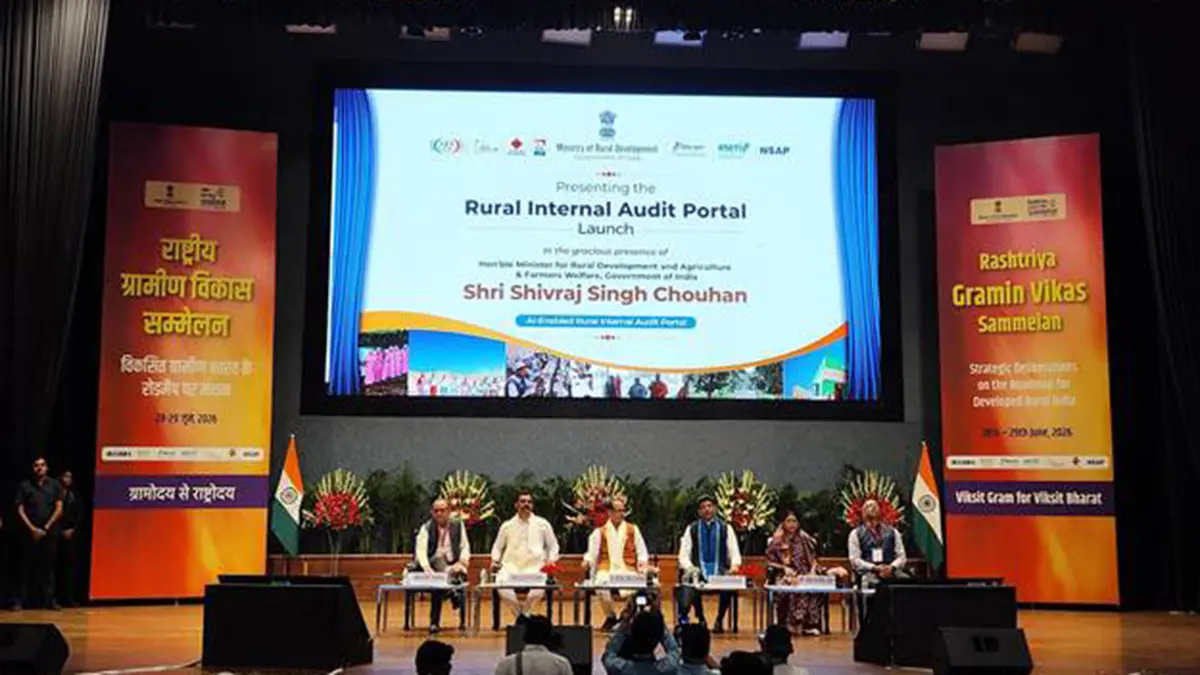
On 28 June 2026, the Union Minister for Rural Development Shivraj Singh Chouhan launched the Rural Internal Audit Portal at the Rashtriya Gramin Vikas Sammelan in New Delhi. The new AI‑enabled platform will modernise internal audits of rural development schemes and promote transparency.
Background
The Ministry of Rural Development implements many programmes such as MGNREGA, PM Awaas Yojana and NRLM. Effective audits ensure that funds reach the intended beneficiaries. Earlier, internal audits were manual, fragmented and time‑consuming. To address these issues the Office of the Chief Controller of Accounts (CCA), with support from the National Informatics Centre (NIC), conceived a unified digital system. After a pilot in Chandauli district in April 2025, core modules went live in October 2025.
Features of the portal
- End‑to‑end workflow: The portal covers audit planning, execution, reporting, compliance tracking and monitoring. Auditors can schedule visits, upload reports and issue observations in one place.
- Risk‑based planning: It allows risk profiling of audit units so that high‑risk areas receive priority.
- Central repository: A database stores details of all schemes, audit units and past audit findings. This eliminates dispersed paper records.
- Analytics and AI: Built‑in analytics help identify patterns and recurring issues. Artificial intelligence flags potential irregularities and suggests corrective actions.
- Real‑time monitoring: Officials can track audit progress and compliance status through dashboards and geospatial map views. The interface is multilingual and accessible on mobile devices.
- Security and integration: Role‑based access and integration with other government systems (such as the Public Financial Management System) ensure data security and interoperability.
Significance
The Rural Internal Audit Portal will strengthen accountability in rural schemes. Automated workflows reduce delays and human error. Risk‑based planning ensures resources are used efficiently. Transparent audits build public trust and help detect fraud early. The system can serve as a model for auditing other sectors.
Conclusion
Digital tools can revolutionise governance. By shifting from fragmented manual processes to a unified platform, the Rural Internal Audit Portal will help ensure that development funds create real benefits on the ground. Continued training and adoption across states will be key to its success.
Sources: PIB