

Why in news?
A severe sal borer outbreak has affected forests in Madhya Pradesh. Dindori officials identified 147,380 damaged sal trees. The state has sought central permission for their possible felling. Local communities have also collected more than 1.4 million adult beetles.
Background
Sal is a large native forest tree with the scientific name Shorea robusta.
It belongs to Dipterocarpaceae, while sal forests occur across northern, central and eastern India.
Sal provides durable timber, while its leaves, seeds and resin support many forest livelihoods.
The tree shapes forest communities, so its decline can affect soil, wildlife and local economies.
What is the sal borer?
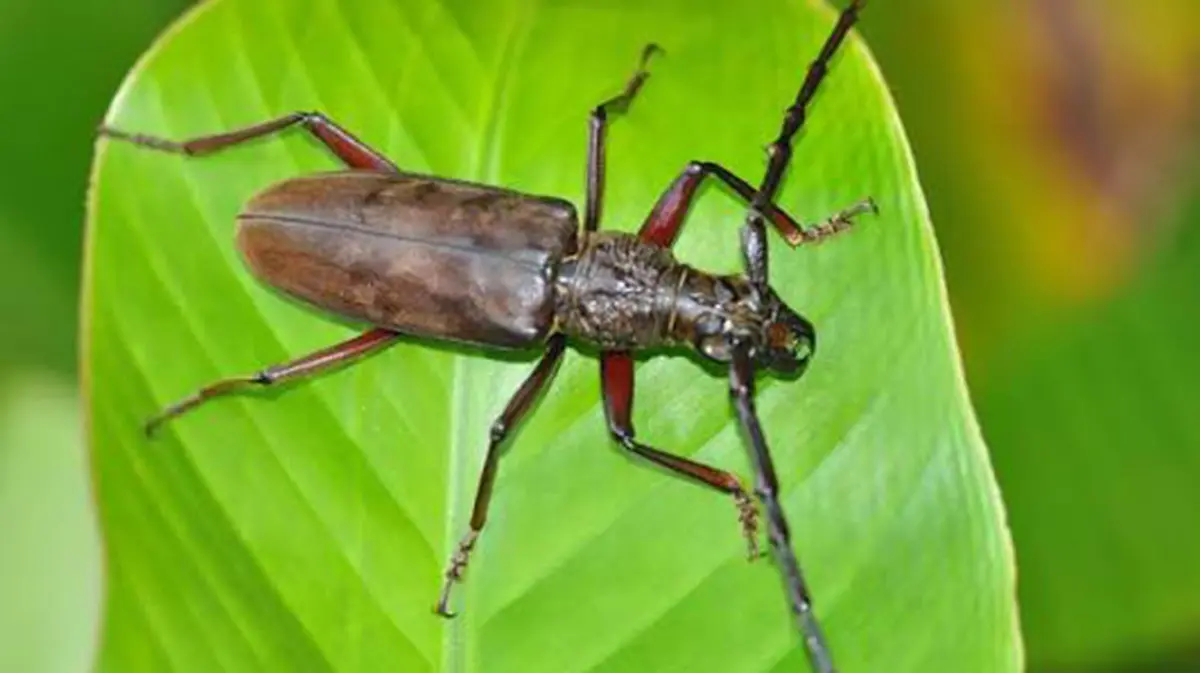
The sal heartwood borer is a longhorn beetle named Hoplocerambyx spinicornis.
It belongs to the beetle order Coleoptera and family Cerambycidae.
Adult beetles reproduce during rains, after which their larvae tunnel inside sal trunks.
Larvae first damage bark and outer wood before deeper tunnels reach the central heartwood.
This damage disrupts water movement and weakens trunks, while severe infestation can kill trees.
Name clue: Longhorn beetles receive their common name from the adults' unusually long antennae.
How can infestation be recognised?
- Fine, sawdust-like material may collect around the lower trunk.
- Small holes and sap discharge may appear upon affected bark.
- The crown may become thin as internal damage interrupts water supply.
- Adult beetles may gather around artificial lights during the monsoon.
Weakened trees are usually vulnerable, although large outbreaks can attack apparently healthy trees.
What is happening in Madhya Pradesh?
Dindori identified 147,380 affected sal trees, whose possible felling could begin during September or October.
Central approval remains necessary, and the proposal covers trees with differing damage levels.
Reports placed Amarkantak's affected count near 24,000 trees, with control work continuing there.
East Karanjia is Dindori's worst affected range, accounting for about 90 per cent of collected beetles.
Officials also used control operations in West Karanjia and South Samanpur.
Why has the outbreak intensified?
Forest officers linked the increase with rainfall and humidity, which can favour beetle survival and breeding.
Larvae remain hidden inside trunks, so visible damage may appear months after initial infestation.
Officials describe an approximate 30-year cycle and identify 1997 as the previous major outbreak.
They expect the present cycle to intensify during 2026–27. This remains an official assessment, not a fixed biological rule.
What is the trap-tree method?
Forest teams use fresh sal material to attract adult beetles, which workers collect before breeding.
Removing adults reduces egg-laying, while timely destruction stops collected insects returning to forests.
The Forest Research Institute developed this approach for sal borer management.
Dindori established five collection centres and paid residents ₹2 for every supplied insect.
By 21 July 2026, the department had purchased 1,417,915 beetles. Officials expected about 2.5 million eventually.
The activity provides temporary income while drawing community knowledge into forest protection.
Why can felling become necessary?
Heavily infested trees can continue supporting larvae and future adults. Removing them may interrupt the pest's breeding cycle.
Dead or weakened trunks can also become dangerous. However, large-scale felling creates its own ecological costs.
Managers must identify trees accurately and remove infested material without spreading the insect.
What should long-term management include?
- Regular surveys should locate new infestation before extensive internal damage develops.
- Trap trees and sanitation work should follow scientifically suitable timing.
- Forest stress from fire, grazing and injury should be reduced.
- Native regeneration should replace ecological loss after necessary tree removal.
- Local communities should receive training, safety equipment and timely payments.
Conclusion
The outbreak needs rapid pest control, but lasting recovery also requires careful sal-forest regeneration.