

Why in news?
Bijalee, an 18-year-old tigress in captive care at Mumbai’s Sanjay Gandhi National Park (SGNP), died on 16 September. The Indian Express reported the death the following day, citing park officials. She had been receiving veterinary support after her food intake declined. Officials initially linked her deterioration to age, but said a post-mortem examination would determine the exact cause. The reported remaining count of eleven tigers concerns the park’s captive animals, not a census of wild tigers in its forest. Bijalee’s death brings attention to animal-care responsibilities within a protected area whose wider significance includes natural habitat, water catchments and public education.
A national park within a metropolitan landscape
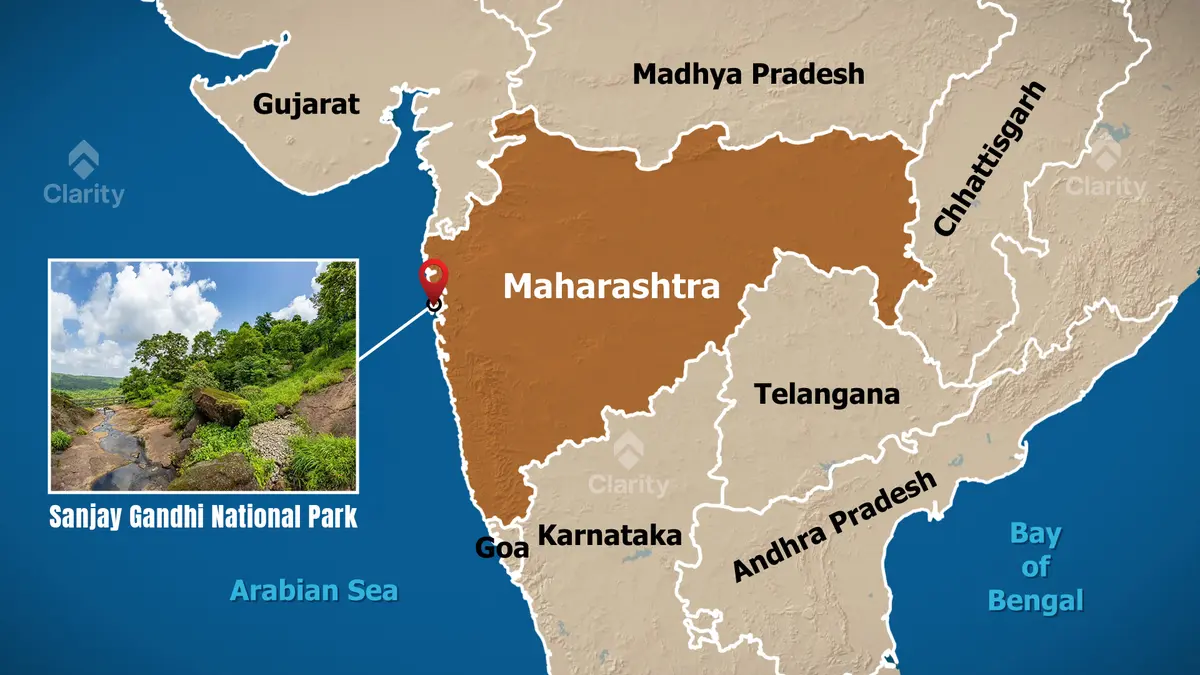
SGNP occupies a forested landscape in the northern Mumbai metropolitan area, with its familiar visitor entrance at Borivali. The surrounding urban region makes its setting distinctive, but the park is not simply a landscaped city garden. Its hills, woodland, streams and lakes support ecological processes that continue beyond the places visitors are normally shown.
The park’s official account links its history to the protection of the Tulsi and Vihar lake catchments. A catchment is the land from which water drains towards a lake or river. Protecting vegetation and managing disturbance around these waters therefore serves a purpose beyond providing shade or scenery. It connects the forest with the city’s water-related infrastructure and environmental conditions.
Kanheri’s rock-cut Buddhist caves add a historical dimension to the landscape. They are part of the park’s cultural setting, while the surrounding forest remains a living habitat. The presence of monuments and visitor facilities should not obscure the distinction between accessible attractions and areas managed primarily for wildlife and ecological protection.
The animal in care and the animals in the forest
Bijalee arrived from Pench in July 2016 and became a familiar animal to visitors and the park’s care teams. Her history concerns a managed animal population. The park’s natural fauna is a separate subject: its official account records leopards, deer, langurs and other mammals, alongside birds and reptiles. These populations cannot be inferred from the inventory of animals under captive care.
Captive care and wild-population conservation are related but different tasks. Captive animals depend on people for food, veterinary treatment and suitable living conditions. Wild populations depend on functioning habitat, prey, movement and protection from harmful disturbance. A change in one captive collection does not by itself establish a change in the abundance of a species across the surrounding forest.
The distinction also affects the information needed. An animal-care record follows individuals and their condition over time. A wild-population assessment asks how animals are distributed and how reliably they have been detected. Both require careful records, but they answer different questions. Reporting a captive count as a wild census would give readers the wrong picture of conservation.
What the veterinary account establishes
The available account records declining food intake, monitoring and supportive treatment before Bijalee’s death. Those observations help explain why the care team was concerned. They do not establish a final diagnosis. Age can influence an animal’s vulnerability, but that is only a preliminary explanation here. The post-mortem was intended to determine the actual cause.
For animal management, the useful lesson is the importance of connecting observations with clinical evidence. Changes in behaviour or feeding need to be recorded consistently so that veterinary decisions have a clear basis. After a death, examination findings can add information that observation alone could not provide. That process supports learning without requiring speculation about an unreported disease or failure.
Conserving the larger landscape
The forest’s value is not confined to its large mammals. The park’s fauna account also describes bats, butterflies, birds and aquatic life. Different species use different parts of the landscape, from tree cover to water-associated habitat. This diversity is a reason to look beyond the most visible attractions when considering what a protected urban forest is for.
In a metropolitan setting, public access and habitat protection must be planned together. Paths and facilities make education possible, while the location and intensity of use can influence disturbance. A useful visitor experience should help people understand the forest as a connected system. It should not imply that every area exists primarily to provide close encounters with animals.
Education can also explain the difference between sympathy for an individual animal and protection of a species in the wild. Both concerns are legitimate, but they lead to different responsibilities. Good care for animals already held in captivity does not remove the need for habitat conservation. Equally, the importance of wild habitat does not lessen obligations towards an animal dependent on human care.
Conclusion
Bijalee’s death is a specific animal-care event, with the final medical explanation awaiting the examination described by officials. It should not be converted into a claim about the park’s wild tiger population. SGNP’s broader role remains the protection of a forest, its water catchments and its diverse wildlife, alongside responsible care and meaningful public education.