

Why in news?
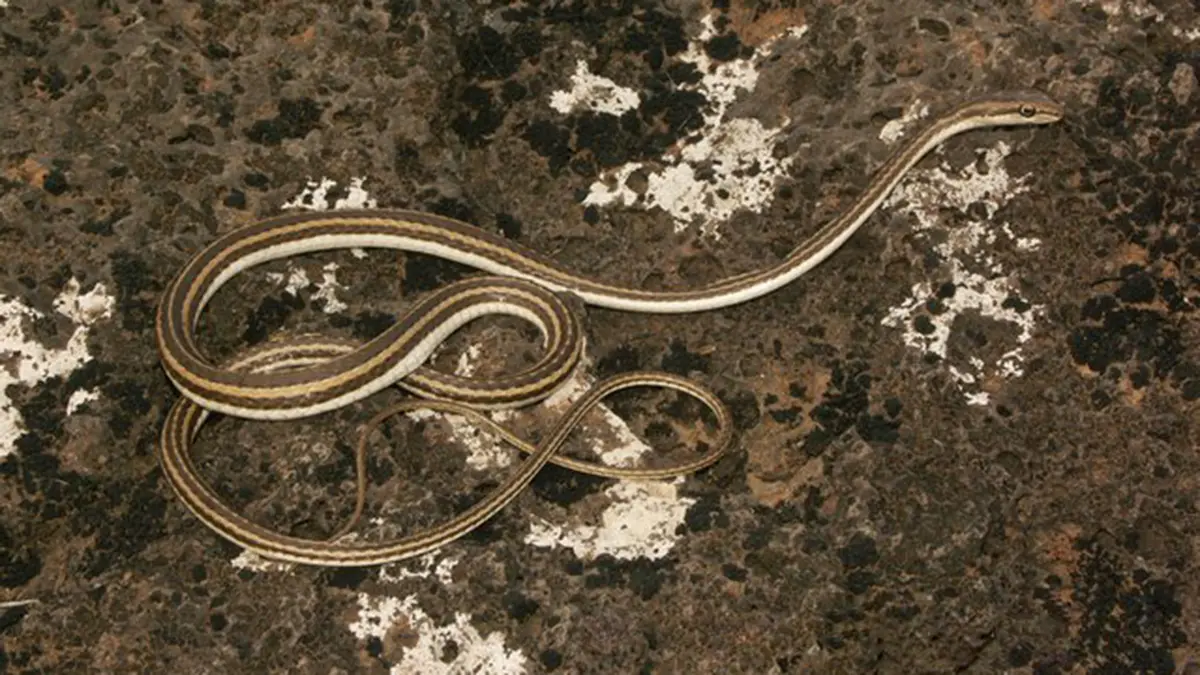
Forest officials in Gujarat reported a Schokari sand racer sighting near Kala Dungar in Kutch, documented on 6 September 2026. The Indian Express reported their account on 30 September, including the photographs and video used for identification. Officials compared the observation with a historical Kutch record associated with Ferdinand Stoliczka in 1872. The snake, scientifically named Psammophis schokari, is known from a much wider range across Africa and Asia. The significance is renewed documentation in a locality with a long gap in records. It is not a newly described species, proof of earlier extinction, or evidence that the snake exists only in Kutch.
Placing the sighting in its landscape
Kala Dungar forms part of northern Kutch's hill landscape overlooking the Rann. Kutch lies in Gujarat, in western India. The district's terrain is not one uniform expanse of open sand: hills, vegetated ground and saline lowlands form different habitats. The reported locality therefore matters more than a broad label such as “desert snake”, which can conceal the variety of environments an animal uses.
The Reptile Database places the species in the family Psammophiidae and records its scientific naming in 1775. Its range extends across parts of North Africa, the Middle East and South Asia, including northwestern India. A species can be well known across that broad range while remaining poorly documented in one district. A new local observation updates the distribution record without changing the animal's scientific identity.
How the snake uses its habitat
The species is associated with dry environments, but vegetation can be important within them. A national assessment for the United Arab Emirates describes its occurrence in vegetated sand and gravel areas, cultivated land and gardens. Individuals use the ground as well as shrubs and trees. Its prey includes lizards and other small vertebrates. These observations describe ecological habits documented elsewhere, not a newly completed study of the Kutch population.
Colour pattern also varies. Scientific records include striped, unstriped and partly striped forms. A photograph therefore needs to be interpreted through a combination of identifying features rather than one conspicuous marking. The species lays eggs, but a sighting of one animal does not establish that breeding occurred at that exact location. Repeated observations would provide a stronger basis for understanding local use of the habitat.
Why a gap in records is not the same as absence
The current account describes an observation by a forest officer followed by documentation and identification. A long interval between published records can arise for several reasons, including limited surveys and low detection. It does not by itself reveal whether the animal persisted locally throughout that period. Equally, one new record cannot establish a recent population increase or explain how the individual reached the site.
There is a useful scientific comparison from Lebanon. A study published in ZooKeys in February 2026 documented 17 records from eleven localities and examined genetic relationships. It confirmed the species in areas where its occurrence had previously been uncertain. Some records came from agricultural land and seasonally cold locations, showing that its ecological range is broader than a strictly desert-only description suggests.
The Lebanese findings do not establish a route connecting those animals with the Kutch individual. Their relevance is methodological: historical accounts, repeated observations and genetic evidence can answer different parts of a distribution question. The same distinction helps interpret the Gujarat news. The observation is valuable now, while more systematic work is needed to establish the extent and continuity of the local population.
Local rarity and conservation status are different questions
The United Arab Emirates' 2018 national assessment classified the species as Least Concern within that country. It also recorded local persecution and road deaths. That is a national assessment, not a population estimate for India or a substitute for evaluating Kutch. A broad distribution can coexist with local threats, just as infrequent local sightings do not necessarily mean global endangerment.
For Kutch, the immediate conservation value lies in a documented location that can guide further observation. Recording habitat, date and reliable identification makes future comparisons possible. Repeated surveys could then investigate where the snake occurs and whether local pressures affect it. Treating the sighting as evidence to build upon is more useful than treating a dramatic rediscovery label as a complete ecological explanation.
Conclusion
The Schokari sand racer sighting adds a credible local record to Kutch's wildlife knowledge. Its importance does not depend on claiming that a species returned from extinction. Further surveys can establish how widely it occurs in the surrounding landscape and which habitats support it. Repeated records would then help distinguish an occasional observation from an enduring local population.