

Why in news?
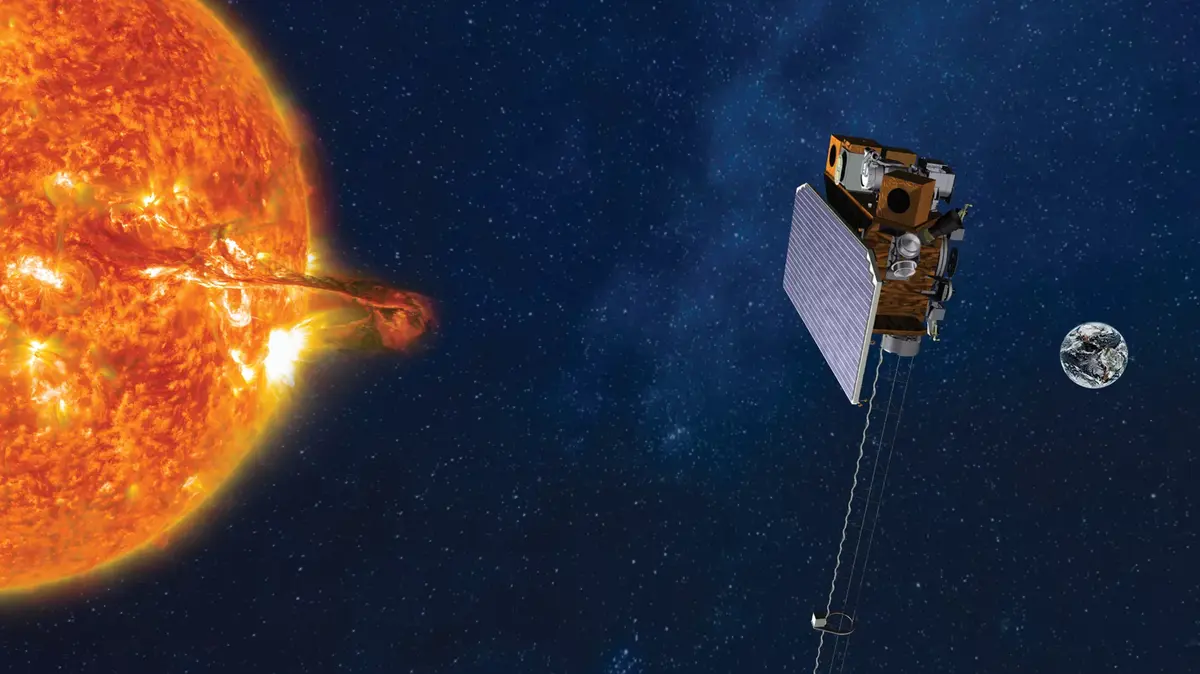
The United States National Oceanic and Atmospheric Administration (NOAA) has placed its first dedicated space‑weather satellite, SOLAR‑1, in orbit around the Sun–Earth Lagrange Point 1 (L1). The mission was officially renamed Space weather Observations at L1 to Advance Readiness (SOLAR‑1) after reaching its operational orbit in January 2026. This satellite is expected to provide faster and more frequent warnings about solar storms than older systems.
Background
For decades, space‑weather monitoring relied on missions like the Solar and Heliospheric Observatory, which took hours to transmit images. SOLAR‑1 builds on this history. It was launched aboard a Falcon 9 rocket from Florida on 24 September 2025 and travelled about 1.5 million kilometres to reach the L1 point, where the gravitational pull of the Earth and Sun balance. After a final engine burn on 23 January 2026, the spacecraft entered its working orbit and received its new name.
Key features
- Advanced instruments: The satellite carries a compact coronagraph to image the solar corona and a solar wind plasma sensor to measure charged particles. These instruments detect coronal mass ejections and solar wind streams that can disrupt power grids and satellites.
- Quick data delivery: Images from the coronagraph reach forecasters within 30 minutes, compared with 8 hours or more for previous missions. This rapid delivery helps agencies issue timely geomagnetic storm alerts.
- Long‑term coverage: Positioning the satellite at L1 allows continuous viewing of the Sun. Unlike Earth‑orbiting satellites, SOLAR‑1 can monitor the solar wind before it hits the planet, extending warning times and improving aurora forecasts.
- Name and legacy: Initially called the Space Weather Follow‑On L1 mission, it was renamed to reflect its role as NOAA’s first stand‑alone space‑weather observatory. Its successful deployment marks a milestone in space‑based weather services.
Conclusion
By positioning SOLAR‑1 at the L1 point with advanced sensors, NOAA has significantly enhanced humanity’s ability to anticipate solar storms. The mission demonstrates how modern engineering can improve warning times and protect power grids, satellites and other critical infrastructure. It represents a new era of dedicated space‑weather monitoring.