

Why in news?
A peer-reviewed study confirmed the spoon-tailed duskhawker in India through verifiable photographs. The male dragonfly was recorded inside Namdapha National Park in Arunachal Pradesh. Its image had earlier been assigned to another species. The correction now supports its inclusion in Indian and South Asian checklists.
What the study found
The Journal of Threatened Taxa published the study on 26 August 2026. The species is scientifically named Gynacantha basiguttata. It belongs to the order Odonata and family Aeshnidae. Its common name refers to the shape of its terminal abdominal appendages.
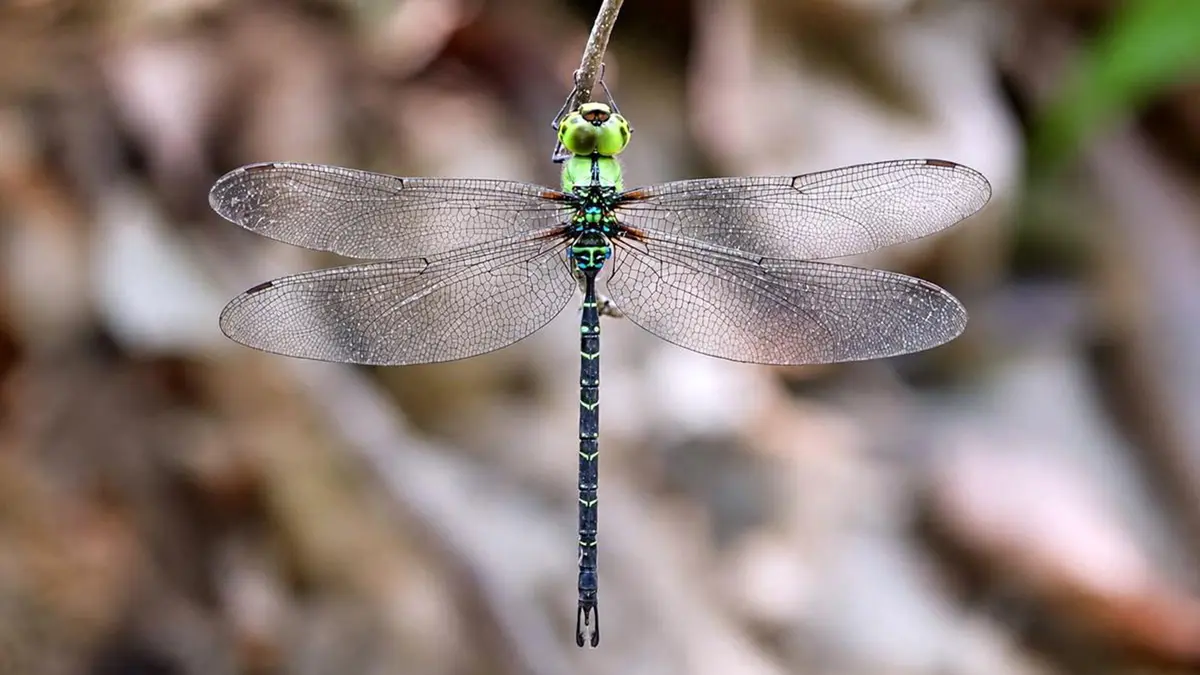
A single male was photographed on 16 October 2024. It was hanging vertically from roadside vegetation on a cloudy morning. The site lay along the Miao–Vijaynagar road inside Namdapha. The researchers recorded an elevation of about 600 metres.
The image first appeared in a study about Gynacantha khasiaca. A later examination showed that one photographed individual was different. The authors formally corrected that record. Scientific corrections protect the reliability of distribution data.
How the species was identified
The male shows a black T-shaped mark on the front of its head. Its thorax is olive green and lacks lateral stripes. Dark pigmentation occurs near the bases of both wing pairs. Its cerci are narrow below and broaden at their ends.
These expanded cerci create the spoon-like appearance. The paper also examined wing cells and markings across the abdomen. Researchers compared these features with published identification keys. They did not collect a specimen because forest rules barred collection.
Photographs can establish a record when diagnostic structures remain visible. However, good images must show the required characters. Date, location and habitat information also strengthen the evidence. The paper presents these elements and explains the earlier error.
Why the Indian record needed clarification
Older literature mentioned the species from Bengal and Assam. Those claims relied on female museum specimens whose identification later became doubtful. Recent Indian and South Asian checklists therefore excluded the species. The new male photograph supplies evidence that was previously missing.
The dragonfly was first described from the Philippines in 1882. Verified records also occur across parts of Southeast Asia. The International Union for Conservation of Nature assesses it as Least Concern globally. That global category does not describe its local abundance in India.
Geography of the discovery
Namdapha lies in Changlang district of eastern Arunachal Pradesh. Myanmar adjoins the reserve towards the south and south-east. Kamlang forests connect on the northern side. Other forests extend westwards through the Namsai and Nampong landscape.
The reserve contains tropical evergreen forests, temperate vegetation and alpine scrub. Its steep altitude range creates many small habitats. Forest pools, streams and shaded wet patches are especially important for dragonflies. The Noa-Dihing River drains much of this mountainous catchment.
This location sits near the meeting zone of Indian and Indo-Chinese biogeographic regions. Species from both regions can occur within the wider landscape. A verified range extension is therefore ecologically plausible. It still requires direct evidence, which the new paper provides.
What the finding means for conservation
One photograph cannot reveal population size or trend. Further surveys should revisit the road and nearby wet habitats. Work should cover different seasons and times of day. Researchers can then assess whether the species breeds locally or appears only rarely.
Dragonflies depend on aquatic habitat during their immature stage. Forest shade and water quality can therefore matter together. Roads, drainage changes and pollution may alter these small sites. Protecting the wider habitat is more useful than focusing only on one photographed insect.
A record and a rectification
The discovery is not based on a newly collected specimen. It rests on a re-examined photograph with visible diagnostic characters. The authors openly corrected the previous identification and documented their reasoning.
Conclusion
The study places Gynacantha basiguttata on firmer scientific ground within India. It also shows why published records must remain open to correction. Namdapha’s varied wet forests may hold more overlooked invertebrates. Repeated surveys should now establish distribution and breeding status. Conservation decisions must follow that evidence.