

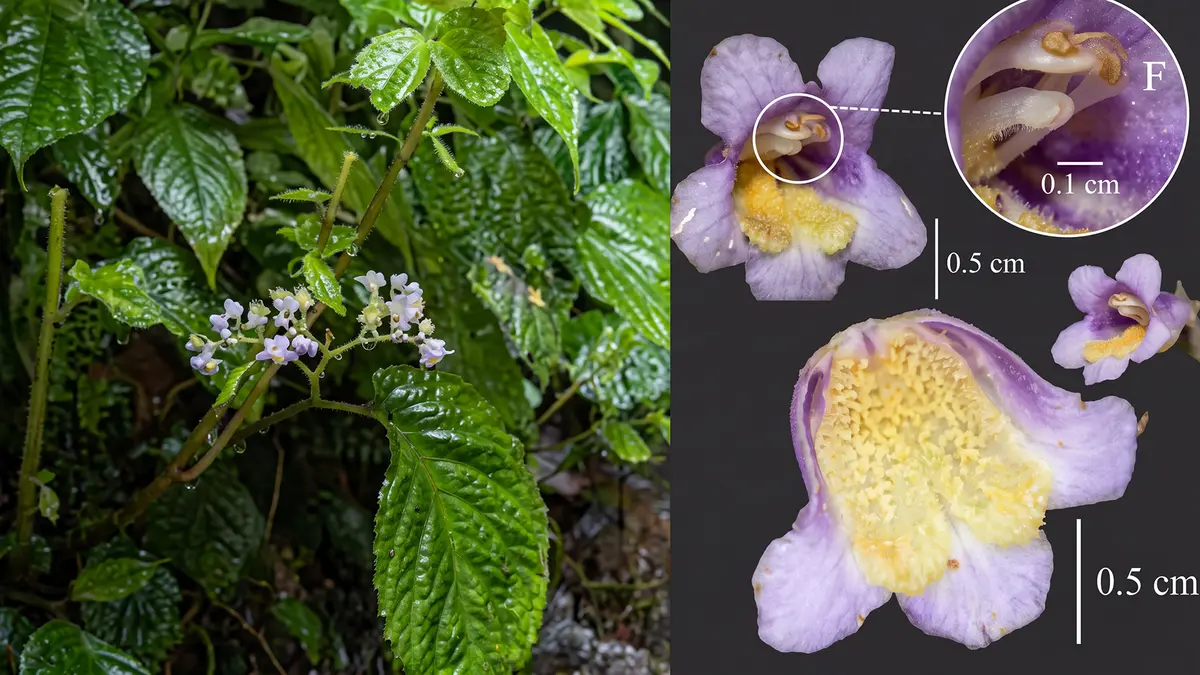
Why in news?
A team of Indian botanists recently discovered a delicate herb with a striking yellow patch inside its flower. This newly described species, named Stauranthera aureoglossa, grows along shaded Himalayan streams. Scientists have provisionally listed it as an endangered species because only a few populations survive in the wild and their habitats are under pressure.
Background
During a floristic exploration in August 2025, researchers from the Thackeray Wildlife Foundation and the University of Trans‑Disciplinary Health Sciences and Technology came across an unusual herb growing on damp rocks in the dense evergreen forests of Arunachal Pradesh. When they compared it with known plants, they realised it represented a previously undescribed species. The plant belongs to the Gesneriaceae family and was later named Stauranthera aureoglossa, meaning “golden‑tongued” in Latin.
Key features
- Habitat and distribution: The herb clings to wet rocks and soil beside streams in the mid‑elevation evergreen forests of Kamle and Upper Subansiri districts in Arunachal Pradesh. Researchers observed only two small populations roughly twenty kilometres apart, totalling fewer than 110 plants.
- Morphology: The plant bears a bell‑shaped, bluish‑purple flower. Unlike its close relatives, its flower lacks a tubular spur at the base. Instead, the lower lip of the corolla carries a raised, bumpy, yellow patch that resembles a tongue. This distinctive feature inspired the species name. The leaves are diamond‑ or spear‑shaped.
- Conservation status: Because the populations are tiny and confined to fragile stream‑side habitats, scientists believe the species is endangered. Logging, landslides and road‑widening projects are damaging its habitat, so immediate conservation measures are needed.
Significance
The discovery of Stauranthera aureoglossa adds to our understanding of the plant diversity of the Eastern Himalayas. It highlights the need for careful management of road and infrastructure projects in biologically rich regions, as even small disturbances can threaten little‑known species. Conserving such plants protects the broader ecosystem on which local communities depend.
Sources: Research Matters