

Why in news?
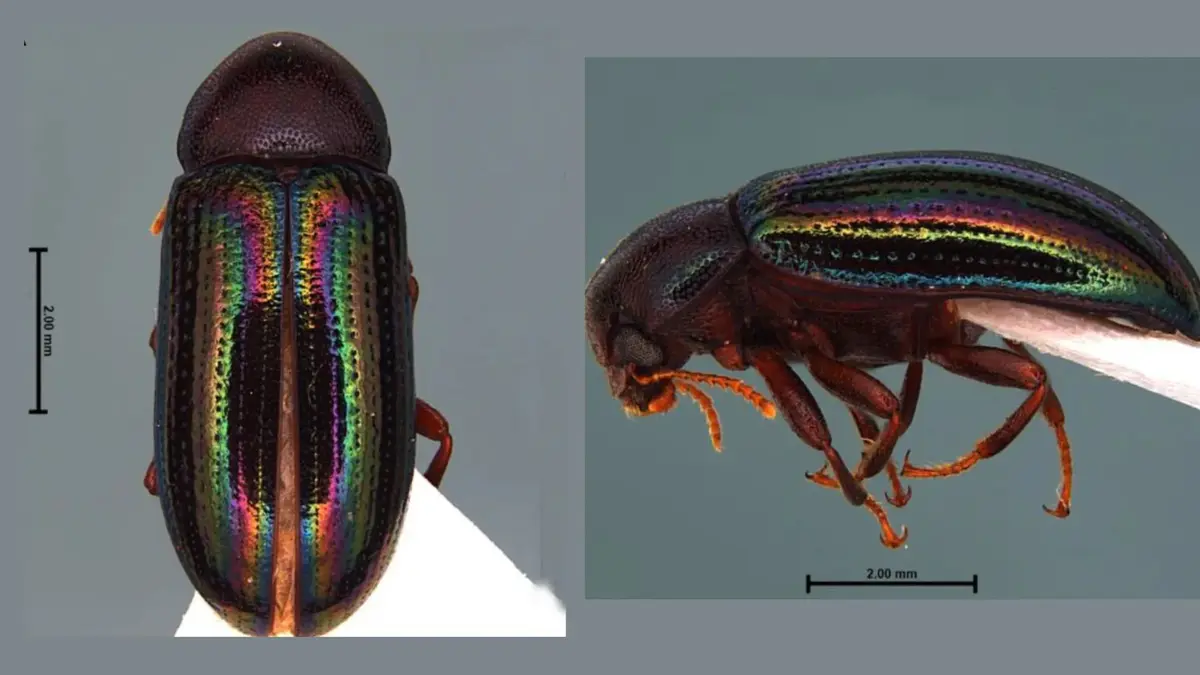
A report on 15 September has brought attention to a newly described darkling beetle from Wayanad Wildlife Sanctuary in Kerala. Named Steneucyrtus wayanadensis, it was formally described in the Records of the Zoological Survey of India on 27 August 2026. The research also revisited an older species, Steneucyrtus pexicollis, and provided an identification key for related beetles in the Indian subcontinent. The new species was distinguished through careful examination of body structures, not simply its striking golden-green sheen. Its recognition adds to knowledge of the Western Ghats, while leaving further questions about distribution, abundance and ecological requirements for future field research.
What makes this a scientific discovery
The paper was authored by T. K. Viswanath, Vishwanath D. Hegde and K. M. Remia. Their institutions include the Zoological Survey of India’s Western Ghat Regional Centre and MES Mampad College. The published description names and illustrates the new species, while comparing it with relatives. This comparison is essential because an unfamiliar specimen may otherwise be mistaken for variation within an existing species.
Research Matters reported that the beetles were collected using light traps in the Chethalayam forest area of Wayanad. Light traps attract insects active around artificial light and allow researchers to examine the catch. Their use establishes how these specimens were obtained. It does not mean that the species’ complete daily behaviour or range can be inferred from those collections.
Looking beyond the metallic colour
Beetles possess hardened forewings called elytra, which cover and protect the wings beneath. Their surface can contain ridges, grooves and small punctures. Taxonomists examine the arrangement of these structures because related species can share a similar overall appearance. The space between two grooves is called an interval; its shape can help distinguish otherwise similar beetles.
The Research Matters account highlights comparatively flat intervals and the pattern of punctures in the new species. It contrasts these with features in Steneucyrtus pexicollis and Steneucyrtus srilankae. These are anatomical comparisons, not a claim that colour alone defines the species. The reported golden-green sheen is an identifying attraction for readers, but the diagnosis rests on more detailed examination.
The paper also supplies an identification key. Such a key guides a reader through successive choices between observable features. It allows another researcher to test an identification systematically rather than relying on a photograph or a general resemblance. Its usefulness depends on access to the relevant structures and on the condition of the specimen being examined.
A new species and a rediscovered species are different findings
The companion finding concerns Steneucyrtus pexicollis, originally described in 1896. Rediscovery refers to renewed scientific documentation of an already named species. It should not automatically be translated as recovery from extinction. An absence of recent records may reflect limited collecting, overlooked specimens or uncertainty about identification, rather than proof that the animal had disappeared completely.
A formal name also needs a stable reference. The International Code of Zoological Nomenclature uses name-bearing specimens to anchor species names. Later researchers can compare new material with those references and the published diagnosis. Accessible descriptions and maintained collections therefore make a discovery open to checking. Its acceptance need not depend solely on one team’s assertion.
The sanctuary within a larger forest landscape
Wayanad Wildlife Sanctuary was established in 1973 and covers approximately 344.44 square kilometres. It lies in northern Kerala, close to Karnataka and Tamil Nadu. Its separate northern and southern sections are commonly associated with Tholpetty and Muthanga. Nearby protected landscapes include Bandipur in Karnataka and Mudumalai in Tamil Nadu, making state boundaries a poor guide to the ecological connections.
The sanctuary forms part of the broader Nilgiri landscape, where forests and other habitats extend across all three states. The Nilgiri Biosphere Reserve received recognition under the United Nations Educational, Scientific and Cultural Organization’s biosphere programme in 2000. That designation is distinct from the Western Ghats World Heritage property, which comprises selected component sites rather than every forest in the region.
For a newly described insect, these large landscape labels provide context but do not establish its range. A specimen from one forest does not prove occurrence throughout the biosphere reserve. Surveys in comparable habitats could test that possibility. Until then, the locality of collection and the wider area of potential investigation should remain clearly distinguished.
Conclusion
Steneucyrtus wayanadensis demonstrates how detailed taxonomic work can reveal diversity that broad wildlife surveys may miss. The discovery combines a new description with improved tools for recognising related beetles. Its lasting value will come from specimens, repeatable comparisons and additional field records. Those foundations can gradually turn a new name into a fuller understanding of the insect’s place within the Western Ghats.