

Why in news?
An Indo-German research collaboration documented fifteen Stenus beetle species new to science. The specimens came from waterfalls and forests in Arunachal Pradesh. The formal study appeared in Linzer Biologische Beiträge. It raises the recorded Stenus diversity of the state to 103 species.
What the researchers reported
Taxonomist Volker Puthz described the findings in a forty-seven-page paper. The new beetles measure between 1.9 and 6.5 millimetres. The wider assessment also added twenty-one Indian records and forty-four state records. A new record differs from a species newly described to science.
Several new names recognise researchers connected with the project. Reported examples include Stenus gogoii, Stenus dobiami and Stenus sonui. Other names recognise German collaborators. Scientific names remain tied to diagnostic descriptions and designated specimens.
The broader collaboration links Rajiv Gandhi University with the University of Tübingen. Field expeditions covered parts of Pakke-Kessang, West Kameng and Shi-Yomi. Researchers collected insects during 2024 and 2025. Local communities supported access and fieldwork in difficult terrain.
What “new to science” means
A species can live for millennia before science formally names it. “New” therefore describes scientific recognition, not recent evolution. Researchers compare body structures with named species and museum specimens. They also record the locality, sex and distinguishing characters.
Beetle taxonomy often examines very small features under magnification. Body proportions, punctures and reproductive structures can separate close relatives. Photographs and identification keys allow later checking. A type specimen anchors each accepted name to physical evidence.
Genetic information can strengthen species boundaries, but morphology remains central in many beetle descriptions. Different lines of evidence may later revise a classification. That is a normal part of taxonomy. A published name creates a testable starting point for further work.
Rove beetles and the genus Stenus
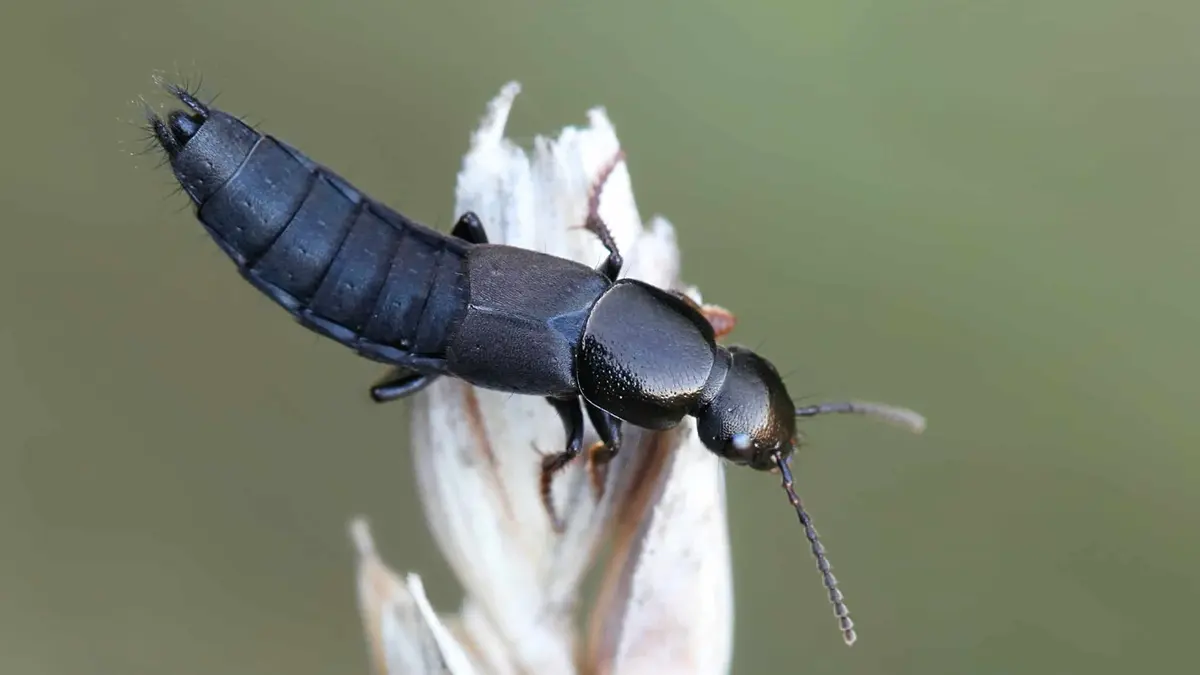
Rove beetles belong to the family Staphylinidae within the order Coleoptera. Many have short hardened wing covers called elytra. These expose several flexible abdominal segments. Their raised abdomen can resemble a scorpion, but it carries no scorpion sting.
The family is extremely diverse in form and ecology. Many species are predators, while others eat fungi or decaying material. Some live under bark, in leaf litter or near water. Broad claims about every rove beetle should therefore be avoided.
Stenus is a species-rich genus in the subfamily Steninae. Many members favour damp margins, moss, leaf litter and streamside habitats. They are small predators of other invertebrates. Some possess an extendable mouthpart that helps seize quick prey.
Why Arunachal Pradesh supports high diversity
Arunachal Pradesh lies in the Eastern Himalaya of north-eastern India. Bhutan borders it to the west and China lies to the north. Myanmar adjoins its eastern side. Assam and Nagaland lie along the southern and south-eastern margins.
The state rises from humid foothills to high Himalayan terrain. Deep valleys, forests and fast streams create many separate habitats. Temperature and vegetation change rapidly with altitude. Small isolated populations can therefore follow different evolutionary paths.
Waterfalls and moist forest floors contain numerous microhabitats. Shade, spray and decaying leaves support prey and shelter. A beetle restricted to one valley may remain overlooked. Repeated sampling across seasons is essential for a reliable inventory.
Why the discovery matters
Taxonomy provides the names required for conservation and ecological research. Scientists cannot track decline without knowing which species occur. A richer inventory can reveal small areas with exceptional endemism. It can also guide environmental assessments before roads or other projects.
Predatory beetles contribute to food webs and nutrient cycling. Their response to moisture and habitat change may offer useful ecological information. That possibility requires species-level evidence. It should not be converted into a universal claim about biological pest control.
The findings also show the value of long international partnerships. Local universities provide regional knowledge and continuity. Specialist taxonomists add comparative expertise and collections. Community cooperation makes field access safer and more respectful.
Conservation and research needs
A description does not automatically establish conservation status. Researchers need distribution, abundance and habitat information. Some species may be widespread beyond sampled sites. Others may depend on one moist forest or stream.
Specimens and field records should remain accessible to Indian institutions. Digital images and locality data can support future checks. Sensitive coordinates may require protection from collecting pressure. Benefit-sharing and permits must respect national biodiversity law.
Long-term monitoring should include water quality and forest disturbance. Climate shifts may alter cool, wet microhabitats. Roads can fragment slopes and increase sediment in streams. Baseline taxonomy allows those changes to be measured more accurately.
Discovery and distribution are different findings
Fifteen species were formally recognised as new. Other records showed that already named species occur in India or Arunachal Pradesh.
Conclusion
The fifteen descriptions reveal how much Eastern Himalayan insect diversity remains undocumented. Careful taxonomy turns small specimens into usable scientific knowledge. Arunachal’s terrain explains both its richness and its sampling difficulty. Future surveys must connect names with habitats and population trends. Conservation becomes stronger when it rests on such precise evidence.