

Why in news?
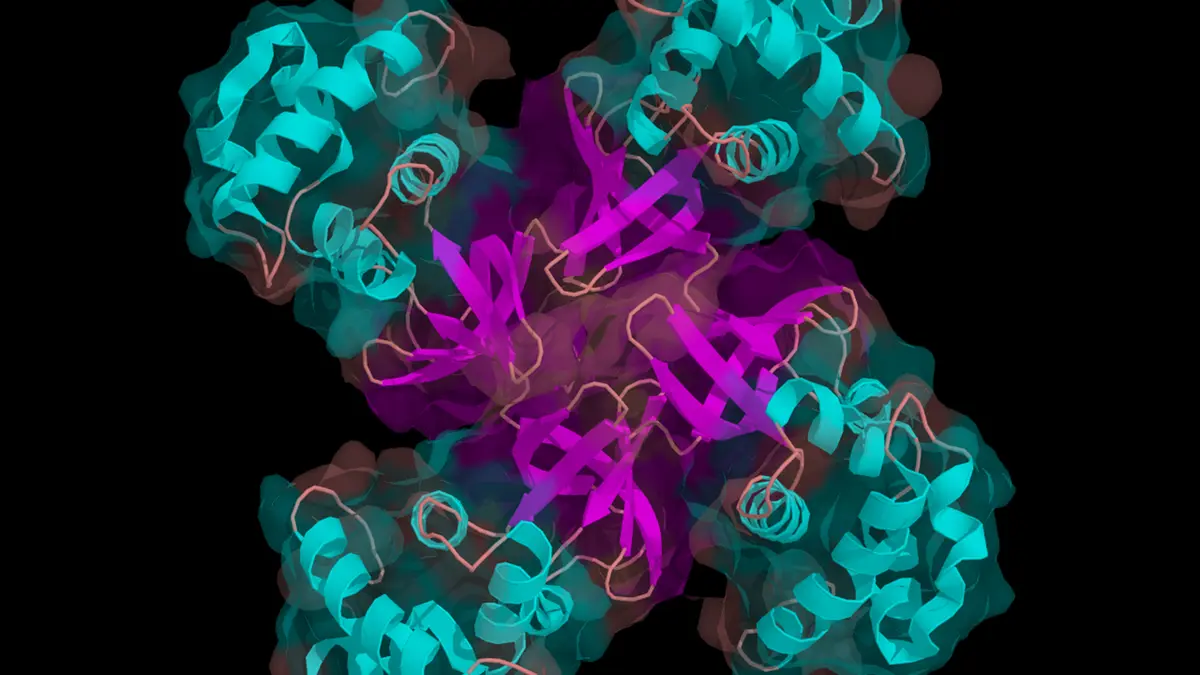
Researchers mapped how the Sld3–Sld7 complex detects a prepared replicative helicase and loads the Cdc45 protein.
What does a helicase do?
Deoxyribonucleic acid, or DNA, stores genetic information in two paired strands. Those strands must separate before a cell copies its genome.
Helicases are molecular motors that help open nucleic acids. They use energy from adenosine triphosphate to move along DNA or ribonucleic acid.
Opening the double helix creates a replication fork. DNA polymerases then build new strands by using each old strand as a template.
A replication error can create mutations or broken chromosomes. Cells therefore activate their copying machinery through several controlled stages.
The MCM2–7 machine
Eukaryotic cells use the minichromosome maintenance complex 2–7 as their main replicative helicase. Six related proteins form each ring-shaped MCM2–7 complex.
Two rings are loaded around double-stranded DNA before replication begins. This inactive double hexamer marks a licensed origin of replication.
Licensing occurs before the cell enters the synthesis phase. It separates helicase loading from helicase activation and limits repeated copying.
The inactive ring becomes an active helicase only after other factors join it. Cdc45 and Go-Ichi-Ni-San, or GINS, form the active helicase.
One engine, several safety locks
The helicase is loaded first and activated later. This sequence helps each chromosome region begin copying only once.
What the structural work found
A Dbf4-dependent kinase first adds phosphate groups to the double hexamer. This change exposes binding sites on the Mcm4 and Mcm6 subunits.
Sld3 uses two short recognition regions to read those prepared sites. Sld7 anchors the complex near the Mcm2–Mcm6 interface.
The researchers used cryogenic electron microscopy to view these assemblies. This method reconstructs structures from rapidly frozen biological particles.
The images show how Sld3 positions Cdc45 near the Mcm2–Mcm5 gate. Cdc45 can then help seal and activate the helicase ring.
Sld3–Sld7 forms a paired assembly in solution. Its shape changes after binding the double hexamer, allowing orderly Cdc45 placement.
Why the finding matters
The study fills a missing step between helicase licensing and activation. It shows how phosphorylation becomes a physical signal for protein recruitment.
This mechanism was reconstructed mainly with budding-yeast proteins. Yeast provides a powerful model, but human proteins are not identical.
Human cells use related factors, including Treslin and Mdm2-binding protein, or MTBP. The core logic appears conserved across eukaryotes.
Faulty replication control can promote genome instability, ageing and cancer. Structural knowledge may reveal future drug targets or research tools.
However, the study does not produce an immediate medicine. Any therapeutic strategy must avoid harming normal DNA replication in healthy cells.
A molecular handover has become visible
The work shows how a prepared but inactive helicase receives Cdc45. That handover begins conversion into a working replication motor.
Conclusion
DNA copying depends on timing as much as chemistry. The new structures explain an important checkpoint within that tightly ordered process.
Further studies must test the mechanism in human cells. They must also examine how failures contribute to disease.