

Why in news?
Scientists have described a striking new plant species named Thismia daemona from western Thailand. They found one small population inside Thong Pha Phum National Park in Kanchanaburi Province. The peer-reviewed description appeared in the journal PhytoKeys on 17 August 2026. Its unusual dark flower and extremely restricted record have attracted scientific attention.
What kind of plant is it?
Thismia daemona belongs to the flowering-plant family Thismiaceae. It is achlorophyllous, meaning that it lacks the chlorophyll needed for photosynthesis. The plant therefore cannot make food from sunlight like most green plants. It obtains carbon through a close relationship with fungi in the soil.
This nutritional strategy is called mycoheterotrophy. Fungal partners connect with the plant's underground tissues and provide organic carbon. The relationship also depends upon the surrounding forest system that supports those fungi. Protecting the visible flower alone would not preserve that network.
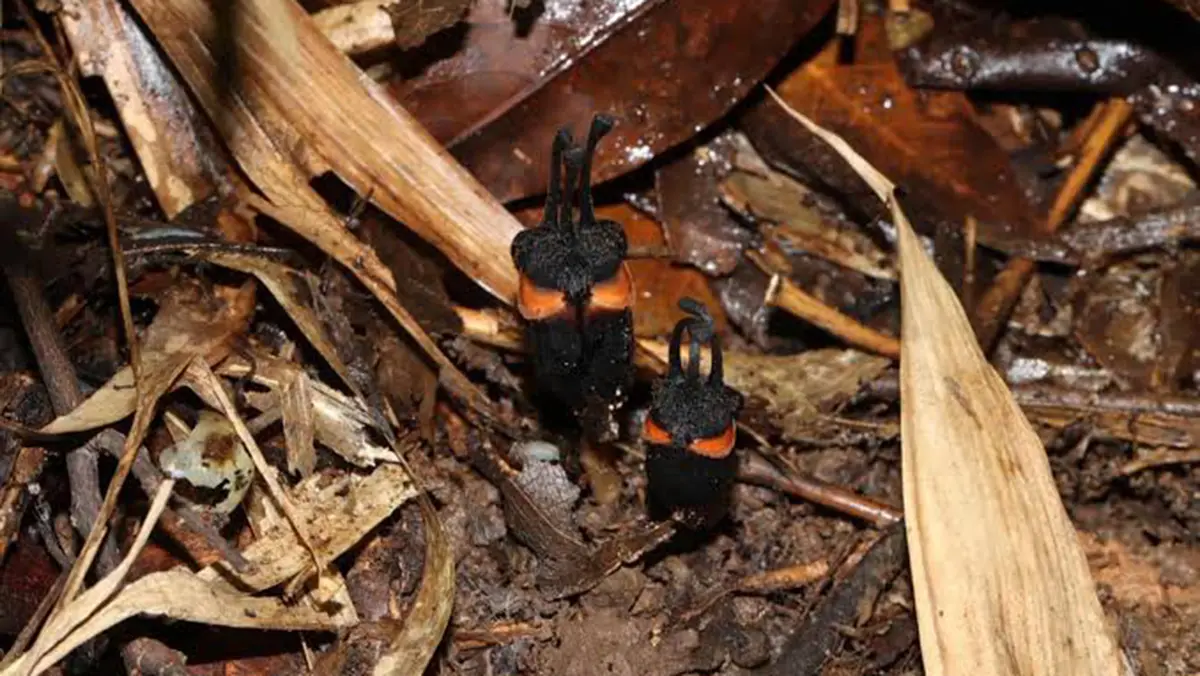
The plant has coral-like roots and a short body reaching about 125 millimetres. It produces between one and three flowers. The flower is largely blackish, with fleshy reddish-orange outer tepals and translucent blue parts. That combination inspired comparisons with a small mythical creature.
How researchers established a new species
The team collected two specimens during fieldwork in May 2025. It recorded the site, elevation and physical characters in detail. Researchers compared the plant with known members of Thismia. They also analysed three nuclear and two mitochondrial genetic markers.
The results placed the plant within section Geomitra. Its closest sampled relative was Thismia betung-kerihunensis from Borneo. However, its floral structure, colouring and genetic sequence were distinct. The authors therefore proposed and formally described a separate species.
A type specimen now provides the permanent reference for the name. Type material is essential when later scientists compare similar collections. Photographs and genetic data add useful evidence. None of them replaces a properly documented physical specimen under botanical rules.
Where was it found?
The known site lies around 970 metres above sea level in Thong Pha Phum National Park. Kanchanaburi Province is west of Bangkok and borders Myanmar. Its western mountains form part of the Tenasserim range. Moist forest and complex terrain support high biological diversity across this frontier.
The tiny population occupied a shaded forest microhabitat. Fewer than fifty individuals were reported during the study. Plants of this group may appear above ground only while flowering. A short survey can therefore underestimate both numbers and distribution.
Western Thailand also connects mainland Southeast Asian and Sundaic biological regions. Mountain valleys and forest blocks can isolate small populations. Such isolation encourages evolutionary divergence but increases local vulnerability. Fire, trail disturbance or fungal disruption may affect an entire known population.
How its conservation position should be read
The authors proposed that the species meets Critically Endangered criteria. Their assessment reflected one known location, few observed plants and possible disturbance. This is a scientific recommendation based on available evidence. It should not be confused with a completed global listing by the International Union for Conservation of Nature.
Formal assessment would need a clearly defined range, population evidence and threats. Repeated seasonal surveys could reveal overlooked sites. Researchers should also document the fungi supporting the plant. Conservation plans must protect forest soil, moisture and host networks together.
Public attention creates both support and risk for a rare species. Precise location details can encourage illegal collection or trampling. Park authorities should control access around the population. Scientific sampling should remain minimal and properly permitted.
Why the discovery matters
Mycoheterotrophic plants expose biological relationships that ordinary vegetation maps miss. They depend upon fungi, which depend upon other forest organisms and soil conditions. Their presence can indicate a complex, functioning underground ecosystem. Losing that system may remove species before they are even described.
The study also shows the continuing importance of field taxonomy. Genetic databases cannot contain species that have never been collected. Local guides, park staff and botanists are essential to finding short-lived flowers. International collaboration can then compare specimens across wider regions.
Conclusion
Thismia daemona is an unusual addition to Southeast Asia's documented flora. Its survival depends upon an intact forest and underground fungal network. One known population cannot establish the species' full range. Careful seasonal surveys should guide any formal threat assessment. Protection must avoid both habitat damage and uncontrolled scientific collection.