

Why in news?
Pakistan's planned participation in a mission to China's Tiangong space station drew renewed attention in a 28 September Outlook report. Two Pakistani candidates had entered training in China, with one expected to fly as a payload specialist after completing the required assessments. Tiangong is an orbiting laboratory where astronauts live and conduct experiments for extended periods. The proposed mission would give Pakistan direct participation in research aboard the station and, if completed as announced, place its first astronaut there. The official programme remained at the training and selection stage. Neither the announcement nor the candidates' arrival established that the flight had already occurred.
How the cooperation developed
Pakistan's Space and Upper Atmosphere Research Commission, known as SUPARCO, records an agreement with the China Manned Space Agency dated 28 February 2025. It provides for astronaut selection, training and participation in the Chinese space-station programme. The arrangement links a prospective crew member with planned experiments. Participation therefore involves both preparing the person for flight and preparing the research to be carried out.
An April agency account identified Muhammad Zeeshan Ali and Khurram Daud as the two candidates admitted for training in Beijing. One was to participate as a payload specialist after completing training and evaluation. That sequence is important: selection for training, qualification for flight and completion of a mission are separate milestones. The September reporting concerned a prospective flight, not a completed national first.
The station's three-module foundation
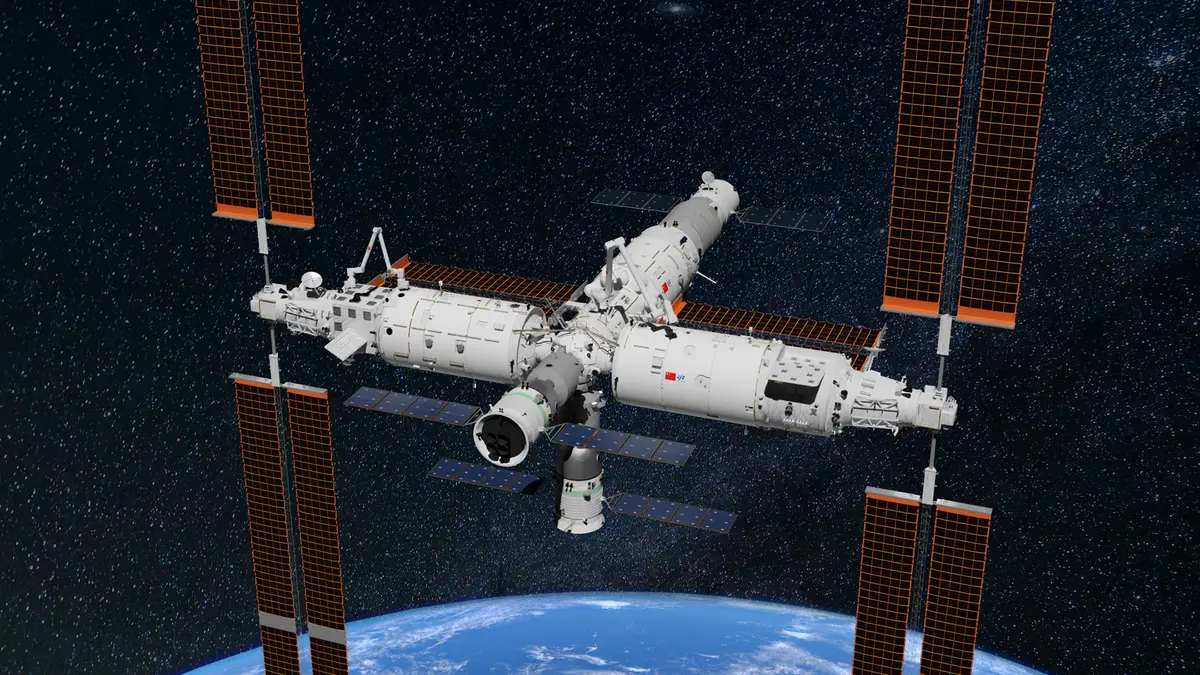
Tiangong is a modular station, meaning its major sections were launched separately and joined in orbit. Tianhe, the core module, was launched in 2021. Wentian and Mengtian, the two laboratory modules, followed in 2022. The China Manned Space Agency's construction account shows their assembly into the station's basic T-shaped configuration.
The core module provides central management and control functions, while the laboratories add space and facilities for experiments. Docking arrangements allow visiting crew and cargo spacecraft to connect with the station. This makes Tiangong different from a single short-duration spacecraft: crews can use a continuing orbital facility while transport vehicles bring people and supplies.
The agency's station design also describes Xuntian as a separately launched optical telescope intended to share the station's orbital environment. It should not be counted as an already attached permanent fourth module. A telescope, a laboratory module and a visiting spacecraft have different functions, even when they belong to the same wider space programme.
Why things float even though gravity remains
The station's research value partly comes from microgravity, the condition of near-weightlessness experienced in orbit. This does not mean Earth's gravity has disappeared. The station, its occupants and loose objects are all falling around Earth together. Their forward motion keeps them in orbit rather than allowing them to fall straight to the surface.
Because objects share that motion, they appear to float relative to their surroundings. On the ground, a container supports its contents against gravity; in orbit, container and contents move together. This changes how processes affected by settling, buoyancy and weight can be studied. The physical environment allows experiments that differ from otherwise similar arrangements on Earth.
NASA also uses short-duration methods on Earth to study microgravity, including drop facilities and aircraft flights. An orbital station provides a different opportunity: experiments can continue for much longer and may be tended by a crew. That does not make every experiment automatically superior. The value depends on the research question, equipment and whether the orbital environment addresses a real scientific need.
What a payload specialist contributes
A payload is the equipment or experiment carried to fulfil a mission's purpose. A payload specialist is trained for responsibilities associated with that work. The role still requires preparation for the spacecraft environment and safety procedures. Expertise in an experiment does not remove the need to function within the crew's operational arrangements.
SUPARCO's programme describes intended work across scientific and technological fields. These are proposed research opportunities, not already demonstrated benefits for agriculture, medicine or industry. An experiment must produce usable observations, undergo analysis and support a result before wider applications can be claimed. A successful launch and a useful scientific finding are distinct achievements.
International participation takes more than one form
The United Nations Office for Outer Space Affairs has previously worked with China on opportunities for international experiments aboard the station. Sending an experiment and sending an astronaut are different forms of participation. An experiment can give researchers access to an orbital facility without a national crew member. An astronaut programme adds training and direct human participation in the mission.
The proposed Pakistani flight should be understood within that distinction. It could expand the country's experience of human spaceflight and onboard research. Those are prospective outcomes requiring completed training, an actual flight and useful work in orbit. Describing them as objectives preserves the significance of the programme without treating its planned results as achievements already secured.
Conclusion
Tiangong offers a continuing orbital laboratory, while the Pakistani programme seeks to add a trained payload specialist to its activities. The station's modular design and microgravity environment explain the research opportunity. As of this edition, the personnel programme remained prospective, with two candidates in training and one intended for flight. The next evidence to distinguish is qualification, mission participation and, later, the research actually produced.