

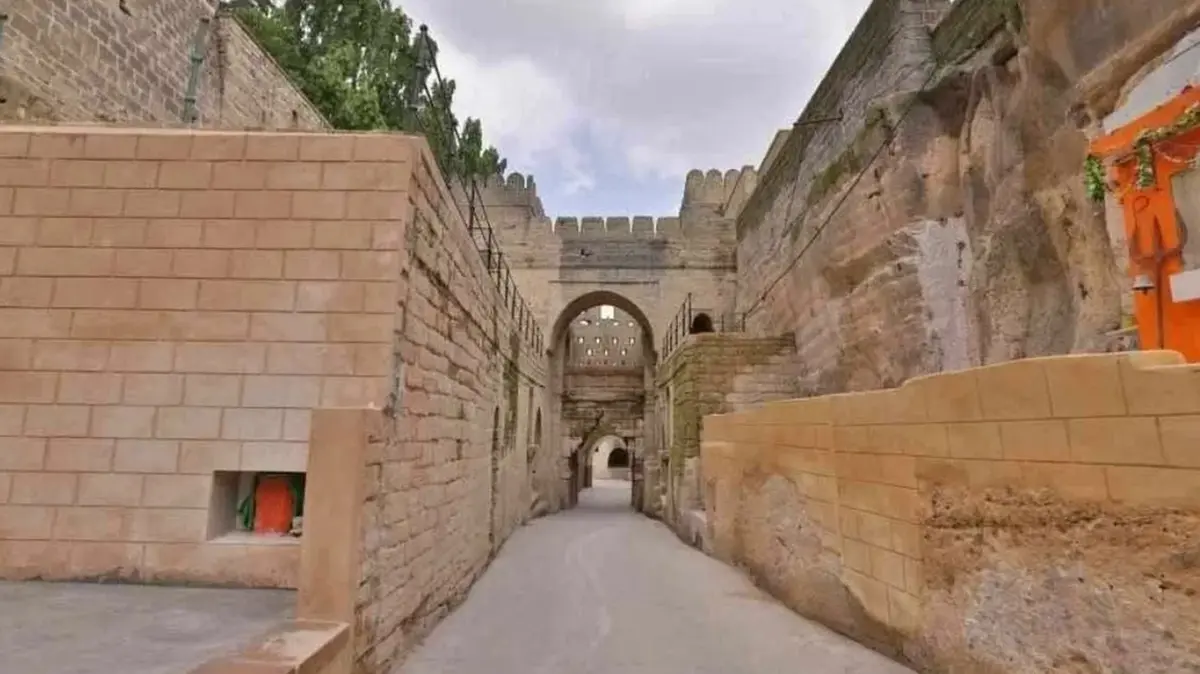
Why in news?
Uparkot Fort in Junagadh remained closed to visitors on 2 September 2026 following leopard sightings. Camera footage had recorded the animal within the fort complex. Forest personnel were monitoring the site before allowing public access again. The incident connects visitor safety with the management of wildlife around historic places.
The fort’s geographical setting
Uparkot stands in Junagadh, in Gujarat’s Saurashtra peninsula. The fort overlooks the city, with the Girnar hills towards the east. This elevated setting helps explain its historical defensive value. It also places the monument within a wider landscape rather than an isolated urban enclosure.
Girnar and Gir should not be treated as interchangeable place names. The immediate geographical reference for Uparkot is Junagadh and the Girnar hills. A leopard sighting inside the fort does not establish where the animal originated. Wildlife management must rely on observed movement rather than assumed travel routes.
The recent sightings were recorded on 30 August and 1 September. Public access remained suspended while officials checked the situation. This was a precautionary restriction at a popular heritage site. Its purpose was to avoid bringing visitors into an uncertain wildlife situation.
A monument built through successive periods
Gujarat Tourism associates the fort’s early origins with the Mauryan period. However, it also records repeated additions and changes over time. The surviving complex should therefore not be understood as one unchanged ancient construction. Its walls and internal buildings reflect different phases of political and architectural history.
Important features include Buddhist rock-cut caves and a former mosque. The complex also contains the Adi Kadi Vav and Navghan Kuvo water structures. These features bring religious architecture and water engineering into the same fortified space. Together, they show how a defensive settlement supported everyday life.
The water structures are especially useful for understanding the fort. Walls could protect an enclosed population only if essential supplies remained available. Access to stored or underground water was therefore strategically important. Their design deserves attention beyond their present value as scenic stops for visitors.
Why a sighting requires a careful response
Leopards can use landscapes close to human settlements when cover and food are available. Their presence does not automatically mean that an attack will occur. Nevertheless, a crowded visitor site creates avoidable risks during an uncertain encounter. Temporary access restrictions can give trained personnel space to assess the animal’s movements.
Camera records help establish where and when an animal was observed. They do not automatically show its present location throughout a large complex. Equally, the absence of a fresh image does not immediately settle the question. Decisions about reopening should therefore combine monitoring with professional assessment.
The Ministry of Environment, Forest and Climate Change emphasises coordinated responses to human-wildlife conflict. Local administration, forest personnel and site managers have different responsibilities. Communication between them can prevent conflicting instructions and unnecessary crowding. Visitors should follow official restrictions and avoid approaching or surrounding wildlife.
Managing heritage without ignoring ecology
Historic places need safety plans suited to their physical layout. Walls, vegetation and enclosed passages may complicate visibility and movement. An appropriate plan should identify how visitors receive warnings and leave restricted areas. This is a management requirement, not a reason to treat every wildlife sighting as a crisis.
Conservation decisions should also respect the monument’s historic fabric. Emergency access measures should avoid unnecessary damage to old structures. Regular coordination can help managers prepare before an incident occurs. Such preparation is more useful than relying only on improvised responses after crowds have gathered.
Clear public information is equally important during a temporary closure. Visitors need to know which areas are restricted and who authorises reopening. Rumours about capture, departure or danger can undermine that process. A dated, factual update helps protect both public confidence and the work of the response team.
Conclusion
Uparkot’s closure highlights the responsibilities that come with managing heritage in a shared landscape. Public safety and wildlife protection need not be opposing goals. Careful monitoring and clear access controls can support both. The fort’s historical structures also require protection during any response. Preparedness should recognise Uparkot as a monument within a living city and environment.