

Why in news?
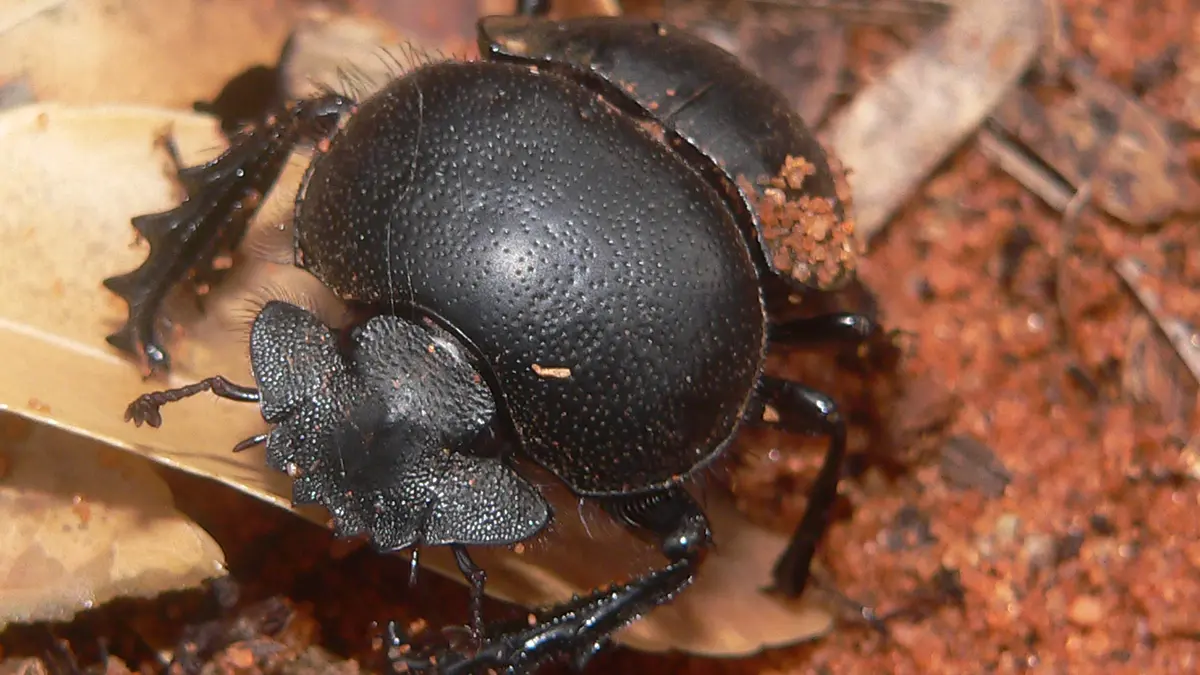
A new study examined how one urban dung beetle responds to dog waste. Adult beetles strongly chose dog dung instead of cow dung. Surviving offspring grew faster and became larger on dog dung. Yet almost sixty per cent of brood balls failed, revealing a serious reproductive cost.
The study and its setting
Researchers from Clark University studied Onthophagus orpheus in Worcester, Massachusetts. Worcester is an urban area in the north-eastern United States. The team combined field surveys with controlled laboratory experiments. It compared dog dung and cow dung as breeding resources.
Adults showed a strong preference for dog dung. Females form brood balls and place one egg in each prepared ball. The larva then develops using that food. The mother’s choice therefore shapes offspring survival and growth.
Offspring raised on dog dung developed faster. They also emerged as larger adults. Those apparent gains might make dog dung seem superior. Mortality produced the opposite conclusion for overall reproductive success.
Nearly sixty per cent of dog-dung brood balls failed. Failure was about 25 per cent with cow dung. The preferred food therefore produced more than twice the mortality. Researchers called this a preference-performance mismatch.
Understanding an ecological trap
Animals use evolved cues to choose food or habitat. Human activity can alter what those cues indicate. An attractive choice may then reduce survival or reproduction. Ecologists often describe that situation as an ecological trap.
Dog waste is common in many urban green spaces. Its smell or composition may strongly attract this beetle. The experiment did not identify one confirmed cause of mortality. Diet, veterinary residues or other dung properties require further study.
The result concerns one beetle species and two dung types. It should not be applied automatically to every city or dung beetle. Different species have different diets and breeding behaviour. Local dog treatment and food can also change waste composition.
What dung beetles are
Dung beetles are not one single taxonomic unit. Many true dung beetles belong to the scarab subfamily Scarabaeinae. Other dung-feeding beetles occur in related groups. Their shared feature is using animal waste for food or reproduction.
Tunnelers bury dung near its original site. Rollers move prepared balls before burial. Dwellers develop within the dung itself. These different behaviours move organic material across and below the soil surface.
Onthophagus orpheus is a tunnelling species. A female prepares brood balls in underground chambers. Each ball supports one developing larva. Reproductive success therefore depends on both dung quality and brood-ball conditions.
Why dung beetles matter
Dung removal returns nutrients to soil and speeds decomposition. Tunnelling can improve aeration and water movement. Burial may also move seeds contained within animal waste. These effects differ across species and environments.
Rapid removal can reduce places where nuisance flies breed. It may also interrupt some parasite life cycles. Farms can gain from cleaner pastures and recycled nutrients. Forests benefit through links among mammals, beetles, soil and plants.
Urban dung beetles receive less public attention. They still process animal waste in parks and other green areas. Reduced breeding could weaken that ecological service. Accumulated dog waste can also create health and sanitation problems.
Responsible interpretation and action
The study does not recommend leaving dog waste for beetles. Owners should collect it under local sanitation rules. Removal limits pollution, conflict and possible disease exposure. It may also reduce access to a risky breeding resource.
Waste should enter approved collection or disposal systems. Plastic bags must not be abandoned in parks. Composting requires suitable facilities and health controls. Household methods may not safely destroy pathogens.
Researchers should test why brood balls fail. Chemical analysis could examine medicines, diet and moisture. Wider surveys can compare cities, seasons and beetle species. Such work would show whether the pattern is broad or local.
Urban ecology often contains hidden links between pets and wildlife. A routine human choice can change insect reproduction. Planning for biodiversity should therefore include ordinary waste streams. Green spaces are ecosystems, not empty recreational surfaces.
A limited but important result
The experiment covered one American species. It identifies a plausible urban risk, but it does not prove the same outcome for all dung beetles.
Conclusion
The Worcester study reveals a hidden cost within an apparently attractive resource. Dog dung helped surviving beetles grow, but many brood balls failed. The contradiction is important for understanding urban ecological traps. Responsible waste collection remains the safest public response. Further experiments must identify the cause and test whether other species share the risk.