

Why in news?
Scientists studied unusually strong X-ray polarisation from magnetar 1E 1547.0−5408. Coordinated space and radio observations tracked the signal across its rotation. Standard surface-emission models could not easily reproduce the pattern. The team says vacuum birefringence provides the most natural explanation so far.
What is a magnetar?
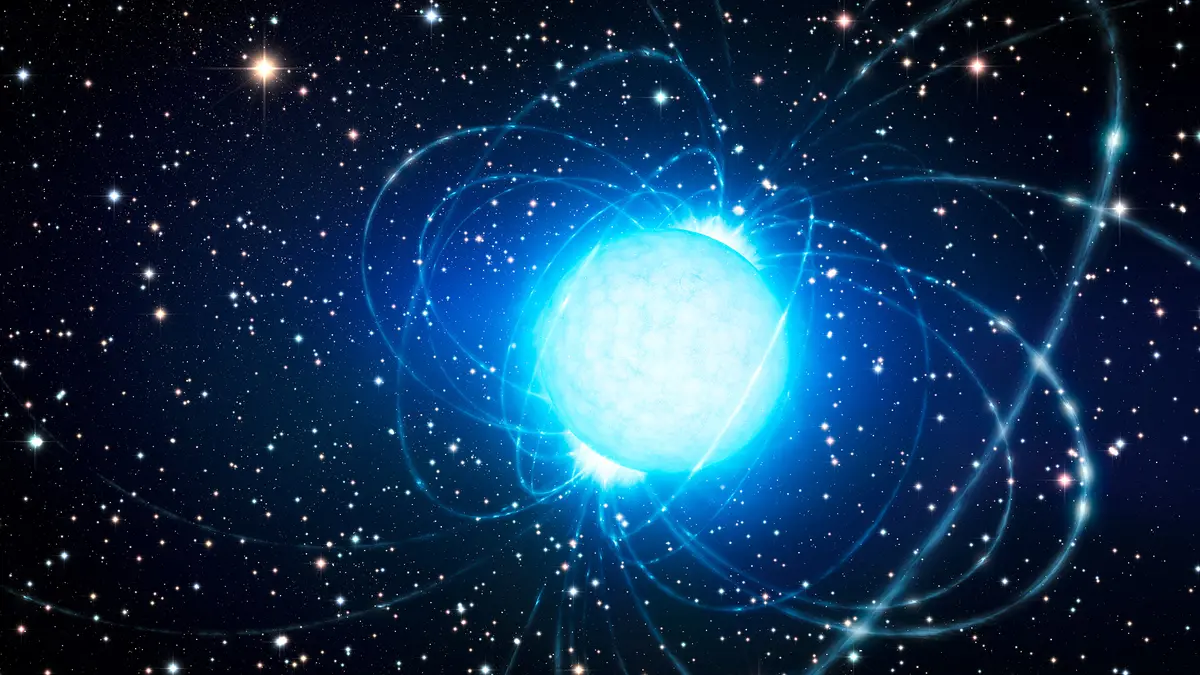
A magnetar is a neutron star with an exceptionally strong magnetic field. A neutron star is the collapsed core of a massive dead star. It packs more than a Sun’s mass into a city-sized body. Gravity and density become extreme.
Magnetar surface fields commonly exceed 100 trillion gauss. Earth’s surface field is less than one gauss. Magnetic-field decay powers much of a magnetar’s high-energy radiation. It can produce short bursts and longer outbursts.
Most magnetars rotate more slowly than ordinary young pulsars. Their strong fields remove rotational energy quickly. Some also emit radio pulses. 1E 1547.0−5408 is valuable because it is bright in radio and X-rays.
The coordinated observations
The Imaging X-ray Polarimetry Explorer is shortened to IXPE. It is a mission of the National Aeronautics and Space Administration and the Italian Space Agency. The team observed the magnetar for more than 140 hours. Measurements occurred during March and April 2025.
The Neutron Star Interior Composition Explorer supplied additional X-ray timing data. Australia’s Murriyang radio telescope observed the radio beam. Coordinating these instruments constrained the star’s magnetic geometry. The magnetar completes one rotation in about 2.1 seconds.
Polarisation describes the preferred orientation of light’s electric field. IXPE measured how X-ray polarisation changed with energy and rotational phase. The phase-averaged degree reached 65 per cent near two kiloelectronvolts. Some phases approached eighty per cent.
What vacuum birefringence means
Quantum electrodynamics is the theory of light interacting with charged particles. It is commonly shortened to QED. The theory treats empty space as a quantum vacuum. Temporary particle effects can influence how light propagates.
An extremely strong magnetic field may make the vacuum optically directional. Different polarisation modes then travel with slightly different refractive behaviour. This effect is called vacuum birefringence. Laboratory fields cannot yet reproduce a magnetar’s conditions.
The idea was developed in the 1930s. Astrophysicists have searched for clear evidence around neutron stars. Birefringence can preserve and strengthen a coherent polarisation pattern. A magnetar therefore becomes a natural quantum laboratory.
Why this case is stronger
The X-ray polarisation was nearly three times stronger than similar measurements. It stayed high where the expected geometry suggested a weaker signal. Its angle changed smoothly with rotation. Radio polarisation followed the same large-scale magnetic structure.
The team tested emission and propagation models against both datasets. Models without refractive vacuum effects struggled to match all constraints. Models including vacuum birefringence reproduced the main features more naturally. This is strong evidence, not a direct laboratory measurement.
The Nature paper calls the result a marked advance. NASA says it may be the first direct observation. Both descriptions retain scientific caution. Further observations must test whether the explanation works across other sources.
Why interpretation remains careful
Polarisation depends on surface emission, atmosphere and magnetic geometry. A complex hot spot can change the observed signal. Magnetospheric particles may also affect X-rays. Model assumptions therefore matter.
Earlier magnetar studies produced suggestive but less decisive evidence. Some geometries can hide or imitate expected signatures. The new radio constraints reduce that freedom. They do not eliminate every alternative.
Repeated IXPE observations can test stability over time. Other radio magnetars can provide independent examples. Better atmosphere and magnetosphere models will refine predictions. Agreement across sources would make the QED interpretation stronger.
Wider scientific value
Magnetars connect stellar evolution with fundamental physics. Their bursts also help scientists study magnetic reconnection. Timing reveals dense matter and rotational change. Polarimetry adds a new dimension beyond brightness and spectrum.
Understanding extreme magnetic fields can improve neutron-star models. Those models support work on gravitational waves and compact-object mergers. The result also shows why coordinated observatories matter. One instrument alone could not constrain the geometry as closely.
Strong evidence is not final proof
The observed pattern strongly supports vacuum birefringence. Confirmation needs more sources, repeated measurements and continued testing of competing models.
Conclusion
The magnetar has provided an unusually clean test of extreme-field physics. Coordinated radio and X-ray data made the case much stronger. Vacuum birefringence explains the high polarisation better than standard models. The interpretation still depends on physical modelling and future observations. Its importance lies in turning a remote star into a quantum experiment.