

Why in news?
Ganesh idols found near the Vasai Fort jetty have raised questions about immersion arrangements and the treatment of a historic waterfront. The Times of India reported the discovery on 17 September, following objections raised the previous night. Residents alleged that idols from artificial immersion ponds had been dumped there. Municipal officials were investigating, while police said the idols had washed ashore. How they reached the site remained disputed. Vasai Fort is a former Portuguese administrative and naval centre on Maharashtra’s coast. The controversy therefore concerns both responsible festival-waste management and care for a heritage landscape, not simply the removal of visible debris.
A coastal stronghold, not an isolated monument
Vasai, historically called Bassein, lies in present-day Palghar district, north of Mumbai. Its fort stands in a coastal setting connected to the Arabian Sea. Water formed a major part of its defensive design, alongside walls and a landward moat. This position made the settlement useful for maritime movement, shipbuilding and the administration of surrounding territory.
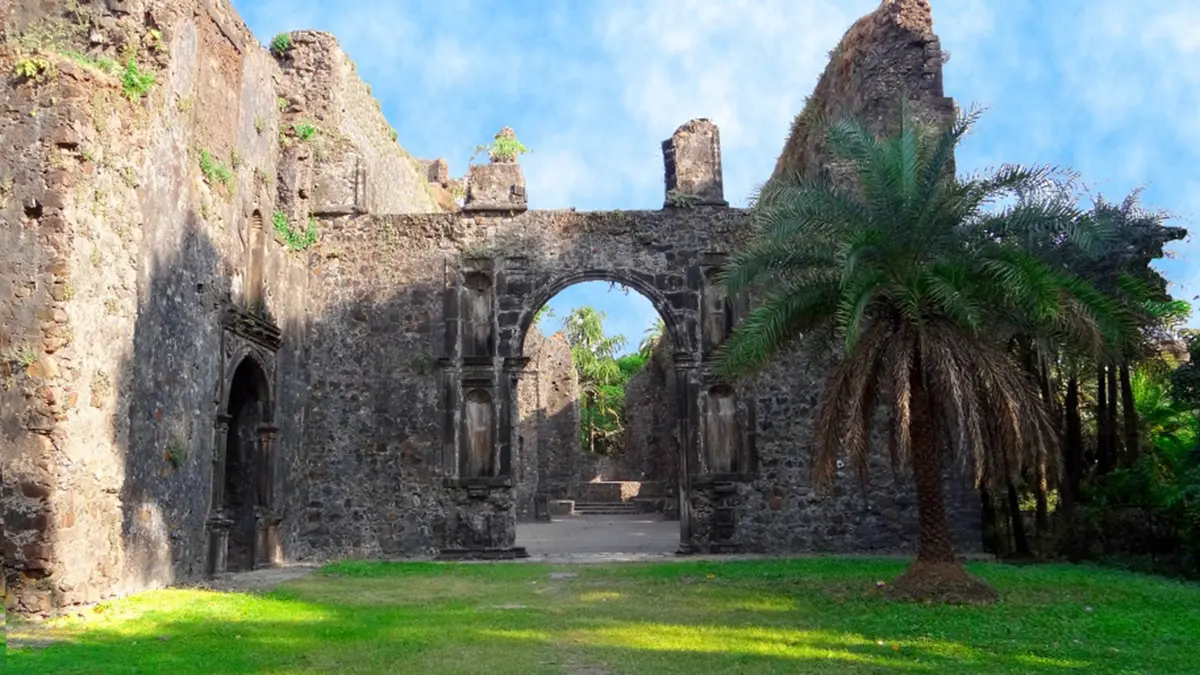
The surviving complex needs to be understood as a fortified town rather than a single palace. The district administration describes bastions, a citadel, storage buildings, water tanks and an armoury within its defences. Churches and other ruined buildings also survive. Their arrangement shows how military protection, religious institutions and everyday administration occupied the same enclosed space.
How Vasai became a centre of power
Historical research places the transfer of Bassein from the Gujarat Sultanate to the Portuguese in 1534. The Portuguese called it Baçaim and made it a centre of their northern possessions. Historian André Teixeira explains its importance through the territory around it, not merely its harbour. Unlike a small coastal outpost, Bassein offered an extensive agricultural and revenue-producing hinterland.
A hinterland is the inland area connected economically to a town or port. Farms, settlements and trading routes supported Bassein’s political importance. Its harbour linked those resources to maritime commerce, while the fortified town housed the institutions controlling them. The connection helps explain why possession of a coastal fort could matter far beyond the walls visible today.
Maratha forces led by Chimaji Appa captured Vasai in 1739, ending Portuguese control there. Another event associated with Bassein belongs to a different political setting: the 1802 treaty between Peshwa Baji Rao II and the British. These dates mark separate episodes. The Portuguese acquisition, Maratha conquest and later British alliance should not be compressed into one transfer of power.
Why artificial immersion ponds require follow-through
Artificial ponds can separate idol immersion from direct disposal into rivers, lakes or the sea. However, creating a pond does not complete the process. Flowers, decorations, frames and other remains still require collection and appropriate handling afterwards. Otherwise, material contained at one stage may simply be moved into another public space or waterbody.
The Central Pollution Control Board’s revised 2020 guidelines address this wider chain. They call for separating offerings and decorative material, providing suitable immersion arrangements, and promptly collecting the remaining waste. Different materials require different treatment; reusable components and biodegradable offerings cannot all be handled as an undifferentiated pile. Local arrangements must therefore cover collection, transport and the final destination.
These responsibilities explain why the Vasai allegation matters without establishing that it is true. An investigation would need to connect the material at the jetty to a particular origin and movement. Statements from residents, municipal records and evidence of handling would need to be assessed together. The police account of material washing ashore represents a different explanation that cannot simply be omitted.
Looking after the setting as well as the stonework
A heritage site’s surroundings shape how people encounter and understand it. At a coastal fort, the waterfront also helps explain the original location and function. Keeping that setting usable requires coordination between conservation, sanitation and local administration. Cleaning the visible remains is necessary, but it does not answer whether the arrangements that produced the problem are adequate.
The practical question is therefore broader than assigning blame immediately. Did collection responsibilities extend beyond the immersion ceremony? Was the final handling location clear? Could officials account for the movement of collected material? These are useful questions for an inquiry, not findings against any person or contractor. They also connect respectful religious observance with environmental and heritage responsibilities.
Conclusion
The Vasai episode calls for an evidence-based explanation of what happened at the jetty and a complete waste-handling process. Its historical setting adds another responsibility: the waterfront is part of the fort’s story, not leftover space outside it. Protecting the monument and managing present-day public use must work together, while the disputed cause of this incident is established.